




- Report Index
- Give Retail Investors Opportunities to Invest in Corporate Restructuring
- Research Report
-
2026.10
Give Retail Investors Opportunities to Invest in Corporate Restructuring
— Responding to the Rise in Management Buyouts —
Masaaki Shigehara
- Summary
-
- To examine the impact of management buyouts (MBOs) on the equity market, this report analyzes and categorizes, based on publicly disclosed information, 30 companies that were delisted from the Tokyo Stock Exchange (TSE) through MBOs or similar transactions (broader MBOs).
- Companies undertaking broader MBOs can roughly be divided into two groups: those whose primary objectives seem to be business restructuring, and those whose primary objectives seem to be exiting the public equity market. Among the former, many seek to bring in external management resources, including through the involvement of private equity funds or other outside investors in management. The latter group can largely be divided into companies that do not meet the TSE's continued listing criteria and companies that see limited benefits from remaining publicly listed and seek to return to family or owner management.
- The delisting of companies undertaking broader MBOs, particularly those that do not meet continued listing criteria, can be viewed as broadly consistent with the objectives of the TSE's market reforms. At the same time, the fact that some companies that want to undertake business restructuring need to leave the public market, at least temporarily, raises concerns both from the standpoint of corporate financing and from that of investors seeking access to a diverse range of investment opportunities. Concerns have also been raised regarding transparency, including potential conflicts of interest.
- To address these issues, this report proposes the creation of a public market designed to provide capital for corporate restructuring and other initiatives that require investors to take a long-term perspective on corporate performance. Bringing restructuring finance into a more transparent public-market framework could give retail investors an opportunity to share in the benefits generated by successful restructuring, while also contributing to the development of deeper and more diverse capital markets in Japan.
- Some companies have also cited the alignment of ownership and management as a reason for undertaking an MBO. This may reflect an attempt to move away from what the Ito Review describes as "double-standard" management and toward a management approach focused on enhancing corporate value over the medium to long term. The recent increase in MBOs may therefore suggest a need to reconsider how corporate management should balance the pursuit of short-term financial performance with the enhancement of long-term corporate value.
We welcome press inquiries. Please contact us at sihgehara@dlri.co.jp.
1. Introduction
The number of management buyouts (MBOs) of companies listed on the Tokyo Stock Exchange (TSE) is increasing. Some of the companies involved are well-known names.
This report examines the broader implications of the increase in MBOs from the perspective of the development of Japan's capital markets as a whole. It first analyzes companies' own disclosures to identify the reasons they give for undertaking MBOs and categorizes the companies accordingly. It then considers how the increase in MBOs is affecting the market and, finally, proposes measures to address the identified issues.
Under the TSE's definition, an MBO involves a tender offer (TOB) (Tokyo Stock Exchange, 2025). For the purposes of this report, however, the analysis also includes three companies that were delisted after management acquired the outstanding shares solely through procedures to squeeze out minority shareholders, such as share consolidations, without conducting a tender offer. These transactions are treated as being comparable to MBOs. In this report, MBOs and such comparable transactions are collectively referred to as "broader MBOs." A total of 30 companies were delisted in 2025 (January through December) from the TSE's three market segments—the Prime, Standard, and Growth Markets—as a result of broader MBOs.
2. Classification of Broader MBOs by Their Inferred Objectives
This report examines the 30 companies (stocks) delisted from the Tokyo Stock Exchange (TSE) in 2025 as a result of broader MBOs. Based on disclosures by each company, including announcements concerning the implementation of an MBO and recommendations that shareholders tender their shares, the report infers the primary objective of each transaction and classifies the companies accordingly.
The primary objectives can broadly be divided into two categories: "Business Transformation-oriented", where the main objective is to transform the company's business, and "Exit-oriented", where the principal objective appears to be delisting and taking the company private.
The Business Transformation-oriented category consists mainly of two subcategories. The first is the "External Resources-oriented" type, in which a company seeks to draw on management expertise, human resources, networks, and other resources provided by external funds or other investors taking an equity stake in the company. The second is the "Restructuring-oriented" type, in which a company undertakes an MBO or similar transaction to restructure its business without bringing in external resources, despite not having originally been an owner-managed company.
The Exit-oriented category also consists mainly of two subcategories. The first is the "Failure to Meet Continued Listing Criteria" type, comprising companies that do not meet the TSE’s continued listing criteria. The second is the "Return to Owner Management" type, comprising companies in which management already holds at least one-third of the shares (*1) and that undertake an MBO to reinforce their character as owner-managed businesses. There are also a small number of companies classified as the "Delisting-oriented" type, where management already owns 50% of the shares and therefore exercises strong control over the company but nevertheless undertakes an MBO. For the "Takeover Avoidance" and "Listing Burden Avoidance" types, see Notes 2 and 3 below.
The number of companies in each category is shown in Figure 1. By market segment, Business Transformation-oriented companies slightly outnumber Exit-oriented companies in the Prime and Growth Markets. By contrast, in the Standard Market, the great majority fall into the Exit-oriented category. This suggests that the TSE's market reforms, including the tightening of continued listing criteria (*4), are having a particularly significant impact on companies that were unable to satisfy the requirements of the Prime Market and remained listed on the Standard Market.
Figure 1: Classification of Companies Delisted through Broader MBOs by Inferred Primary Objective
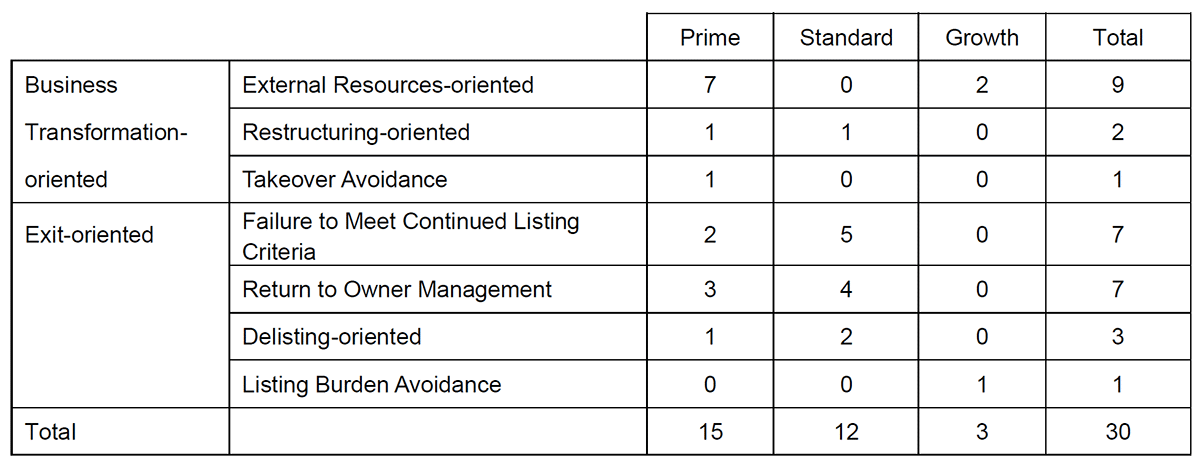
Source: Prepared by DLRI based on companies’ disclosure materials
3. Broader MBOs and TSE Market Reforms
Based on the preceding chapter's examination of the reasons for broader MBOs and the circumstances surrounding them, this chapter considers the relationship between the growing number of such transactions and the Tokyo Stock Exchange's market reforms.
The TSE has been pursuing a series of market reforms. These include the restructuring of its market segments and the tightening of continued listing criteria in April 2022, as well as its request to listed companies, issued on March 31, 2023, entitled "Action to Implement Management that is Conscious of Cost of Capital and Stock Price". The TSE has stated that the objective of these reforms is to encourage listed companies to enhance their corporate value over the medium to long term, and that promoting management that is conscious of the cost of capital and stock price is a means of achieving this objective (*5).
The TSE reforms are generally considered to have been influenced by the Ito Review (Ito, 2014). The Ito Review uses the term "investment chain" to describe the capital flowing from its providers down to where companies deploy it towards business activities, together with the linkages among the various functions involved along the way. One of its key messages is the need for investment-chain reform aimed at optimizing the chain as a whole.
Viewed from this perspective, exits of companies that are unable to improve their capital efficiency from the public equity market through MBOs would appear to be consistent with the direction advocated by the Ito Review. Even if such exits were not an explicit objective of the TSE reforms, they can therefore be regarded as broadly consistent with the reforms' underlying aims.
At a time when the traditional perception of being a listed company as a form of corporate status appears to be gradually fading, it is also reasonable, in terms of the fundamental functions of capital markets, for companies that do not need to raise capital through share issuance or other forms of equity financing to leave the public market.
From the perspective of enhancing corporate value over the medium to long term, however, the increase in MBOs and similar transactions also raises questions about the effectiveness of the TSE reforms.
Disclosures by companies undertaking MBOs and similar transactions—including announcements concerning the implementation of an MBO and recommendations that shareholders tender their shares— frequently contain statements by management or the acquiring party along the following lines:
"Transforming the business structure with the aim of enhancing corporate value over the medium to long term may entail the risk of temporarily worsening the Group's financial condition and business performance, including lower earnings and deterioration in cash flow, and may temporarily make it difficult for the Group to generate the level of earnings expected of it."
Another frequently expressed concern can be summarized as follows:
"If decisions are made that prioritize medium- to long-term growth, the capital markets may not adequately recognize their value. This could result in a decline in the Company's share price and adversely affect the interests of existing shareholders, making it difficult to implement these measures while maintaining the Company's public listing."
Put simply, the argument is this: measures intended to enhance corporate value over the long term may temporarily worsen a company's financial performance. If the capital markets fail to recognize the value of those measures, the company's share price may decline. The company therefore chooses to delist through an MBO before undertaking the necessary transformation.
Given the current market environment, in which monetary returns to shareholders in the form of dividends and share buybacks tend to attract considerable attention, this argument has a certain degree of plausibility. Yet this situation also appears to run counter to the original objective of the TSE reforms—namely, to encourage the enhancement of corporate value over the medium to long term (*6).
There are, of course, companies that temporarily leave the public market through an MBO or similar transaction, undertake restructuring, and subsequently relist. In such cases, the process as a whole results in the enhancement of corporate value over the medium to long term. It is also necessary to consider whether the restructuring plans proposed by management are likely to succeed and, more fundamentally, whether those plans are realistic in the first place.
Even after taking these considerations into account, however, important issues remain from the perspectives of retail investors' access to investment opportunities and the distribution of the gains created through corporate restructuring.
These issues are examined in the next chapter.
4. Allocation of Corporate Value Created through Broader MBOs and Corporate Restructuring
In broader MBOs undertaken for the purpose of corporate restructuring, an increase in corporate value is expected after the restructuring. The increase in value is ultimately shared between the following two groups:
a. Minority shareholders, who receive a premium when their shares are sold; and
b. Post-MBO shareholders, consisting of management and the funds participating in the broader MBO.
The consideration paid to minority shareholders for their shares is calculated using a share price above the prevailing market price, taking into account factors such as expected future improvements in business performance. The portion above the market price—the premium—can, in a sense, be viewed as an upfront share of the anticipated gains from improved performance.
At the same time, however, the increase in corporate value resulting from improved performance is uncertain, and even when restructuring succeeds, it is difficult to estimate its effects accurately in advance. Moreover, it is the post-MBO shareholders—management and outside funds—that undertake the restructuring needed to improve the company's performance. It would therefore seem reasonable for them to receive at least part of the value created as a result of their efforts.
There has been considerable debate over how the gains from increased corporate value should be allocated between groups (a) and (b). In the past, some argued that all such gains should accrue to the post-MBO shareholders. More recently, however, the prevailing view appears to be that the gains should be shared between the two groups. This seems reasonable given that existing shareholders have also contributed to the development of the intangible assets, including employees and intellectual property, that provide the foundation for subsequent restructuring. There is also the practical consideration that, where a tender offer is used, the offer must attract sufficient shareholder participation for the MBO to succeed.
It is difficult, however, to establish an objective standard for determining how these gains should be allocated. In practice, a purchase price that reflects market expectations regarding the restructuring and is sufficiently attractive to enable the tender offer to succeed will presumably serve as a benchmark. Yet there is considerable latitude in valuation methodologies. In actual MBO processes, it is therefore common for the management or acquiring party and the target company, acting through its special committee, to engage in multiple rounds of negotiations over the purchase price.
Another issue that warrants attention in determining the price is the potential for conflicts of interest. The Ministry of Economy, Trade and Industry's Fair Acquisition Study Group has compiled a list of issues raised during its discussions (Fair Acquisition Study Group, 2026). Among them are the following two issues. It should be noted that these materials were prepared while the Study Group's deliberations were still ongoing.
5. There are concerns that, in cases where an activist investor proposes that a company go private or undertake a management buyout (MBO), which ultimately results in an MBO led by a private equity (PE) fund or other investor, the activist may reinvest in the acquisition vehicle used for the MBO or make an LP investment in the PE fund that is itself an investor in the acquisition vehicle.
Such arrangements could enable the activist that proposed the going-private transaction or MBO to secure benefits on terms favorable to itself that are not shared by other shareholders, potentially resulting in a divergence between the activist’s interests and those of ordinary shareholders. This raises concerns from the perspective of transaction transparency and equal treatment of shareholders.
8. There have also been cases raising concerns that, after accumulating a substantial stake in a company, an activist investor may call for the company to go private and offer to introduce a PE fund as a potential buyer. Other cases have raised questions as to whether certain PE funds may be coordinating with activist investors. If activists and PE funds are in fact coordinating behind the scenes, such arrangements could raise questions regarding the transparency of the acquisition process.
Here, an activist investor, sometimes referred to as an activist shareholder, is an investor that seeks to influence a company through the active exercise of shareholder rights. A private equity (PE) fund is a fund that invests in unlisted companies or in companies that are being taken private. An LP (limited partner) investment refers to an investment made on a limited-liability basis through a venture capital fund or similar vehicle.
Broadly speaking, both cases raise concerns, from the standpoint of transparency and related considerations, about the possibility that an activist investor that has accumulated shares in a company could work together with a fund to structure a going-private transaction—including a broader MBO—in a manner favorable to itself.
Broader MBOs that are ultimately completed generally involve efforts to ensure the fairness and transparency of the acquisition price, including negotiations between the management or acquiring party and the target company. The risk that minority shareholders will receive less than the fair value of their shares can therefore be considered relatively limited. Nevertheless, questions remain when the issue is viewed in terms of how the incremental corporate value generated by post-MBO restructuring should be allocated.
There is also a more fundamental issue: retail investors have limited opportunities to participate in corporate restructuring itself.
Companies undertaking restructuring may, of course, raise funds through bonds, private equity, or, depending on the size of the financing, crowdfunding (*7). Once a company has been taken private, however, it loses the scrutiny provided by the public market, and its restructuring is carried out among a relatively limited group of stakeholders. Retail investors consequently have only limited opportunities to provide capital, as market participants, to privately held companies seeking to enhance their corporate value from a long-term perspective.
Even if retail investors wish to invest with a long-term perspective and earn returns commensurate with doing so, there are relatively few means available to them. Apart from owner-managers, the resulting gains are therefore largely captured by a limited group of investors, such as private equity funds.
Companies undertaking MBOs and similar transactions often explain their decisions by stating that "decisions that prioritize medium- to long-term growth may fail to receive sufficient recognition from the capital markets." Various factors may have contributed to this feature of today's market, including the strong impact of the Ito Review's reference to "ROE exceeding 8%" (*8) and the influence of annual accounting and reporting practices. Another contributing factor, however, may be the limited availability in the public market of investment assets that enable investors to pursue returns from a genuinely long-term perspective.
Moreover, rather than removing companies undergoing restructuring from the scrutiny of the public market, keeping such companies within the market could also help address conflicts of interest of the kind identified above by the Study Group on Fair M&A Transactions.
From these perspectives, the next chapter proposes a framework that would enable companies undertaking corporate restructuring to remain within the public capital markets.
5. A Capital Market for Companies Undertaking Restructuring
As discussed above, the growing number of broader MBOs could reduce investment opportunities for retail investors and diminish the diversity of the market. One factor behind this is that companies seeking to enhance their corporate value over the long term may find it necessary to leave the public market temporarily in order to pursue the restructuring they need.
To address this problem, this report proposes the creation of a dedicated public market for companies undergoing restructuring. Such a market would be designed not to focus on short-term earnings. As a condition of listing, companies would be required, in addition to annual reporting, to formulate a medium-term business improvement plan and undergo annual monitoring of progress against that plan. A company that falls substantially short of its business improvement plan would be delisted at that point.
Because business improvement plans would necessarily be highly company-specific, no market index should be calculated for this market. Monetary distributions to shareholders, such as dividends and share buybacks, would also be restricted according to each company's financial condition to prevent an erosion of capital—or, alternatively, such distributions could in principle be prohibited.
The principal investors in this market would be institutional investors, such as pension funds, whose long-term liabilities make long-term investment appropriate. However, subject to appropriate rules governing the sale of such investments, participation would also be open to retail investors who have the willingness, knowledge, and financial capacity to invest in this type of market (*9). Trading would not be designed for high-frequency trading (HFT); transactions might instead be executed, for example, once an hour or twice a day (*10). Provided that companies make robust disclosures and provide adequate explanations regarding progress on their business improvement plans, requirements such as earnings forecasts and quarterly disclosures might also be simplified or waived.
If such a market existed, companies in the various Business Transformation-oriented categories and the Return to Owner Management category—which together accounted for approximately two-thirds of the companies delisted from the TSE through MBOs and similar transactions in 2025—might choose to remain publicly listed on this market rather than undertake an MBO (*11).
Minority shareholders in companies choosing the new market instead of an MBO would not lose their investment opportunity. They would be able to monitor the progress of corporate restructuring through dialogue at general meetings of shareholders and other channels, while sharing in the resulting gains through dividends and other shareholder distributions. Companies, for their part, would remain subject to public scrutiny, helping them avoid conflicts of interest and other problems that can arise when management takes place behind closed doors.
A shift toward disclosure centered on business improvement plans could also help curb investment decisions based excessively on short-term performance indicators such as return on equity (ROE).
There are already examples of stock markets overseas that incorporate some of these characteristics. The example that appears closest to the proposal in this report in terms of its emphasis on long-term returns is the Long-Term Stock Exchange (LTSE) in the United States. The LTSE received approval from the U.S. Securities and Exchange Commission (SEC) in May 2019 and began trading in September 2020. Its listing standards require companies to adopt a long-term perspective in five areas: stakeholders, strategy, compensation, governance, and investors (*12).
Many overseas markets emphasizing long-term perspectives, including the LTSE, appear to focus on young startup companies, or at least have attracted startups as listed companies. Nevertheless, the underlying framework could also be used by established companies undergoing restructuring (*13).
The TSE's market reforms appear to be succeeding in raising the quality of listed companies, particularly those on the Prime Market. Yet high-quality companies are not the only companies that need equity financing. Equity financing can also play an important role for companies that face problems and need to undertake restructuring.
Providing a public-market venue for such equity financing would, in my view, make Japan's equity market deeper, more diverse, and ultimately richer.
6. The Ito Review's Concept of "Double-Standard" Management and the Alignment of Ownership and Management
The Ito Review contains the following discussion (*14).
There is a view that until the 1980’s, during which Japanese companies were performing well, a “double standard” management style was practiced in which many management teams would manage the company under a long-term perspective, while on the other hand making profitability commitments to short-term oriented capital markets. This management style is believed to have made long-term investments towards innovation possible.
The Ito Review argues that, as the profitability of Japanese companies declined sharply from the 1990s onward, this "double standard" became increasingly apparent to the capital markets. It also identifies the double standard as one of the factors that led corporate managers to lack—or place less emphasis on—the perspectives of capital efficiency and enhancement of corporate value.
A wide range of reforms have been implemented since the Ito Review was published, and the importance of indicators such as ROE now appears to be widely recognized. Nevertheless, there are signs that the issue of capital markets that can, at times, be overly short-term oriented remains at least partly unresolved. For example, aggregate dividends by listed companies for the fiscal year ended March 2025 were projected to reach a record ¥18 trillion for the fourth consecutive year (Nikkei, 2025). Share buybacks by listed companies reached their highest level in 2024 since comparable data became available in 2004 (Kawase, 2025; *15). In addition, many asset management companies have launched funds that invest in Japanese equities with high dividend payout ratios.
Some companies undertaking MBOs state in their disclosures that one reason for doing so is the need to "align ownership and management." At first glance, this may seem counterintuitive: was not the stock company intended, at least in part, to facilitate the separation of ownership and management? The rationale becomes more understandable, however, if "aligning ownership and management" is interpreted as an attempt to resolve the kind of "double standard" identified in the Ito Review by bringing the two approaches to corporate management into alignment in favor of a longer-term perspective.
What the increase in MBOs suggests, therefore, goes beyond a simple process of corporate renewal or the withdrawal of owner-managed companies from the public market. It may also indicate that, at least in some respects, today's equity market does not function sufficiently well as a source of financing for companies seeking to undertake the restructuring necessary for their future development.
If we are to create a market in which retail investors can also share in the benefits of long-term corporate value creation, all market participants—including retail investors themselves—may need to take a fresh look at how the market can genuinely encourage companies to enhance their corporate value over the long term.
Notes
- A shareholder holding at least one-third of a company's shares can block major changes in the company's business that require a special resolution at a general meeting of shareholders. Such a shareholder can therefore be regarded as having substantial influence over the company's overall strategic direction.
- The company classified under the Takeover Avoidance category is primarily engaged in transportation services using specialized freight containers. After receiving an acquisition proposal from a business partner, the company considered the proposal internally and ultimately decided to undertake an MBO instead. Its announcement concerning the implementation of the MBO and recommendation that shareholders tender their shares provides only a limited explanation, stating essentially that maintaining independent management under the incumbent management team, which was capable of leading the development of new businesses, would be more desirable from the standpoint of protecting shareholder interests. The same document, however, repeatedly refers to the need to secure facilities for the inspection and cleaning of containers and to make investments necessary to obtain relevant certifications. This suggests that management placed considerable importance on maintaining an independent approach to management suited to the distinctive nature of the company's business, which may have contributed to its decision to pursue an MBO rather than accept the proposed acquisition.
- The company classified under the Listing Burden Avoidance category is engaged in architectural and other design services. Like other companies, it cited the possibility of a temporary decline in earnings during the implementation of its future business strategy as a reason for undertaking the MBO. In addition, however, it pointed to the growing burden associated with disclosure requirements, including the preparation of annual securities reports and corporate governance reports. Specifically, the company states management's view that the increasing number of compliance requirements is raising the human and financial costs of maintaining the company's listing and could become a significant burden on the execution of its business strategy, in its announcement concerning the implementation of the MBO and recommendation that shareholders tender their shares. The founder and representative director, who would become the company's owner through the MBO, also appears to serve as one of the company's principal designers—in effect, as a "player-manager." It is therefore possible that the MBO was also intended to reduce the burden on the founder by taking the company private.
- Among the companies examined that implemented MBOs in response to non-compliance with continued listing criteria, all but one failed to meet the requirement for the market capitalization of tradable shares (at least JPY 1.0 billion for companies listed on the Standard Market). The remaining company failed to meet the tradable share ratio requirement; however, as the founder’s family held 72.05% of its shares, the transaction could arguably also be classified as an “MBO aimed at delisting.”
- See Tokyo Stock Exchange (2025a).
- Share buybacks are essentially a “denominator policy,” whereby a company seeks to improve its ROE by reducing equity, the denominator in the ROE calculation. While denominator policies can produce an immediate improvement in ROE, they entail the risk of leading to a contractionary cycle. For sustainable enhancement of corporate value over the longer term, therefore, a “numerator policy” aimed at increasing returns is important. See Shigehara (2025), and Kawase (2025). However, it is questionable that corporate share buybacks are really done under the significant motivations to improve ROE, noting that the scales of such buybacks are generally limited to around 2–4% of shareholders’ equity.
- For crowdfunding, see Shigehara (2022).
- The Ito Review shows that the cost of equity expected by institutional investors for Japanese equities varies considerably among both domestic and overseas investors. It also notes that, because qualitative information about a company can affect its cost of equity, companies should recognize that engaging in dialogue with investors and promoting a better understanding of their businesses can contribute to lowering their cost of equity.
The target of an ROE above 8% was proposed based on the finding that 75% of Japanese investors and 80% of overseas investors expected a cost of equity in the range of 5–8%. On this basis, an ROE exceeding 8% would surpass the cost of equity assumed by approximately 90% of global investors. It should be noted, however, that the survey of institutional investors cited in the Ito Review was conducted in 2012. - Even today, some retail investors invest in products characterized by limited liquidity and a long investment horizon, such as fractional real estate investment products and investment-type crowdfunding. This suggests that there is likely to be a meaningful group of retail investors with the willingness, knowledge, and financial capacity to invest in a market of the kind proposed here.
- One potential concern with infrequent trading is the reliability of transaction prices. This could, for example, be addressed through a framework similar to that used for proprietary trading systems (PTSs) for unlisted shares and other securities, under which PTS operators are required to provide price information such as executed prices and the latest quotations. See Articles 9 and 9-2 of the Japan Securities Dealers Association (2023).
- In companies classified as Return to Owner Management, shareholders other than management still hold more than half of the outstanding shares. If such companies could remain publicly listed without facing excessive pressure to deliver short-term profits, management might have less incentive to undertake an MBO, particularly where doing so would require taking on debt or other financial burdens.
- I hope to discuss the LTSE in greater detail in a future report.
- Japan has also begun to take steps to broaden retail investors' access to investments in unlisted shares. These initiatives, however, have generally been discussed in the context of providing capital to startups. See Nikkei (2026) and Nikkei Money (2025).
- See Ito (2014), p. 1, “The Limits of ‘Double-Standard’ Management and Concerns over ‘Japanese-Style Short-Termism’ in Corporate Management.”
- It should be noted that this amount represents the value of share buybacks conducted by companies themselves and does not include the value of shares acquired in MBOs through acquisition vehicles established for such transactions.
References
(In Japanese unless otherwise noted.)
- Fair Acquisition Study Group (2026), “Issues Raised for Discussion by the Fair Acquisition Study Group (Draft),” Material 6, 11th Meeting of the Fair Acquisition Study Group, June 2, 2026, Ministry of Economy, Trade and Industry (METI) website.
https://www.meti.go.jp/shingikai/economy/kosei_baishu/pdf/011_06_00.pdf - Ito, Kunio (2014), “Final Report of the Project on Competitiveness and Incentives for Sustainable Growth: Building Favorable Relationships between Companies and Investors (Ito Review)”, chaired by Kunio Ito, August 2014. (English) https://www.meti.go.jp/policy/economy/keiei_innovation/kigyoukaikei/ito_review__released_august2014_en.pdf
- Kawase, Hironori (2025), “Changes over Time in Share Buyback Behavior by Japanese Listed Companies: A Univariate Analysis, 2004–2024” Fukuoka University Review of Commercial Sciences, Vol. 70, No. 2, September 2025.
- Shigehara, Masaaki (2025), “Three Ways to Improve Productivity: The Numerator, the Denominator, and One More,” Dai-ichi Life Research Institute Report, June 2025. (English) https://www.dlri.co.jp/english/report_en/202505MS.html
- Shigehara, Masaaki (2022), “Keyword in Focus: Crowdfunding,” Dai-ichi Life Research Institute Report, September 2022. https://www.dlri.co.jp/report/dlri/201074.html
- Tokyo Stock Exchange (2025), “Securities Listing Regulations (Tokyo Stock Exchange)”, Article 441, revised December 8, 2025.
- Tokyo Stock Exchange (2025a), “What Is the TSE Market Restructuring? An Overview of the Reforms,” TSE Money-bu, No. 133, October 7, 2025. https://money-bu-jpx.com/news/article063284/
- Nikkei (2026), “Unlisted Share Trading to Be Opened to Individual Investors: FSA to Ease Eligibility Requirements to Allow Participation by SME Executives and Others,” The Nikkei, morning edition, May 18, 2026, p. 1.
- Nikkei (2025), “Corporate Dividends to Reach Record JPY 18 Trillion This Fiscal Year: Individual Investors Benefit through NISA as Companies Boost Shareholder Returns to Improve Capital Efficiency,” The Nikkei, morning edition, January 30, 2025, p. 1.
- Nikkei Money (2025), “Promising Investment Products That Could Revitalize Japan: (3) Investing in Unlisted Companies — Opening the Door to Individual Investors,” Nikkei Money, February 2025 issue.
- Japan Securities Dealers Association (2023), “Rules Concerning Transactions in Unlisted Securities on Proprietary Trading Systems”, June 30, 2023. https://www.jsda.or.jp/shijyo/seido/jishukisei/web-handbook/106_saiken/files/20241121_ptstorihiki.pdf
- Japan Exchange Group (2026), “List of Delisted Companies,” 2025 and 2026, accessed May 25, 2026. https://www.jpx.co.jp/listing/stocks/delisted/index.html
- Long-Term Stock Exchange website. https://ltse.com/
- Disclosure materials issued by companies delisted from the Tokyo Stock Exchange through MBOs and similar transactions in 2025, including notices concerning the implementation of MBOs and recommendations to tender shares.
Original in Japanese
https://www.dlri.co.jp/report/asset/623377.html
Disclaimer:
This report has been prepared for general information purposes only and is not intended to solicit investment. It is based on information that, at the time of preparation, was deemed credible by Daiichi Life Research Institute, but it accepts no responsibility for its accuracy or completeness.