



- Report Index
- Suicide (Jisatsu/Jishi) Prevention in Japan Part 2: Terminology Choice Between Jisatsu and Jishi
- Illuminating Tomorrow
-
2026.03
Suicide (Jisatsu/Jishi) Prevention in Japan Part 2: Terminology Choice Between Jisatsu and Jishi
—Reshaping Suicide (Jisatsu/Jishi) Prevention with Policy, Science, and Empathy—
Rui Shuhama
- Abstract
-
- This article constitutes Part 2 of a two-part series that examines suicide (jisatsu/jishi) in Japan from the perspectives of policy, scientific evidence, and social implementation. While Part 1 reviewed the structural background of suicide in Japan and the evolution of policy responses, this article focuses on the terminology choice between jisatsu and jishi, examining their historical background, current usage, and implications for future suicide prevention practice.
- In 2025, the provisional number of suicides in Japan fell below 20,000 for the first time since national statistics began in 1978, reaching 19,097. At the same time, the number of suicides among elementary, junior high, and high school students reached a record high (MHLW, 2026), indicating that suicide among younger people remains a major social concern.
- After reviewing the historical background of the two terms, this article examines how they are used across four major domains: official and legal contexts, academic and clinical settings, media and journalism, and bereavement support. It highlights how their roles and nuances of jisatsu and jishi differ depending on context. Rather than framing the two terms as opposing alternatives, the article proposes a way of organizing current terminology practices in Japan that balances institutional precision with consideration for those directly affected. In doing so, it clarifies the central issues in the ongoing debate and outlines key considerations for the use of these terms in research, policy, and support practice.
1. Introduction
In Japan, the terminology used for suicide remains divided by context. In law, official statistics, national government policy, and standard psychiatric usage, the dominant term is still jisatsu (“suicide”), written with two Chinese characters (kanji) meaning “self” and “to kill”. By contrast, in bereavement support, some local governments, the insurance industry, and support practices working more closely with those directly affected, jishi (“suicide”), written with two Chinese characters (kanji) meaning “self” and “to die,” is widely used. According to materials released by the Ministry of Health, Labour and Welfare (MHLW) on January 29, 2026 (Figure 1), the provisional number of suicides in 2025 was 19,097, down 1,223 from 20,320 the previous year. This was the lowest figure recorded since national statistics began in 1978 and the first time the annual total fell below 20,000. However, the number of suicides among elementary, junior high, and high school students reached 532, three more than the confirmed figure of 529 in 2024, marking the highest since comparable statistics began (MHLW, 2026). Seen in this light, the question of whether to use jisatsu or jishi is not simply about preferred wording. It also concerns how society understands this issue, how it communicates about it, and how it offers support with empathy.
Figure 1. Annual trends in the number of suicides in Japan (1978–2025)

Sources: Author’s compilation using data from MHLW, Trends in the Number of Suicides Based on National Police Agency Statistics (2026). 2025 values are provisional.
The position taken in this article is straightforward. First, neither jisatsu nor jishi should be treated as the one uniquely correct term. Second, terminology choice should be considered from both conceptual precision and consideration for those directly affected. Third, because the role of each term differs across fields, the central question is not which word is “more correct,” but rather in which context a given term is used, and what effects and limitations accompany that choice (National Support Center for Suicide Bereavement, 2013; JSCP, 2024).
2. Historical Background of Jisatsu and Jishi
From the standpoint of public institutions, the standard term historically used in Japan has been jisatsu. The current law, enacted in 2006, is titled the Basic Act on Suicide Countermeasures, and its stated objective is to realize “a society in which no one is driven to suicide.” In addition, the General Principles of Suicide Countermeasures Policy, first approved by Cabinet decision in 2007, reframed suicide from something often treated as an individual matter into a social issue, describing many suicides as “deaths at the end of being cornered.” In other words, while the state has retained jisatsu as its institutional term, it has also redefined the meaning of suicide in a direction that distances it from simple narratives of individual responsibility (Basic Act on Suicide Countermeasures, 2006/current version; MHLW, 2022).
By contrast, the spread of jishi in contemporary Japan is closely connected to the sharp surge in suicides after 1998 (Figure 1) and to the increasing visibility of bereaved families and children. According to the historical record published by the National Support Center for Suicide Bereavement, annual suicides exceeded 30,000 in 1998. In 2000, a booklet written by bereaved children was published under the title Jisatsu tte Ienai (“I Can’t Say ‘Suicide’”), and in 2001, people bereaved by suicide appealed directly to the Prime Minister about the need for suicide countermeasures. These developments helped make visible the pain and stigma experienced by the bereaved and encouraged the spread of terms such as “children bereaved by jishi” (National Support Center for Suicide Bereavement, n.d.; MHLW, 2023).
In 2013, the National Support Center for Suicide Bereavement published guidelines that explicitly called not for a simple “replacement” of terms, but for “careful differentiation in use.” The document argued that the word jisatsu—and especially the character satsu (“to kill”)—can evoke associations with crime and can reinforce prejudice and discrimination toward the deceased and their families. At the same time, it also stressed that jisatsu remains necessary as a term for describing the act itself. The important point here is that jishi was not introduced as a word intended to replace jisatsu across the board. Rather, it spread as a term shaped by bereavement support and by efforts to respond to social stigma (National Support Center for Suicide Bereavement, 2013).
3. Nuances and Usage Across Fields
The distinction between jisatsu and jishi is not determined in a single social arena. It operates differently across administration, academia and medicine, media, and bereavement support, each with its own context and function. The following sections outline how the two terms are used in these major fields.
(1) Official and Legal Usage
In official and legal usage, jisatsu is the institutional standard. Law titles, government policy documents, white papers, police statistics, and major administrative indicators all use jisatsu. This is not simply a matter of convention. It also serves the functions of legal stability, continuity in statistics, and comparability across time and across countries.
At the local-government level, however, some variation appears. Shimane Prefecture, for example, states that, except for legal titles and statistical terminology, it will in principle use jishi out of consideration for the feelings of bereaved people and others (Shimane Prefecture, 2008). Yao City in Osaka Prefecture, similarly, notes that opinions on terminology vary and therefore uses jishi in the field of bereavement support (Yao City, 2024). It is therefore difficult to describe the whole public sector as following a single terminology practice. In broad terms, the reality is closer to this: at the national level, jisatsu remains standard, while in local administrative practice terminology is often adjusted to context.
(2) Academic and Clinical Usage
In academic and clinical fields as well, jisatsu remains the dominant basic term. Guidance published by the Japanese Society of Psychiatry and Neurology uses terms such as “suicidal ideation” and “suicide attempt,” and psychiatric practice continues to rely on a terminology system centered on jisatsu for risk assessment and intervention (Japanese Society of Psychiatry and Neurology, 2013).
In Japan, the Suicide Prevention Research Group, founded in 1970 by psychiatrists and psychologists with the aim of preventing suicide, changed its name to the Japanese Association for Suicide Prevention in 1981. In 2017 it was incorporated and has continued its activities as a general incorporated association (JASP, n.d.). In September 2025, the 49th Annual Meeting of the Japanese Association for Suicide Prevention was held in Izumo, Shimane Prefecture, under the presidency of Professor Masatoshi Inagaki of the Department of Psychiatry, Faculty of Medicine, Shimane University, who also supervises this article series (JASP, 2025). The author also attended the meeting as a member of the association (Figure 2). The theme of the 49th meeting was “Facing Widening Difficulties in Living: Toward Effective Approaches in Suicide Prevention.” Dai-ichi Life Holdings, Inc., which since 2023 has been sponsoring research at the Dai-ichi Life Mental Healthcare Collaboration Research Course at Shimane University Faculty of Medicine, became the first life insurance company to sponsor this academic meeting (Dai-ichi Life Group, 2023). This illustrated that suicide prevention requires not only policy, academic, and medical engagement, but also broader societal understanding and collaboration.
Figure 2. The 49th Annual Meeting of the Japanese Association for Suicide Prevention (JASP)
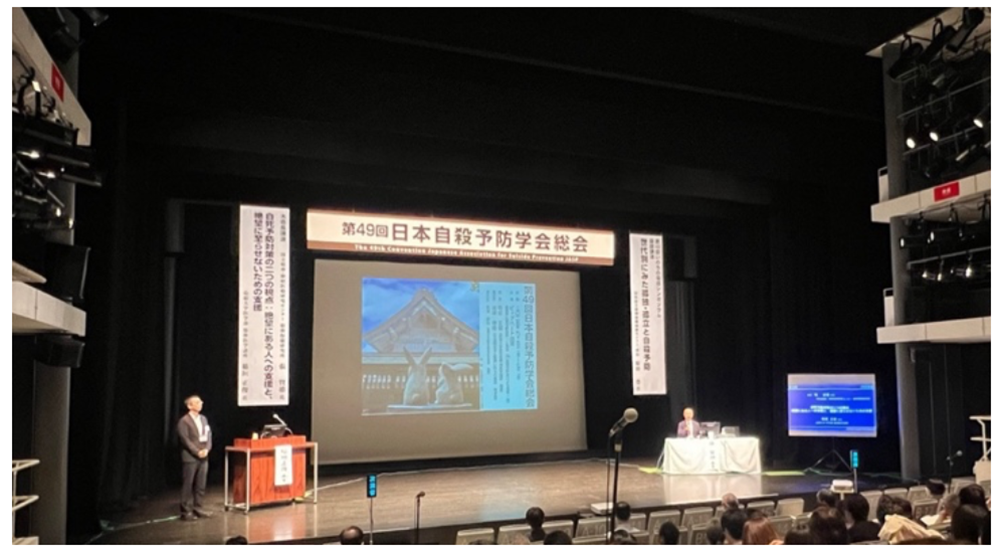
Source: R.SHUHAMA, Izumo, Shimane Prefecture, 2025
In contrast, jishi is widely used in bereavement support, mental health welfare, and nursing. Kusumoto et al. (2023), for example, reported on support practice under the title “Support for People Bereaved by Jishi in Mie Prefecture.” Kurihara’s literature review states explicitly that, while jisatsu is retained in literature searches and citations, the body of the paper uses jishi out of consideration for bereaved families (Kurihara, 2025). The academic reality, then, is not one of full migration to either term. Rather, the two are used side by side, depending on the object of discussion and the level of analysis.
(3) Media and Journalism
In the field of reporting, the first point to emphasize is that major guidelines focus less on uniform terminology than on the quality of reporting itself. The World Health Organization’s 2023 guidelines for media reporting on suicide, first issued in 2000, emphasize the following points (WHO, 2023):
What not to do
- Do not report specific methods or means of suicide in detail.
- Do not describe in detail the place or circumstances of the death.
- Do not romanticize suicide or report it in a dramatic or sensational manner.
- Do not publish the contents of a suicide note.
- Do not explain suicide through a single simple cause.
- Do not give excessive prominence to the suicide of a public figure.
What to do
- Provide contact information for support services alongside the report.
- Convey accurate information and statistics about suicide.
- Indicate that alternatives to suicide and possibilities for recovery exist.
- Avoid sensational headlines and expressions.
However, unifying all reporting under the term jishi is not itself presented as a central goal, nor is it explicitly required.
At the level of individual media organizations, examples can be found where jishi is used in relation to bereaved people. In a review of coverage by The Mainichi (Mainichi Shinbun), it was noted that writing “people bereaved by jishi” had become almost standard when reporting on the experiences of the bereaved (The Mainichi, 2015). Even so, no single industry-wide rule has been clearly established across media organizations. At present, it is more reasonable to state cautiously that jisatsu tends to appear in reporting on incidents, statistics, and policy, whereas jishi tends to appear in reporting on bereavement and support contexts.
(4) Bereavement Support and Advocacy
The bereavement support and advocacy field is where the distinction is drawn most explicitly. In its 2024 handbook and related materials, the Japan Suicide Countermeasures Promotion Center (JSCP) distinguishes among contexts as follows: in law, medicine, and similar institutional settings, it uses jisatsu; for people who have lost someone close to them, including children, it uses jishi; and in other contexts it uses the paired form jishi/jisatsu. The same handbook also recommends carefully considering the distinction between jishi and jisatsu in awareness-raising activities and avoiding wording that may hurt bereaved families. In this field, terminology is understood not simply as a matter of labels or symbols, but as a practical consideration necessary to avoid harming support relationships (JSCP, 2024).
4. Main Points at Issue and the Debate
Arguments in favor of using jishi generally center on three points. First, the Chinese character (kanji) satsu (“to kill”) can evoke strong pain and a sense of blame for bereaved families. Second, many deaths should not be understood as deaths freely chosen, but rather as outcomes of profound suffering and isolation. Third, in settings of support and shared experience, jishi may function as a more acceptable and less injurious expression. These points are repeatedly emphasized in bereavement support guidelines and in JSCP’s discussion materials (National Support Center for Suicide Bereavement, 2013; JSCP, 2024).
Nevertheless, there are also substantial arguments for caution regarding any wholesale replacement of jisatsu with jishi. First, as a term describing an act or a clinical state, jisatsu is often regarded as conceptually clearer, and expressions such as “jishi attempt” are not considered appropriate. Second, it has been argued that avoiding the word jisatsu too thoroughly may itself turn the term into a taboo, thereby creating a new form of stigma. Third, views among bereaved people and supporters are diverse: some prefer jisatsu rather than jishi, while others feel uncomfortable with either term (National Support Center for Suicide Bereavement, 2013; JSCP, 2024). JSCP itself explicitly notes that perspectives differ even among people bereaved by suicide and among supporters (JSCP, 2024). Any argument that treats only one of the two terms as correct therefore risks failing to reflect the diversity of those most directly concerned.
It is also important to note that many of the key materials reviewed in this article organize lived experience, practical consideration, and ethical judgment. While important knowledge has accumulated concerning the psychological and social implications of terminology choice, the debate still remains, to a considerable extent, within the domain of practical knowledge and value judgment. For writing in research and policy contexts, it is therefore desirable to distinguish clearly between claims grounded in lived experience and claims grounded in institutional or analytical necessity (Kurihara, 2025).
5. Conclusion — The Practice and Meaning of Terminology Choice
In present-day Japan, the most reasonable way to understand this issue is not as a matter of replacing one term with the other, but as a matter of contextual differentiation. In institutional and analytical settings—such as legal titles, statistics, medical terminology, and existing research—jisatsu functions as the standard term. By contrast, in contexts involving people bereaved by suicide, children, support for those directly affected, and spaces for sharing grief, jishi is often used as a more acceptable expression. In broader discussion, it can also be effective to use a paired form such as jishi/jisatsu or “suicide (jisatsu/jishi)” and to state one’s terminology policy clearly at the outset. This approach is consistent with the guidance issued by JSCP and with administrative practice in Shimane Prefecture and elsewhere (JSCP, 2024; Shimane Prefecture, 2008).
At the same time, terminology alone does not complete the work of consideration. Bereaved people are hurt not only by a given term itself, but also when that term is embedded in narratives of blame, oversimplification, or discrimination. JSCP has warned that expressions used in awareness-raising—such as “Cherish life,” “Don’t throw your life away,” or “Jishi/jisatsu can be prevented”—may themselves hurt bereaved families (JSCP, 2024). What research and public-facing writing require, therefore, is not only the choice of an appropriate term, but also a refusal to reduce death to individual weakness, an effort to show background factors and possible support, and an assumption that those directly affected will respond to language in diverse ways.
In this sense, the relationship between jisatsu and jishi in Japan is best understood not as opposition, but as coexistence with differentiated roles. Jisatsu functions as the standard term in institutions, statistics, medicine, and research, while jishi has come to play an important role in bereavement support and in contexts requiring sensitivity toward those directly affected. For public-facing writing aimed at policy and research audiences, what matters is not to absolutize one term over the other, but to make the reason for one’s terminology choice explicit and to preserve both precision and consideration. The debate over these terms also illuminates a broader question: how Japan’s suicide countermeasures can connect institutional rigor with social empathy.
In 2025, the provisional number of suicides in Japan fell below 20,000 for the first time since statistics began in 1978, reaching the lowest level on record, while the number of child suicides reached a record high (MHLW, 2026). This is a reality that each of us needs to confront as our own concern. If we continue to treat suicide (jisatsu/jishi) as a question for society as a whole, continue the dialogue, and deepen our understanding of the suffering experienced by those bereaved by suicide, there may yet be a future in which suicides among younger people begin to decline. It is my hope that the Dai-ichi Life Research Institute’s Illuminating Tomorrow series, including this article, may in some small way help light that path forward.
[For those who are struggling]
You do not have to carry painful feelings on your own. The Ministry of Health, Labour and Welfare provides information on consultation services where trained counselors offer support in confidence. These services are available both through telephone helplines and SNS- or chat-based consultation services, allowing people to seek help in a way that feels accessible to them.
Ministry of Health, Labour and Welfare — How to Seek Help / Helplines (“Mamorou yo Kokoro”)
Reviewed by Masatoshi Inagaki, Ph.D., Professor, Department of Psychiatry, Faculty of Medicine, Shimane University.
[References]
- Basic Act on Suicide Countermeasures, Act No. 85 of 2006 [In Japanese]. (2006). https://laws.e-gov.go.jp/law/418AC0100000085
- Dai-ichi Life Holdings, Inc. (2023, December 26). A new collaborative research course established at the Faculty of Medicine, Shimane University: Challenging healthcare innovation through mental health and digital technology [In Japanese]. https://www.dai-ichi-life-hd.com/newsroom/newsrelease/2023/pdf/index_027.pdf
- Japan Suicide Countermeasures Promotion Center (JSCP). (2024, September 30). Supporting people bereaved by suicide and others: Handbook for comprehensive support (Rev. ed.) [In Japanese]. https://jscp.or.jp/assets/img/240927_handbook2024-facing-pages.pdf
- Japanese Association for Suicide Prevention (JASP). (n.d.). About the association [In Japanese]. Retrieved March 9, 2026, from https://jasp.gr.jp/outline.html
- Japanese Association for Suicide Prevention (JASP). (2025). Announcement of the 49th annual meeting of the Japanese Association for Suicide Prevention [In Japanese]. https://jasp.gr.jp/meeting.html
- Japanese Society of Psychiatry and Neurology. (2013). Guide to suicide prevention in everyday clinical practice [In Japanese]. https://www.jspn.or.jp/uploads/uploads/files/journal/suicide_prevention_guide_booklet.pdf
- Kurihara, J. (2025). Literature review on the feelings of bereaved family members who experienced the unexpected death of a family member [In Japanese]. Journal of Japan Academy of Psychiatric and Mental Health Nursing, 34(1), 59–68. https://doi.org/10.20719/japmhn.34.24-020
- Kusumoto, M., Nakanishi, S., Shibata, I., & Nodono, T. (2023). Support for people bereaved by suicide in Mie Prefecture [In Japanese]. Psychiatria et Neurologia Japonica, 125(6), 524–529. https://doi.org/10.57369/pnj.23-073
- Mainichi Shimbun. (2015, July 28). Newspaper review digest: How the suicide of a second-year junior high school student in Iwate was reported [In Japanese]. https://mainichi.jp/articles/20150728/org/00m/040/033000c
- Ministry of Health, Labour and Welfare. (n.d.). Telephone helplines | How to seek help and counseling services | Mamorou yo Kokoro [In Japanese]. Retrieved March 9, 2026, from https://www.mhlw.go.jp/mamorouyokokoro/soudan/tel/
- Ministry of Health, Labour and Welfare. (2022, October 14). General principles of suicide countermeasures [In Japanese]. https://www.mhlw.go.jp/content/001000844.pdf
- Ministry of Health, Labour and Welfare. (2023). 2023 white paper on suicide countermeasures [In Japanese]. https://www.mhlw.go.jp/stf/seisakunitsuite/bunya/hukushi_kaigo/seikatsuhogo/jisatsu/jisatsuhakusyo2023.html
- Ministry of Health, Labour and Welfare. (2026, January 29). Trends in the number of suicides based on National Police Agency suicide statistics [In Japanese]. https://www.mhlw.go.jp/content/001644132.pdf
- National Support Center for the Bereaved by Suicide. (n.d.). History [In Japanese]. Retrieved March 9, 2026, from https://izoku-center.or.jp/history/
- National Support Center for the Bereaved by Suicide. (2013). Guidelines on the expressions “jishi” and “jisatsu”: Not simple replacement, but careful differentiation in use [In Japanese]. https://www.izoku-center.or.jp/doc/guideline.pdf
- Shimane Prefecture. (2008). Shimane Prefecture comprehensive suicide (jishi) countermeasures [In Japanese]. https://www.pref.shimane.lg.jp/medical/fukushi/jishi/taisaku/
- Shuhama, R. (2025, September 2). Suicide (Jisatsu/Jishi) Prevention in Japan Part 1—Structural Challenges and the Road Ahead—Reshaping Suicide (Jisatsu/Jishi) Prevention with Policy, Science, and Empathy—. Dai-ichi Life Research Institute. https://www.dlri.co.jp/english/report_en/202509RS.html
- World Health Organization. (2023, September 12). Preventing suicide: A resource for media professionals, update 2023. https://www.who.int/publications/i/item/9789240076846
- Yao City. (2024). Second Yao City suicide countermeasures promotion plan [In Japanese]. https://www.city.yao.osaka.jp/_res/projects/default_project/_page_/001/008/264/2jikeikaku.pdf
Original in Japanese:
https://www.dlri.co.jp/report/ld/582781.html
Disclaimer:
This report has been prepared for general information purposes only and is not intended to solicit investment. It is based on information that, at the time of preparation, was deemed credible by Daiichi Life Research Institute, but it accepts no responsibility for its accuracy or completeness.