




- Report Index
- Deliberations Begin on “Earning Power” Amendments to the Companies Act
- Flash Insight
-
2025.5
Deliberations Begin on “Earning Power” Amendments to the Companies Act
~To achieve effective amendments through deliberations as swift as possible~
Yoshio Kawatani
1. The deliberation on the Companies Act amendment has officially begun
On April 23, 2025, the Subcommittee on Corporate Law (concerning shares, shareholders’ meetings, etc.) (hereinafter referred to as the “Corporate Law Subcommittee”), established under the Legislative Council of the Ministry of Justice, began deliberation on amendments to the Companies Act. This deliberation is based on a request for deliberation submitted by the Minister of Justice to the Legislative Council in February 2025.
The Companies Act was enacted in 2005 through the integration of Chapter 2, “Companies,” of the former Commercial Code, the Limited Liability Company Act, and the Act on Special Provisions of the Commercial Code concerning Audits of Joint-Stock Companies. The language of the Act was also modernized, replacing classical expressions and old-style katakana with contemporary Japanese. Since then, there have been two major amendments, in 2014 and 2019.
In this report, I will first outline the developments to date and the expected timeline for this amendment. Then, I will introduce the key points of the amendment and discuss expectations for future deliberations.
2. Progress so far and Future Outlook
Figure 1 shows the actions taken so far by the government and the Ministry of Justice regarding the recent amendment to the Companies Act.
Figure 1 Developments to Date in the Current Companies Act Amendment (Government and Ministry of Justice Initiatives)
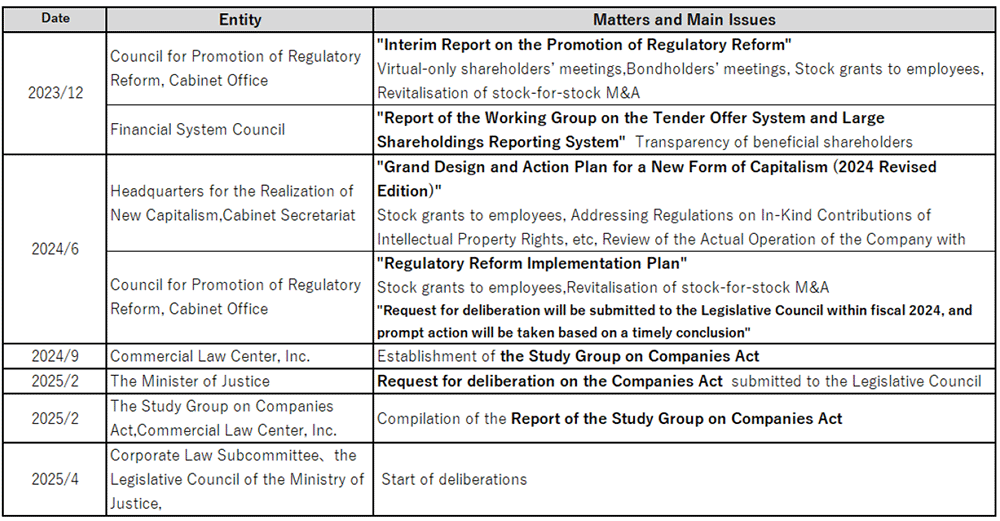
Source: Compiled by Dai-ichi Life Research Institute
Figure 1 Developments to Date in the Current Companies Act Amendment (Government and Ministry of Justice Initiatives)
Source: Compiled by Dai-ichi Life Research Institute
One notable feature of the considerations leading up to this amendment is that the process has been regarded less as a matter of “corporate governance”—the main theme in previous deliberations—and more as part of regulatory reforms led by the Kishida administration, aimed at increasing managerial flexibility for companies. The current considerations are based on the “Report of the Study Group on Companies Act” by Commercial Law Center, Inc., which was presented at the first meeting in April 2025. Much of its content overlaps with that of the “Report on the Amendment of the Companies Act,” published earlier by the Study Group on Corporate Governance for Enhancing Earning Power at the Ministry of Economy, Trade and Industry (hereinafter “METI”). The request for deliberation that was submitted to the Legislative Council can be found in Figure 2.
Figure 2 Request for deliberation by the Minister of Justice to the Legislative Council regarding the current amendment to the Companies Act

Source: English translation by Dai-ichi Life Research Institute of materials published by the Ministry of Justice
Figure 2 Request for deliberation by the Minister of Justice to the Legislative Council regarding the current amendment to the Companies Act
Source: English translation by Dai-ichi Life Research Institute of materials published by the Ministry of Justice
It cannot be said that the current amendment focuses solely on increasing managerial flexibility for companies and strengthening their “earning power.” Rather, it can be characterized as being strongly influenced both by the direction set forth by METI to enhance companies’ earning power and by the need to coordinate existing systems related to companies and the interests of various stakeholders.
Careful and thorough discussions are required for the amendment of the Companies Act. Going forward, it is expected that discussions will be held about once a month and that the review will proceed according to the timeline shown in Figure 3. There is still considerable time before the amended law comes into effect, and there may be twists and turns during the course of the discussions.
Figure 3 Expected Schedule for the Current Amendment of the Companies Act
Source: Compiled by Dai-ichi Life Research Institute
Figure 3 Expected Schedule for the Current Amendment of the Companies Act
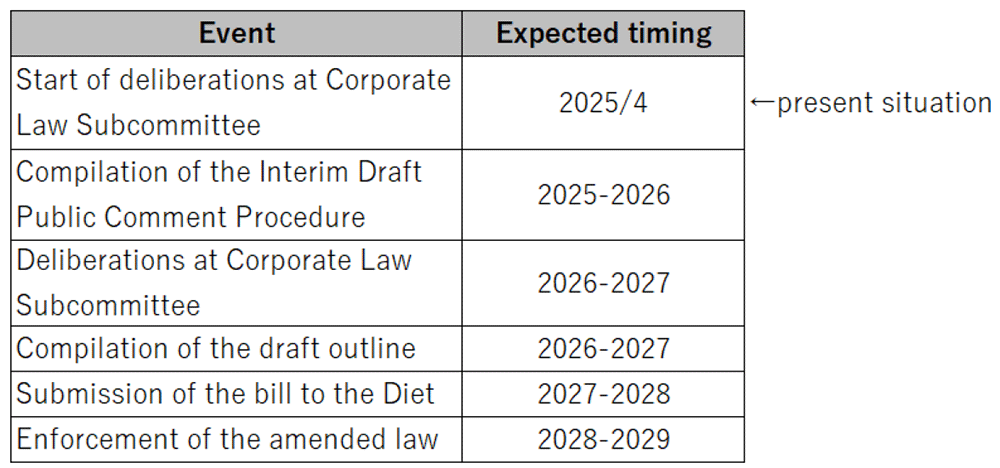
Source: Compiled by Dai-ichi Life Research Institute
3. Main Points of the Current Amendment
At the first meeting of the Corporate Law Subcommittee in April 2025, the Industrial Organization Division of METI presented a document titled “Issues Regarding the Amendment of the Companies Act.” This document is based on the “Report of the Corporate Law System Study Group” introduced in the previous chapter, as well as the “Report on the Amendment of the Companies Act,” both compiled by METI, and outlines the main points of the current amendment.
The introduction of this document first states that Japanese companies need to enhance their “earning power” and achieve growth, and that legal systems should be improved to facilitate this. Japanese companies are required to develop and implement growth strategies that provide a competitive advantage in a complex business environment. The introduction also emphasizes that building trust-based relationships with shareholders and investors through dialogue is important. Furthermore, the government needs to create an institutional environment that enables corporate managers to proactively implement growth strategies. Therefore, a review of the Companies Act is considered necessary.
One of the first issues raised is the expansion of options for companies and the removal of obstacles to implementing growth strategies. Measures are proposed to eliminate barriers to bold corporate reforms, such as limitation of liability agreements for executive directors (Note 1), written resolutions for unlisted companies, and cash-out procedures (Note 2).
Next, reviewing systems to promote constructive and effective dialogue (Engagement) between companies and shareholders is another key issue. Specifically, this includes streamlining procedures for general shareholders’ meetings and reviewing shareholders’ proposal rights.
In addition, a wide range of other legal issues related to corporate management are also being considered, such as the investigator system, the right to request the convocation of extraordinary general meetings, shareholder derivative actions, and improvement of pre-shareholders’ meeting securities disclosure.
Through these amendments, the aim is to create an environment that enables Japanese companies can pursue sustainable growth. Going forward, the Corporate Law System Subcommittee will conduct broad-based discussions on these issues from a variety of perspectives.
4. Hopes for the Deliberations on the Current Amendment
This amendment to the Companies Act is strongly characterized by deregulation and focuses on enhancing the “earning power” of Japanese companies. In recent years, the business environment for Japanese companies has been has changed rapidly. In order to respond appropriately to these changes, it is important to expand options for swift corporate action. On the other hand, since some of these options may restrict the rights of minority shareholders and others, objections are also expected. Nevertheless, it is necessary to relax the regulations of the Companies Act, and the current review can be considered timely.
As noted in the previous chapter, it will take some time before the amended law comes into effect, but it is also undesirable for this process to be excessively prolonged. While the actual review is entrusted to the Corporate Law System Subcommittee, which consists of experts and stakeholders, it is beneficial to promptly check what kinds of discussions are taking place, for example, by referring to the Ministry of Justice website. It is also important for a wide range of stakeholders to recognize themselves as parties involved and to follow the deliberations. While hasty consideration should be avoided avoided, we hope that discussions will proceed as swiftly as possible, that they will be fruitful, and that the results will help strengthen the competitiveness of Japanese companies.
[Notes]
- 1) A limitation of liability agreement is stipulated in Article 427 of the Companies Act. It is a contract that limits the scope of liability for damages for outside directors, auditors, and accounting auditors of a company when performing their duties, provided that they act in good faith and without gross negligence.
- 2) In general, the term “cash-out” refers to the outflow of funds to external parties. However, in the context of corporate restructuring, a "cash-out" refers to a situation in which the majority shareholder (the acquirer) acquires all shares held by minority shareholders in exchange for cash.
[References]
- Yoshio kawatani (2025)
“One-Minute Explanation: What is a Cash-Out?” - METI the Study Group on Corporate Governance for Enhancing Earning Power(2025)
“Report on the Amendment of the Companies Act” - Commercial Law Center, Inc. (2025)
“Report of the Study Group on Companies Act”
Original in Japanese:
https://www.dlri.co.jp/report/ld/448891.html
Disclaimer:
This report has been prepared for general information purposes only and is not intended to solicit investment. It is based on information that, at the time of preparation, was deemed credible by Daiichi Life Research Institute, but it accepts no responsibility for its accuracy or completeness.