




- Report Index
- Japan Economic Outlook (September 2026)
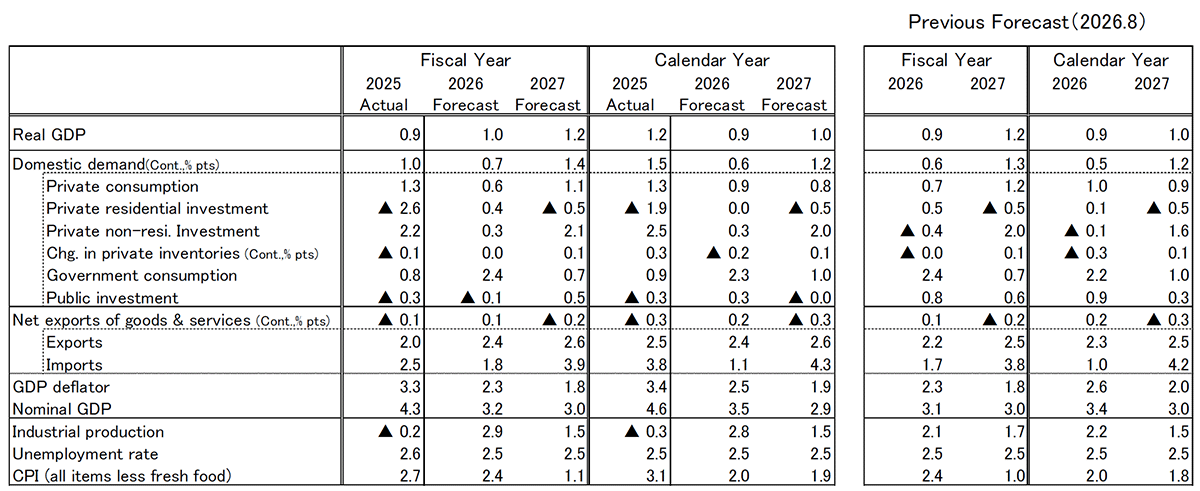
Real GDP growth is forecast at +1.0% in FY2026 (August forecast: +0.9%) and +1.2% in FY2027 (unchanged at +1.2%). On a calendar-year basis, growth is projected at +0.9% in 2026 (unchanged) and +1.0% in 2027 (unchanged). The FY2026 growth forecast has been revised slightly upward to reflect the upward revision to Q2 2026 GDP growth in the second preliminary estimate. However, this revision largely reflects recent data and does not represent a significant change in our assessment of the outlook. Looking ahead, although downward pressure from higher costs will remain, the economy is expected to maintain a moderate recovery trend.
In the current forecast, we assume that the consumption tax rate on food products will be lowered to 1% for two years from April 2027, accompanied by annual cash benefits of JPY 600 billion to households, equivalent to one percentage point of the consumption tax on food products. The resulting increase in household purchasing power is estimated to boost real GDP growth in FY2027 by slightly more than 0.2 percentage points. The measures are also expected to lower the headline CPI by 1.4 percentage points and the core CPI (excluding fresh food) by 1.2 percentage points in FY2027.
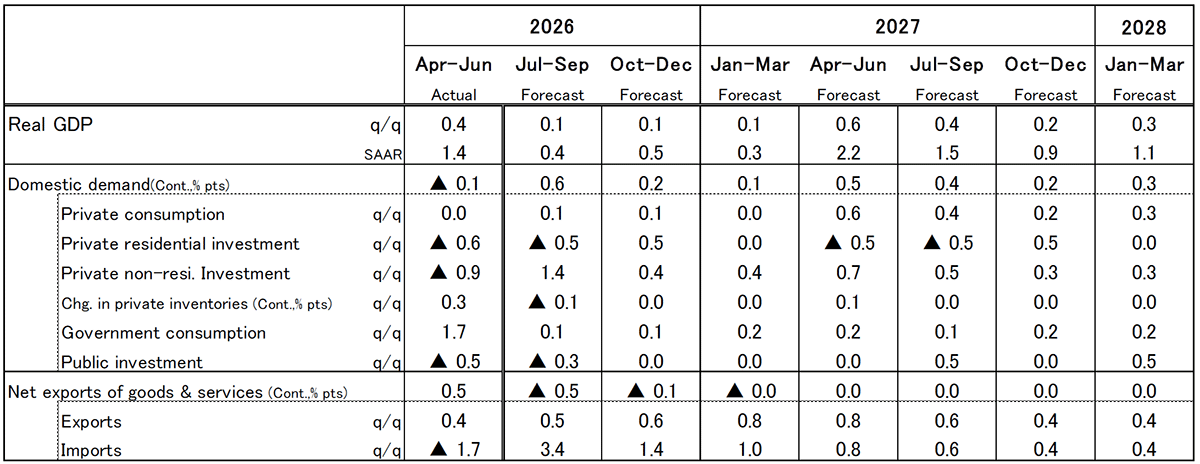
Real GDP growth in Q2 2026 (April–June) came in at +1.4% on a quarter-on-quarter annualized basis, marking the third consecutive quarter of positive growth. Although the details were somewhat underwhelming, with domestic demand remaining sluggish, the fact that the recovery trend was maintained in Q2 following strong growth in Q1 is encouraging, particularly given that the quarter coincided with a period when worsening conditions in the Middle East intensified headwinds from supply uncertainty and higher import prices. The release of government stockpiles and progress in alternative sourcing from the United States and other countries helped avert severe supply constraints, while strengthening AI-related demand also supported economic activity. The economy’s underlying recovery trend remains intact.
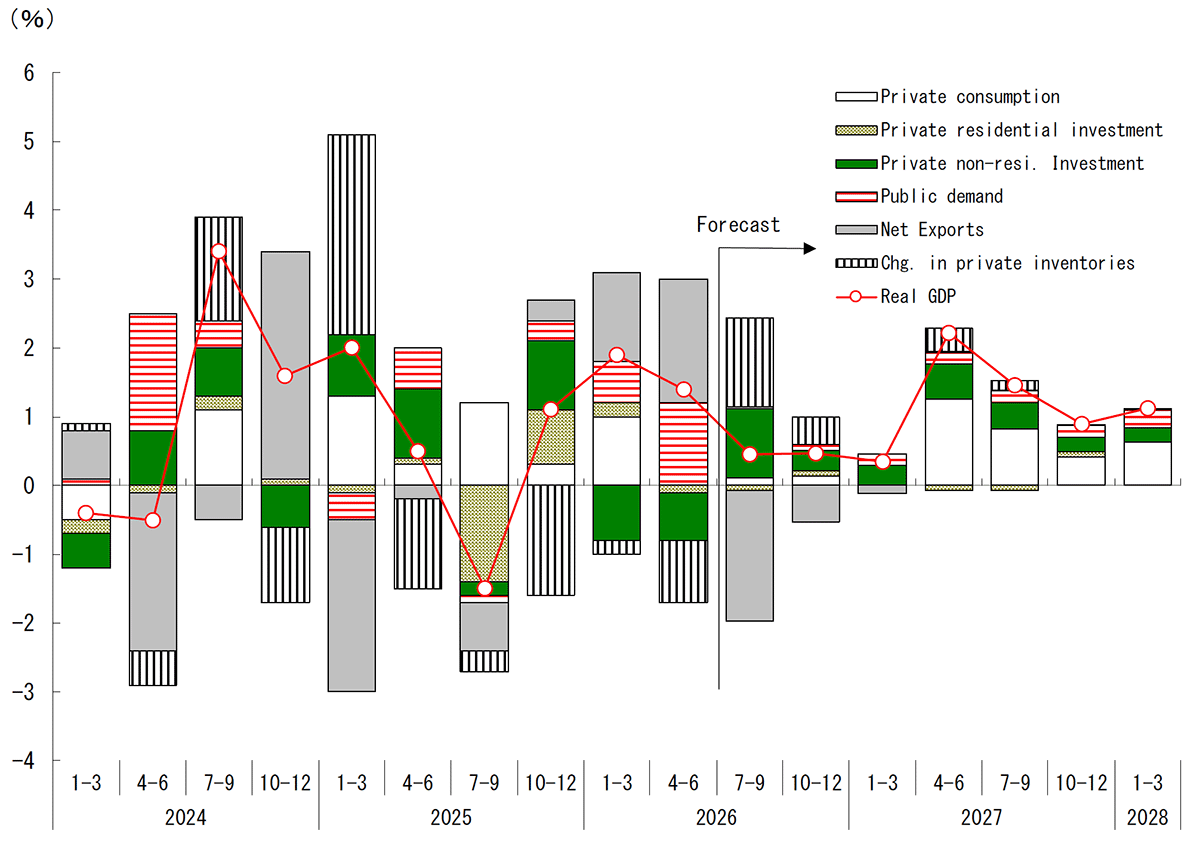
For Q3 2026 (July–September), real GDP growth is forecast at +0.4% on a quarter-on-quarter annualized basis. We expect the economy to maintain positive growth following Q2 and continue a moderate recovery. Private consumption will receive less support from demand for durable goods such as automobiles and air conditioners than in Q2, while a series of heavy rain events and other natural disasters across the country could temporarily weigh on travel, outings, and service consumption. On the other hand, strong wage growth, a resilient labor market, and government subsidies for electricity and gas charges should provide support, allowing private consumption to post a modest quarter-on-quarter increase. Exports are also expected to be supported by resilient overseas economies and robust AI- and semiconductor-related demand. Meanwhile, demand for business investment remains firm, particularly for labor-saving, digital, and AI-related investment. Sourcing difficulties for materials have eased substantially as alternative sourcing has progressed, while uncertainty surrounding developments in the Middle East has also diminished from its earlier levels. As a result, investment projects that had been postponed are expected to be gradually implemented, leading to a recovery in business investment. Although natural disasters may exert some temporary downward pressure, these underlying support factors should allow GDP to maintain positive growth in Q3.
Despite the continued downward pressure from higher prices, the economy is likely to maintain a moderate recovery trend in the second half of FY2026. Corporate profits remain at high levels and should provide some cushion against the impact of rising costs. Firms retain sufficient financial capacity to invest despite persistent cost pressures, while demand for labor-saving, digital, and AI-related investment remains firm amid persistent labor shortages. The easing of supply uncertainty should also encourage firms to move ahead with investment projects that had previously been postponed. In addition, resilient overseas economies and expanding global AI- and semiconductor-related demand are expected to support exports and business investment. In the household sector, although some recent consumption-related indicators have shown weakness, strong wage growth and a resilient labor market should provide support, making a sharp downturn in private consumption unlikely. Taking these factors into account, the economy is expected to continue a moderate recovery, albeit without strong momentum.
In FY2027, the recovery is expected to gradually gain momentum as the adverse effects of higher resource prices and procurement costs stemming from worsening conditions in the Middle East fade and downward pressure through price and income channels diminishes. In the corporate sector, easing cost pressures should improve the earnings environment, while business investment is expected to increase, particularly in labor-saving, digital, and AI-related areas. Exports should also continue to be supported by resilient overseas economies and AI-related demand. In the household sector, inflation is expected to moderate as cost-push pressures run their course. In addition, the reduction in the consumption tax rate on food products and cash benefits to households from April 2027 should boost household purchasing power and strengthen the recovery in private consumption. As headwinds from inflation ease and improvements in corporate earnings and household purchasing power become more pronounced, the recovery in domestic demand should become clearer. Against this backdrop of improving domestic and external demand, real GDP growth is forecast to accelerate to +1.2% in FY2027, from +1.0% in FY2026.
The core consumer price index (CPI, excluding fresh food) is forecast to rise by +2.4% in FY2026 (August forecast: +2.4%) and +1.1% in FY2027 (previously +1.0%). In FY2026, inflation is likely to accelerate toward the second half of the fiscal year. The recent moderation in food price inflation is showing signs of stalling, while price increases have also begun to emerge for daily necessities. In addition to the effects of earlier increases in resource prices and sourcing difficulties, rising costs for packaging materials and logistics are expected to be passed through to downstream prices with a lag, exerting upward pressure on inflation. Earlier increases in fuel prices will also feed through to electricity and gas charges with a lag. Although government subsidies temporarily restrained CPI inflation during the summer, upward pressure from energy prices is likely to intensify from autumn into winter. With firms also becoming more proactive in passing higher costs on to prices, core CPI inflation is likely to exceed +3% year-on-year from late 2026 into early 2027.
In FY2027, by contrast, CPI inflation is expected to decline substantially as earlier cost-push pressures begin to run their course and the consumption tax rate on food products is reduced from April. On a quarterly basis, inflation is expected to peak in Q1 2027 (January–March) and moderate thereafter. In the current forecast, the consumption tax cut is assumed to lower the headline CPI by 1.4 percentage points and the core CPI by 1.2 percentage points in FY2027. However, much of this decline will reflect the temporary impact of the policy change. Upward pressure on underlying inflation is not expected to weaken rapidly, given continued strong wage growth and associated increases in labor costs, persistent labor shortages, and firms’ increasingly proactive price-setting behavior.
On monetary policy, we expect the Bank of Japan to deliver its next rate hike in September 2026. With underlying inflation approaching 2%, the BOJ has become increasingly alert to upside risks to inflation and is likely to raise the policy rate to 1.25% at its September meeting.
We then expect the BOJ to raise rates further in December 2026, March 2027, and June 2027, bringing the policy rate to 2.0%. In our previous forecast, we had expected rate hikes in September 2026, January 2027, and June 2027, with the policy rate reaching 1.75%. We now expect a faster pace of rate hikes, reflecting a further increase in concerns over upside risks to inflation amid earlier increases in resource prices, yen depreciation, and firms’ increasingly proactive price pass-through, as well as the BOJ’s clearer stance of proceeding flexibly with further rate hikes. Another important factor is that, with the United States expressing support for the normalization of Japan’s monetary policy, the Japanese government appears to have less room to push back strongly against further BOJ rate hikes. Upside risks to inflation are likely to become more pronounced from late 2026 into early 2027, while underlying inflationary pressure is expected to remain strong, making consecutive quarterly rate hikes in December and March increasingly likely.
Furthermore, if wage growth remains strong in the 2027 spring wage negotiations and upward inflationary pressure through wages and service prices persists, we expect the BOJ to raise the policy rate to 2.0% in June 2027, with a view to preventing underlying inflation from becoming entrenched above 2%.
Japan's Economic Outlook(Yearly)
Note: Forecasts are by the Dai-ichi Life Research Institute.
Source: Cabinet Office, Ministry of Economy, Trade and Industry, Ministry of Internal Affairs and Communications.
Japan’s Economic Outlook(Quarterly)
Note: Forecasts are by the Dai-ichi Life Research Institute.
Source: Cabinet Office.
Forecast of Real GDP
(Quarter-on-Quarter Annualized Rate,Contribution)
Note: Forecasts are by the Dai-ichi Life Research Institute.
Source: Cabinet Office.
Original in Japanese:
https://www.dlri.co.jp/report/macro/654872.html
Disclaimer:
This report has been prepared for general information purposes only and is not intended to solicit investment. It is based on information that, at the time of preparation, was deemed credible by Daiichi Life Research Institute, but it accepts no responsibility for its accuracy or completeness. Forecasts are subject to change without notice. In addition, the information provided may not always be consistent with the investment policies, etc. of Daiichi Life or its affiliates.