




- Report Index
- Toward Coexistence Between the AI Boom, Data Centers, and Local Communities
- DLRI Report
-
2026.02
Toward Coexistence Between the AI Boom, Data Centers, and Local Communities
Mei Makinouchi
What Is Happening Behind the AI Boom
Generative AI is permeating every sector of industry, and investment in data centers (hereafter, “DCs”), which provide the computing capacity that underpins this trend, has been positioned as one of the pillars of the Cabinet Office’s target of 100 trillion yen in Japan’s inward foreign direct investment stock. However, the rush to build DCs driven by the explosive spread of generative AI is, at times, creating friction with local communities.
Reasons Behind Opposition Movements in the United States
In the United States, there have been reports that investment plans totaling 3.8 trillion yen were forced to be cancelled over roughly three months from late March through June 2025. Because the U.S. system allows the cost of strengthening the transmission grid required for DC operations to be passed on to local consumers, concern about higher electricity bills is the primary reason for opposition.
DCs also maintain large numbers of diesel generators and gas turbines as emergency power supplies. Some residents are concerned about potential health impacts from nitrogen oxides and PM2.5 emissions when these units operate during power outages or periodic testing.
In regions where water is scarce, water consumption for cooling is another issue. Annual water use by U.S. DCs amounts to 66 billion liters—roughly equivalent to the domestic water use of 500,000 people in Japan—and it continues to increase year after year.
In addition, a Pew Research Center survey indicates that voices expressing concern about the risks of AI significantly outnumber those who feel its benefits, suggesting that underlying anxiety toward major tech companies fuels opposition to DCs.
Japan’s Reception Differs from the United States
In Japan, by contrast, DC siting tends to prioritize proximity to data demand centers as well as the availability of electricity and telecommunications networks; as a result, approximately 90% of DCs are concentrated in the Greater Tokyo and Greater Osaka areas. Perhaps for that reason, public concerns often focus on deterioration of the living environment stemming from the “close proximity” of DCs to residential neighborhoods.
From a security standpoint, DCs often have few windows and a massive, box-like appearance. If built in a residential area, this may give rise to landscape-related issues such as blocked sunlight and a sense of visual oppression. Moreover, concerns about noise and waste heat from air-conditioning outdoor units operating 24 hours a day have, according to some studies, heightened anxiety among nearby residents.
At the root of frictions surrounding DCs lies a familiar pattern of conflict between large-scale development projects and residents. Issues that have accompanied the construction of high-rise condominiums or the attraction of industrial facilities are, in part, now being directed at DCs as infrastructure for the AI era.
Material 1: Data Center Location Trends
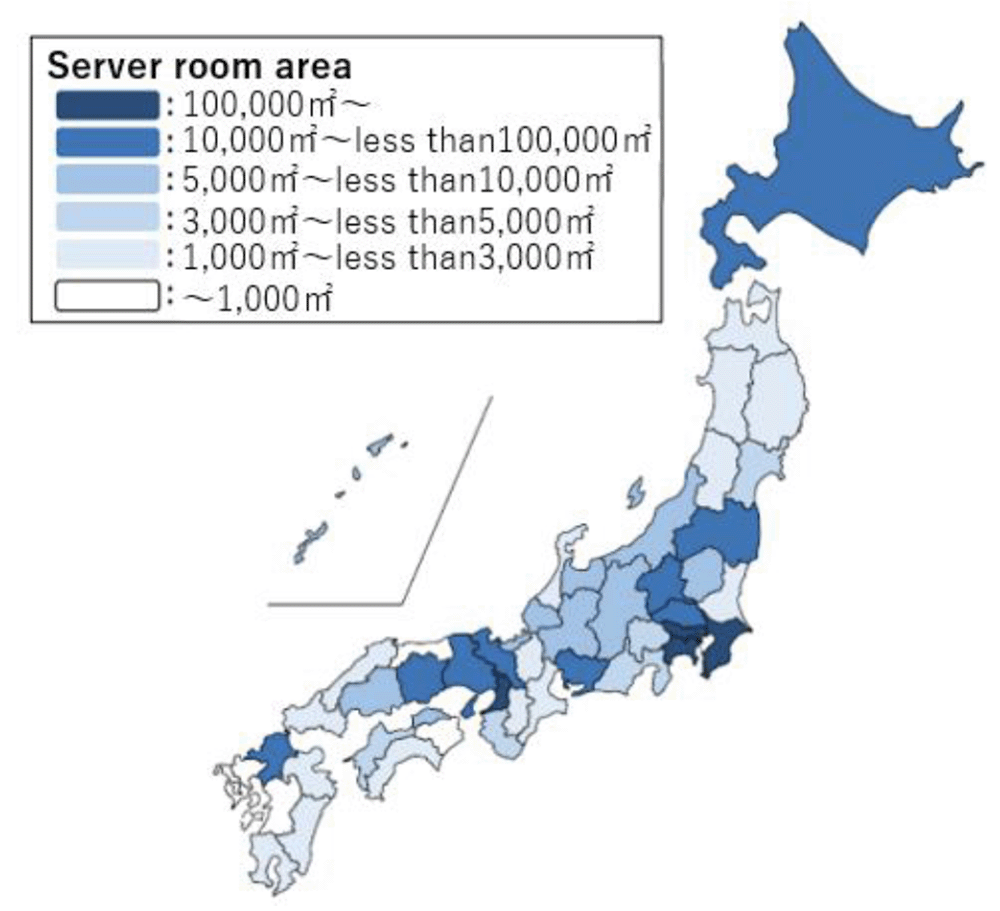
Source: Ministry of Internal Affairs and Communications and the Ministry of Economy, Trade and Industry, “Expert Meeting on the Development of Digital Infrastructure (DCs, etc.): Secretariat Briefing Materials (7th Meeting).”
Perspectives for Coexistence
Against this backdrop, local governments have begun to respond. In April 2025, Koto City, Tokyo announced its “Policy on Responding to Data Center Construction.” It calls for posting notice signs for building plans earlier than usual, making prior briefing sessions mandatory, and requesting that operators take steps to mitigate impacts on the living environment—such as revisiting the placement of air-conditioning outdoor units.
Opposition movements may arise regardless of DC operators’ efforts. While disclosure by DC operators is, of course, necessary, it may also be key to reducing friction for municipalities to present urban planning frameworks and lay the groundwork for consensus-building, rather than leaving neighborhood considerations and explanations solely to operators.
Original in Japanese:
https://www.dlri.co.jp/report/dlri/565743.html
Disclaimer:
This report has been prepared for general information purposes only and is not intended to solicit investment. It is based on information that, at the time of preparation, was deemed credible by Daiichi Life Research Institute, but it accepts no responsibility for its accuracy or completeness.