




- Report Index
- Why Are Japanese Homes So Cold?
Overlooked Winter “Cold”
Many people struggle with a lingering chill in their homes during winter, yet in Japan the health risks associated with inadequate residential insulation have often been underestimated. The World Health Organization (WHO) recommends maintaining an indoor temperature of at least 18°C for healthy adults. However, according to the Japan Sustainable Building Consortium’s “Nationwide Survey on Home Insulation and Its Effects on Occupants’ Health (9th Report Meeting),” the average winter living-room temperature while residents are at home in Japan is 17.1°C, which falls short of this recommendation. Because central heating is not widely adopted, temperatures in changing areas, bathrooms, and toilets often drop significantly, leading to large temperature differentials between rooms. Such cold indoor environments are said to increase the risk of hypertension and cardiovascular disease, and to contribute to so-called “heat shock.”
It should be noted that “heat shock” is not an official medical diagnosis. Accordingly, “heat shock” is not recorded as the direct cause of death on death certificates; instead, cases are classified under multiple diagnoses and external causes such as myocardial infarction, cerebral hemorrhage, arrhythmia, and drowning or near-drowning. In this article, all numerical references are derived from proxy indicators—such as bathing-related accidents, drowning in bathtubs, and cardiopulmonary arrest during bathing—that are strongly suspected to be associated with rapid temperature changes.
Postwar Housing Shortages and a History of Underprioritizing Insulation
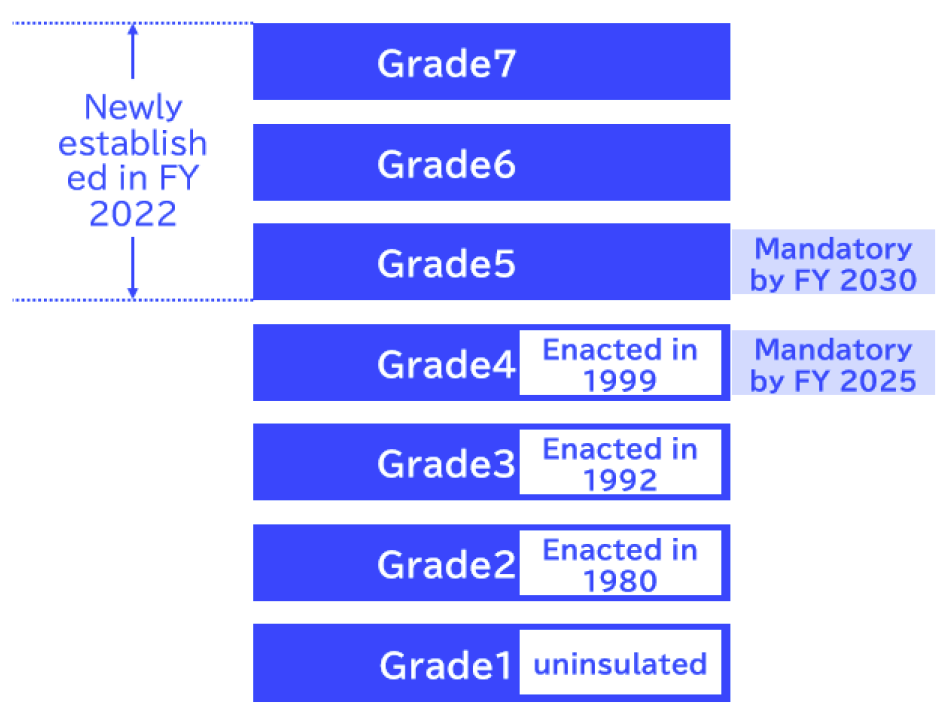
One reason Japanese homes came to be perceived as “cold” lies in the policy priorities that shaped housing development from the postwar period through the era of high economic growth. Immediately after World War II, Japan faced a severe housing shortage—particularly in urban areas—due to air-raid damage and population inflows. Ensuring housing quantity was treated as the country’s most urgent national priority. During the high-growth period, government housing finance support and mortgage tax incentives further accelerated new construction. Japan’s first nationwide, standardized insulation criteria related to energy conservation were established only in 1980. While the standards were strengthened in stages in 1992, 1999, 2013, and 2016, they largely remained non-mandatory targets at the design stage for new construction and were not treated as targets for existing homes for many years.
Material 1: List of Insulation Grades
Source: Dai-ichi Life Research Institute
Insulation Standards Lagging International Benchmarks
Although improving residential energy performance has attracted more attention in recent years, Japan’s insulation standards remain relatively less stringent than those of other advanced economies. Japan was the only G7 country that, as of 2024, had not mandated compliance with energy-efficiency standards for newly built houses. Only from April 2025 did the government implement regulatory changes requiring all new houses and buildings to comply with energy-efficiency standards and to meet at least Insulation Grade 4.
In Japan, insulation performance is commonly measured using the UA value (the average heat transfer coefficient of the building envelope). A lower UA value indicates that heat escapes less easily. While Japan’s Insulation Grade 4 corresponds to a UA value of 0.87 W/m²·K in regions such as Tokyo and Osaka, California in the United States is cited as being at a level equivalent to a UA value of 0.42. In this comparison, Japan’s latest standards allow more than twice the heat loss of California.
At the same time, national standards differ depending on climate conditions and building typologies, and definitions are not fully identical across countries. Therefore, UA values alone cannot determine relative housing performance in a definitive way. However, in the limited sense of comparing each country’s “minimum acceptable level of envelope heat loss,” set against its domestic climate assumptions, Japan’s standards can be characterized as relatively lenient compared with those of major countries.
Material 2: UA Values by Insulation Grade (by Climate Zone)
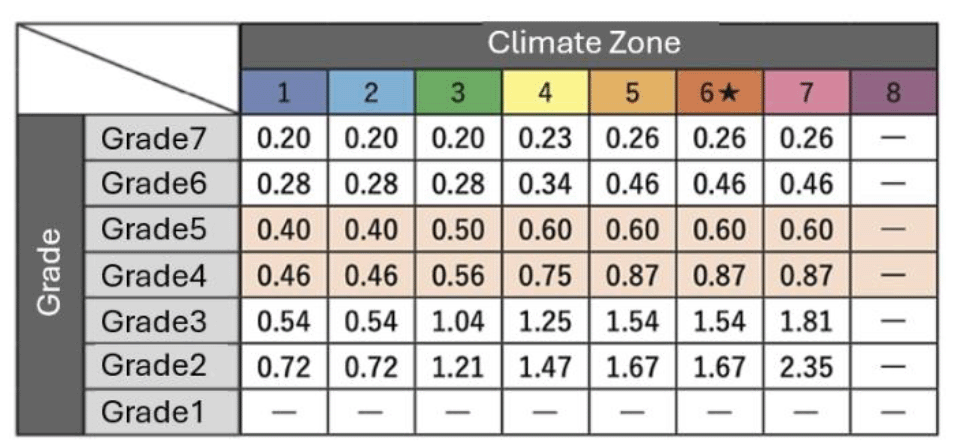
Note: Because Japan has wide regional temperature variation, it is divided into eight climate zones. Hokkaido corresponds to Zone 1 or 2; Okinawa corresponds to Zone 8; Tokyo and Osaka correspond to Zone 6.
Source: Ministry of Land, Infrastructure, Transport and Tourism (MLIT), “Explanation of Label Items.”
Existing Homes as a Structural Challenge
According to the Statistics Bureau of Japan’s “Housing and Land Survey,” Japan’s total housing stock reached 65.02 million units as of 2023. Yet only 18% of homes meet Insulation Grade 4 (according to MLIT). In addition, 24% of all homes are non-insulated and fail to meet even the 1980 standard. Because performance provisions under the Building Standards Act are not retroactive for existing homes, poorly insulated housing remains in the stock. A fundamental improvement in the residential conditions that contribute to “heat shock” cannot be discussed without addressing insulation retrofits for existing homes.
Insulation Retrofits and Their Effects
According to MLIT’s “Smart Wellness Housing Promotion Survey Program,” insulation retrofits raise average winter indoor temperatures in living spaces by approximately 2°C and improve health indicators, including an average 3.1 mmHg reduction in systolic blood pressure upon waking. Insulation retrofits provide benefits not only through household savings but also through improved public health outcomes.
In the “Dekokatsu” initiative (a national campaign promoted by the Ministry of the Environment to encourage lifestyles that contribute to decarbonization), an illustrative “Ten Years Ahead” scenario estimates that upgrading a home from Insulation Grade 2 to Grade 4 could reduce CO2 emissions by 1,130.7 kg per year and lower annual utility costs by JPY 94,000.
A key challenge is the cost of retrofits. A Ministry of the Environment estimate indicates that, compared with achieving the same insulation performance at the time of new construction, insulation renovation of existing homes can impose a larger financial burden; for a typical detached house, the required investment can amount to several million yen.
Material 3: Example Estimate of Costs for Residential Energy-Efficiency Renovations (JPY 10,000)
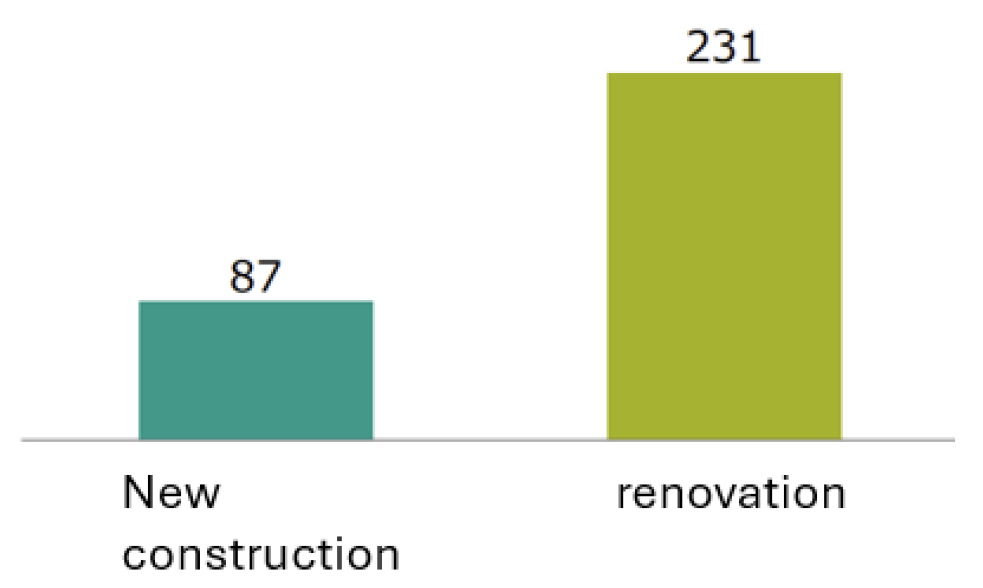
Note: Assumes upgrading a wooden detached house (total floor area approximately 120 m²) in Climate Zone 6 (e.g., Tokyo/Osaka) from Insulation Grade 3 to Grade 4.
Source: Ministry of the Environment, “Roadmap for the Next 10 Years of Living,” reference materials.
Policy Support and Barriers to Wider Adoption
Support measures exist, including the Ministry of the Environment’s subsidy program for insulation retrofits in existing homes, the “Housing Energy-Saving 2025 Campaign” jointly implemented by MLIT, the Ministry of Economy, Trade and Industry, and the Ministry of the Environment, and MLIT’s “Long-Life Quality Housing Renovation Promotion Program.” However, several factors impede broader adoption: subsidy programs depend on annual budgets and therefore offer limited medium- to long-term predictability; investment is difficult to promote in rental housing due to misaligned incentives between owners and tenants; and energy performance is not sufficiently reflected in prices in Japan’s existing-home market.
Insulation as Both Climate Adaptation and Mitigation
In a poorly insulated home, heat continues to escape even when rooms are heated, resulting in sustained costs in the form of higher utility bills and elevated health risks. In summer, increased air-conditioning use during extreme heat can also raise energy consumption, thereby contributing to climate change.
Improving residential insulation is important not only for preventing “heat shock” but also from both adaptation and mitigation perspectives. Rather than leaving insulation retrofits solely to individual homeowners’ decisions, it is necessary to position them as social infrastructure investment linked to policy areas such as health, welfare, energy, and climate change, and to further strengthen the scale of support and the provision of information.
Original in Japanese:
https://www.dlri.co.jp/report/dlri/556056.html
Disclaimer:
This report has been prepared for general information purposes only and is not intended to solicit investment. It is based on information that, at the time of preparation, was deemed credible by Daiichi Life Research Institute, but it accepts no responsibility for its accuracy or completeness.