




- Report Index
- Japan Economic Outlook (November 2025)
The forecast for real GDP growth is +1.0% for FY2025 (up from +0.7% in the September projection) and +0.8% for FY2026 (up from +0.7%). On a calendar-year basis, growth is projected at +1.3% in 2025 (previously +1.1%) and +0.6% in 2026 (previously +0.5%). The upward revision—particularly for FY2025—reflects a 0.2 percentage point carry-over effect stemming from retroactive revisions to past GDP data and the stronger-than-expected resilience of the U.S. economy. While the FY2025 growth rate exceeds that of FY2026, this mainly reflects the statistical carry-over. Excluding this factor, within-year growth is estimated at +0.3% for FY2025 and +0.7% for FY2026.
Real GDP in 2025 Q3 (July–September) contracted at an annualized –1.8%. The decline was driven by a sharp drop in housing investment following front-loaded demand ahead of a legal revision, along with weaker exports. However, the fall in housing investment is likely temporary, and part of the export decline reflects a payback from strong gains in Q2. Thus, the weakness in Q3 does not guarantee excessive pessimism. On average with prior positive quarters, the economy remains on a modest upward trend. Despite tariff hikes, the U.S. economy has stayed resilient, helping Japan avoid the sharp export slowdown that had been feared. So far, no signs of a broader downturn have emerged.
Nonetheless, uncertainty persists regarding the export outlook. While the U.S. economy remains firm, a gradual slowdown is under way. As the pass-through of higher tariffs progresses and labor market conditions soften, consumption—particularly among lower-income households—is expected to face increasing downward pressure. Japanese automakers have so far avoided sales declines in the U.S. by lowering export prices to offset tariffs, but with the tariff rate now fixed at 15%, price increases appear inevitable, likely weighing on U.S. sales volumes. Exports therefore remain likely to decline in 2025 Q4. Although GDP growth should return to positive territory—supported by a stabilization in housing investment and an increase in capital spending—the rebound will likely be modest relative to the Q3 downturn, with growth forecast at +0.4% on an annualized basis. In the absence of a strong growth driver, the Japanese economy is expected to see only a mild recovery in the second half of the fiscal year.
In FY2026, the economy is projected to continue a gradual recovery. While the negative effects of U.S. tariff hikes will linger, earlier interest rate cuts will increasingly support economic activity with a lag. Tax reductions will also contribute to the U.S. recovery. As the U.S. economy stabilizes, Japanese exports are expected to bottom out, helping to stem the deterioration in corporate earnings. An improved profit environment and reduced uncertainty should support a moderate increase in capital investment.
Another positive factor will be the stabilization of real wages. Wage negotiations in spring 2026 are expected to deliver an average wage increase of 5.20% (Ministry of Health, Labor and Welfare basis), marking the third consecutive year of 5%-range gains. Contributing factors include: (1) deepening labor shortages, (2) continued high inflation and efforts to offset declines in real wages, and (3) strong corporate earnings. As cost-push pressures ease and inflation moderates, real wages are projected to return to positive territory. This should help stabilize private consumption, although the increase in real income is expected to be modest, limiting the strength of consumption growth.
Major risk factors include (1) deterioration in Japan–China relations and (2) developments in the U.S. stock market. A prolonged suspension of travel from China could materially dampen inbound demand, which has provided significant support to the Japanese economy. Any escalation—such as boycotts of Japanese products or a reduction in trade transactions—would amplify the negative impact. Meanwhile, U.S. equity markets remain buoyant on strong expectations for AI-related growth, but concerns about overheating have emerged. A decline in such expectations could trigger a correction. Given the sizable role of wealth effects among high-income households in supporting U.S. consumption, stock market trends warrant close monitoring.
The core Consumer Price Index (CPI excluding fresh food) is projected to rise by +2.7% in FY2025 and +1.8% in FY2026. Although further price hikes for food items are likely amid yen depreciation, year-on-year inflation is expected to moderate as the high base from the previous year fades. Moreover, the abolition of the former provisional gasoline tax rate and the continuation of electricity and gas subsidies through winter are expected to push core CPI below +2% year-on-year in 2026 Q1. In FY2026, while rising service prices will exert upward pressure, the waning of cost-push effects on food prices will likely keep core CPI slightly below +2% year-on-year.
Japan's Economic Outlook (Yearly)
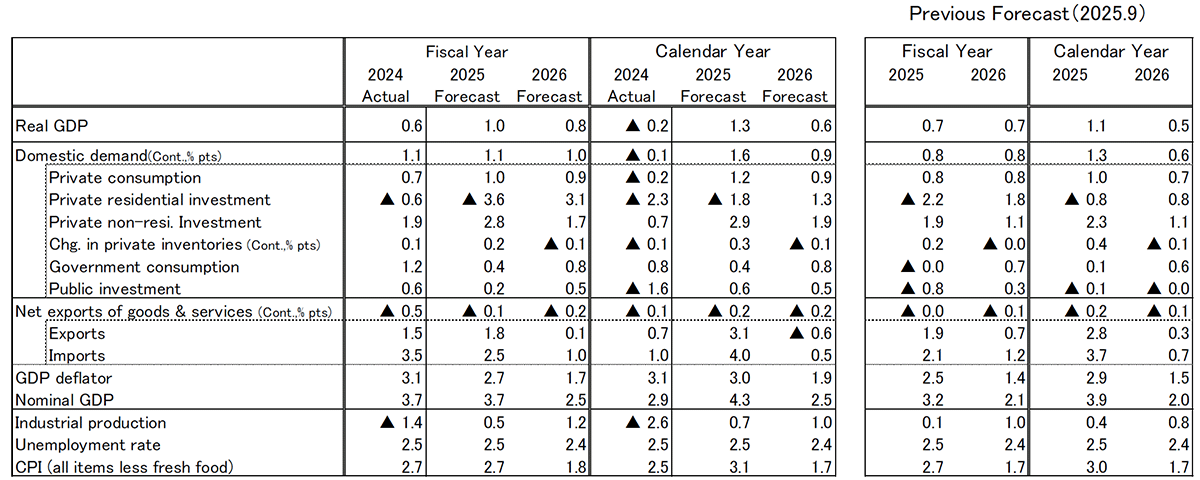
Note: Forecasts are by the Dai-ichi Life Research Institute.
Source: Cabinet Office, Ministry of Economy, Trade and Industry,Ministry of Internal Affairs and Communications.
Forecast of Real GDP
(Quarter-on-Quarter Annualized Rate,Contribution)

Note: Forecasts are by the Dai-ichi Life Research Institute.
Source: Cabinet Office.
Japan’s Economic Outlook(Quarterly)
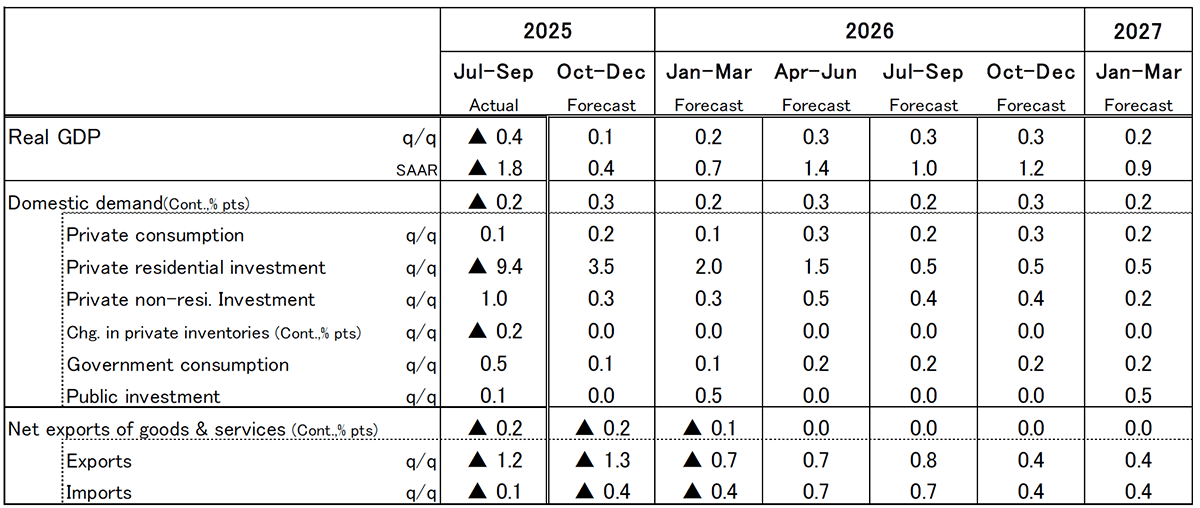
Note: Forecasts are by the Dai-ichi Life Research Institute.
Cabinet Office.
Original in Japanese:
https://www.dlri.co.jp/report/macro/541933.html
Disclaimer:
This report has been prepared for general information purposes only and is not intended to solicit investment. It is based on information that, at the time of preparation, was deemed credible by Daiichi Life Research Institute, but it accepts no responsibility for its accuracy or completeness. Forecasts are subject to change without notice. In addition, the information provided may not always be consistent with the investment policies, etc. of Daiichi Life or its affiliates.