




- Report Index
- Examining the Issue of Rising Life Insurance Non-participation rate Among Young Households
- DLRI Report
-
2025.11
Examining the Issue of Rising Life Insurance Non-participation rate Among Young Households
Yoshio Kawatani
Rising Non-participation Rate in Life Insurance Among Young Households
In the 2024 Survey on Life Insurance in Japan conducted by the Japan Institute of Life Insurance (hereinafter, “the Survey”), the household participation rate in life insurance, including individual annuities and policies provided by Japan Post Insurance, JA, and cooperative associations, was 89.2%.
Since its inception in 1965, the Survey has been conducted every three years, and the reported participation rate is widely regarded as a representative indicator of life insurance coverage in Japan.
From 2015 onward, the participation rate has remained almost unchanged, slightly below 90%. Accordingly, the household non-participation rate (hereinafter referred to as the non-participation rate), derived by subtracting the participation rate from 100%, has consistently remained just above 10%.
Figure 1. Trends in Life Insurance Non-Participation Rate by Age Group of Household Head

Source: Compiled by Dai-ichi Life Research Institute from the Survey data
Figure 1 illustrates how this non-participation rate has changed by age group of household heads since 2015.
When examining the non-participation rate by age group of household heads, we observe an increase among younger households in their 20s and 30s. The rate remains stable among middle-aged households in their 40s to 60s, who account for the majority of life insurance policyholders, and declines among elderly households aged 70 and over. In the 2024 Survey, the non-participation rate of elderly households was lower than that of younger households.
In the following sections, this report analyzes younger households—whose non-participation rate has been rising—focusing on their stated reasons for not having life insurance and perceived knowledge gaps based on the Survey responses. Based on this analysis, the report discusses the importance of addressing non-participation in life insurance among younger generations.
Trends in Non-Enrollment Reasons Among Younger Households
In both the 2024 and 2015 surveys, respondents from households without life insurance were asked exactly the same question regarding their reasons for non-enrollment.
Figure 2 presents a comparison of the results from these two surveys.
In both surveys, the most common reason for not having life insurance was “lack of financial resources.” However, in the 2024 survey, the proportion of respondents citing this reason decreased by 15 percentage points. In contrast, the proportion of those citing “no perceived need for life insurance” increased by 18 percentage points. In addition, there was an increase in the number of respondents who cited reasons such as “other forms of saving are more advantageous” or “rely on public pension and social security systems.”
Figure 2. Reasons for Non-Enrollment Among Young Households (Multiple Answers)

Source: Compiled by Dai-ichi Life Research Institute from the Survey data
Thus, although the high non-participation rate among younger households in recent years is indeed largely attributable to limited financial capacity, the recent increase in non-participation may also reflect a change in perceptions toward life insurance itself.
Knowledge Gaps on Life Insurance Among Young Households
This section examines the level of understanding of life insurance among younger households.
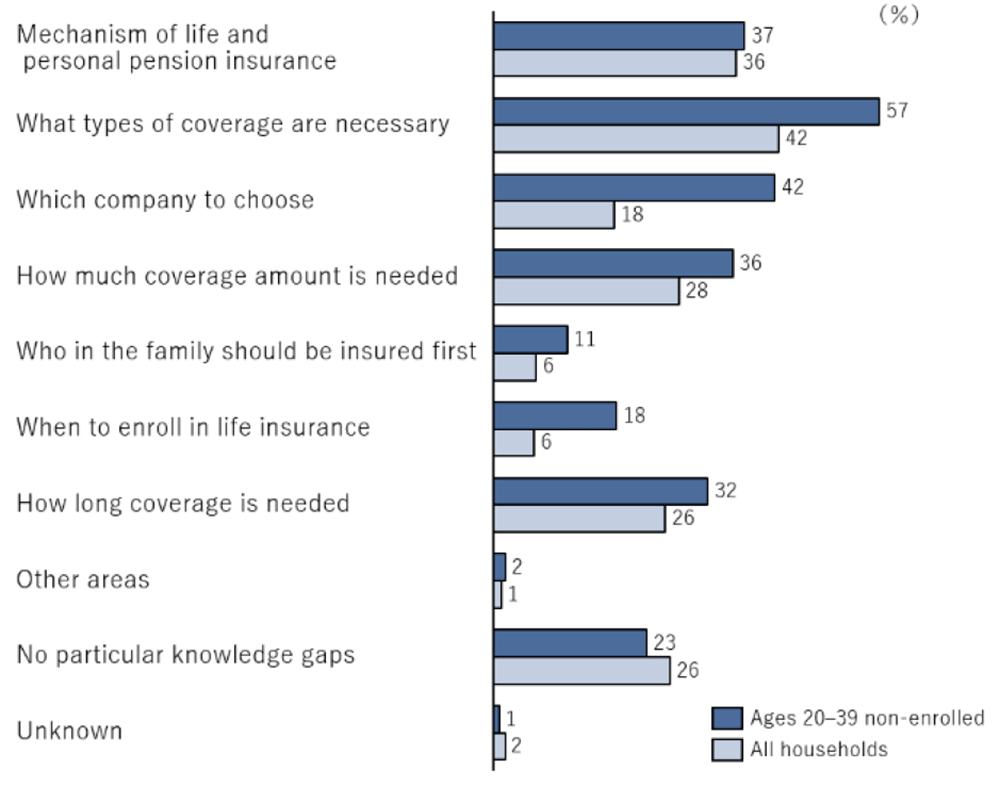
Figure 3 presents responses to the question on “knowledge areas considered insufficient regarding life insurance” in the 2024 survey, comparing younger households without life insurance with all households.
Figure 3. Areas of Life Insurance Knowledge Considered Insufficient (Multiple Responses)
Source: Compiled by Dai-ichi Life Research Institute from the Survey data
As shown in Figure 3, a higher proportion of younger households without life insurance consider their knowledge of life insurance to be insufficient across all items, compared with the overall sample.
In particular, more than half of respondents in this group indicated that they lack sufficient knowledge about “what kinds of coverage are necessary.”
This suggests that such knowledge gaps may be one of the factors behind the limited progress in life insurance enrollment among younger households.
How, then, has the level of knowledge about life insurance—identified earlier as insufficient among younger households—changed in line with the recent rise in the non-participation rate observed in Figure 1?
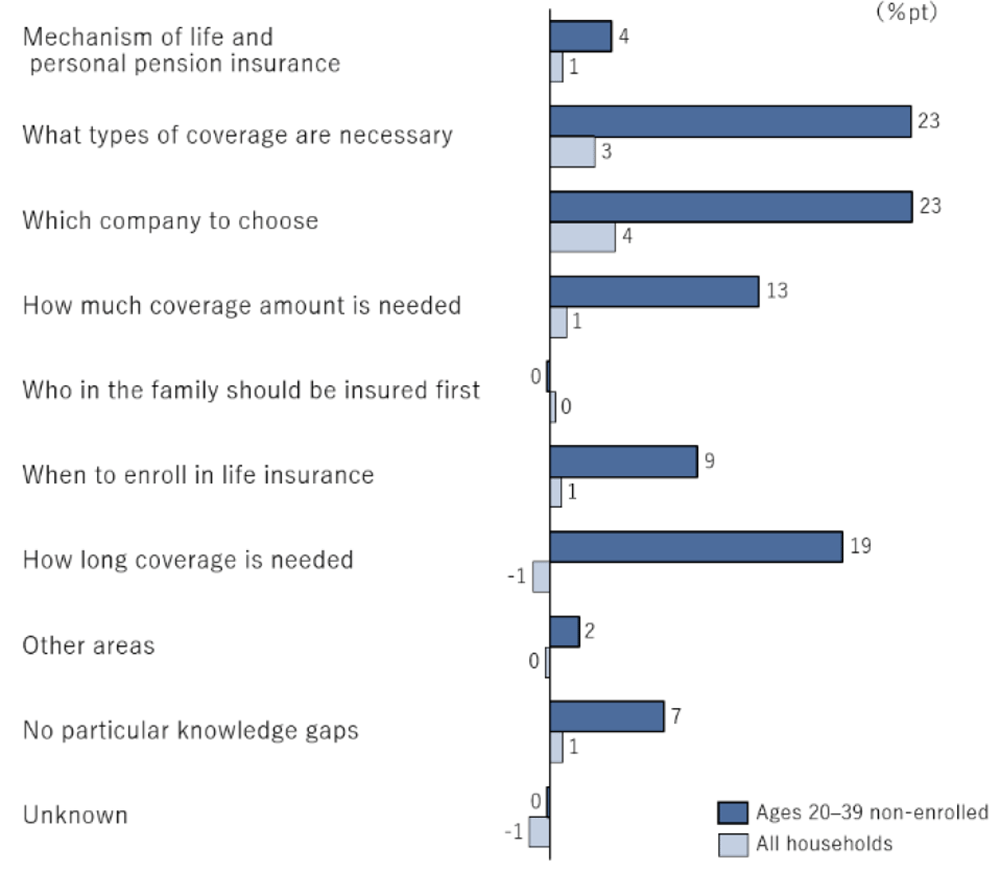
To examine this point, differences between the 2015 and 2024 surveys were reviewed for both younger non-participating households and all households, based on responses to the same question (see Figure 4).
Figure 4. Changes in Areas of Life Insurance Knowledge Considered Insufficient Among Younger Non-Enrolled Households (Difference Between 2024 and 2015, Multiple Responses)
Source: Compiled by Dai-ichi Life Research Institute from the Survey data
As shown in Figure 4, among younger households without life insurance, the proportion of respondents who consider their knowledge of life insurance to be insufficient has increased substantially from 2015 to 2024 across almost all areas, compared with the overall population.
In particular, the share of respondents indicating insufficient knowledge about “what kinds of coverage are necessary” has risen by more than 20 percentage points.
These results suggest that, even within the same group of younger non-participating households, the level of knowledge regarding life insurance has markedly deteriorated between 2015 and 2024.
The Importance of Reducing Non-Participation Among Younger Households
Throughout this report, we have examined the reasons for non-enrollment and the level of understanding of life insurance among younger households.
The findings suggest that younger households have less knowledge about life insurance than other age groups, and that this knowledge gap has been widening, potentially contributing to the rise in their non-participation rate.
Younger households constitute the core of future life insurance policyholders.
If the current trend among younger households becomes entrenched, it may lead to a higher overall non-participation rate across Japan in the future.
At present, Japan faces an era of rapid population aging and declining birth rates, making a fundamental review of the social security system unavoidable.
Under such circumstances, the importance of life insurance—a key instrument of self-help—is unlikely to diminish; rather, it is expected to increase.
Given this outlook, it is essential to accurately communicate the role and functions of life insurance to younger generations, among whom the non-participation rate has been rising, and to enhance their understanding of it.
Based on these findings, it is essential first to accurately communicate the role and functions of life insurance to younger generations, among whom the non-participation rate has been rising, and to deepen their understanding of it. To this end, the public and private sectors should work together to promote this effort.
Original in Japanese:
https://www.dlri.co.jp/report/dlri/534653.html
Disclaimer:
This report has been prepared for general information purposes only and is not intended to solicit investment. It is based on information that, at the time of preparation, was deemed credible by Daiichi Life Research Institute, but it accepts no responsibility for its accuracy or completeness.