




- Report Index
- The Four Processes to Improve Financial Well-being
What is Financial Well-being?
In recent years, the term “financial well-being (FWB)" has been gaining attention. Though it may sound unfamiliar, the meaning is simple: a state in which one feels financially secure and able to make life choices for the future with confidence.
For example, instead of being worried that "my household budget is in deficit again this month,” it is better to feel that “I can manage daily expenses, I am saving for the future and my children's education, and I also have a safety net for emergencies.” This sense of security is what lies at the heart of FWB.
In the United States and the United Kingdom, national-level initiatives are underway to enhance citizens' financial security. In Japan as well, the Japan Financial Literacy and Education Corporation (J-FLEC) was established in 2024 to raise the overall financial knowledge and behavior of the public.
The Four Pillars of FWB
FWB is not merely about being wealthy. It is a concept that includes both objective measures such as income and assets, and subjective feelings such as “Do I feel secure?", "Do I have fewer worries?", and "Do I have hope for the future?"
The U.S. Consumer Financial Protection Bureau (CFPB) describes FWB using four pillars:
- Being able to manage current living expenses properly.
- Being prepared for unexpected future events such as illness or unemployment.
- Having financial freedom to enjoy life—such as hobbies and travel.
- Feeling on track toward long-term goals such as buying a home, paying for education, or preparing for retirement.
In short, FWB is a state of having economic security and being able to make choices that allow one to enjoy life.
Financial Security Enhances Life Satisfaction
In 2025, the Financial Well-being Subcommittee of the Society of Well being conducted a nationwide survey of 11,022 people, establishing a unique “Japanese FWB Index." The survey quantified satisfaction with current and future asset building and planning. Results confirmed that individuals with higher FWB also reported higher life satisfaction.
This finding highlights an important truth: financial security forms the foundation of life. It directly influences mental ease and happiness. While increasing income and assets is important, enhancing FWB holds the power to positively transform our entire lives even more.
Four Processes to Improve FWB
So how can individuals improve their financial well-being? Research points to four key processes (Material): “learn, grasp, consult, and act."
Four Processes to Improve FWB
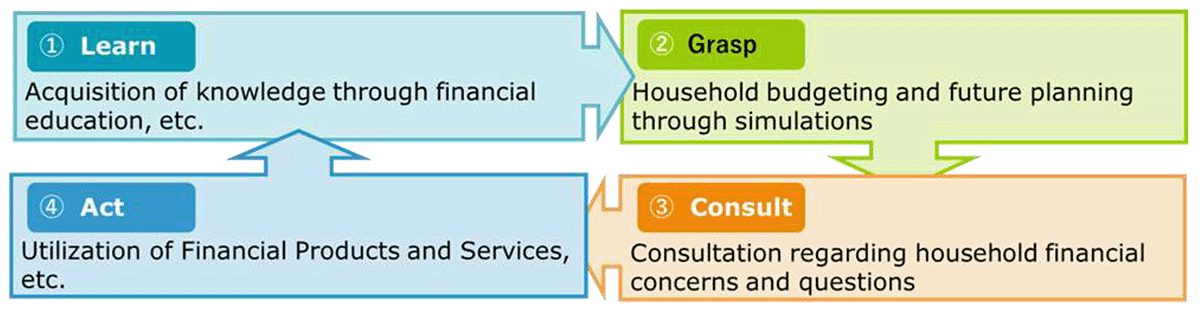
Source: Financial Well-being Subcommittee, Society of Well being (2025) "Q&A on Well-being & Financial Well-being: Achieving a Comfortable Relationship with Money"
- Learn: Acquire knowledge through financial education and information.
- Grasp: Understand your current situation by keeping a household budget or making a life plan.
- Consult: Seek advice from professionals or trusted people about financial concerns.
- Act: Take concrete steps such as saving, investing, or using insurance.
Surveys show that “learning” alone has little impact. Real improvements occur through "grasping” and “acting.” In other words, knowledge must be put into practice.
The Importance of National and Social Support
Improving FWB is not just about individual effort – society and government also play a vital role. For example, the UK has set ambitious goals: to increase the number of people aware of life planning for 5 million and to expand financial education for 2 million more children and young people by 2030.
In Japan, as part of the government's "Policy Plan for Promoting Japan as a Leading Asset Management Center”, J-FLEC is leading initiatives such as promoting financial education and offering personalized financial planning and counseling through certified advisors.
Individuals create life plans, supported by education and institutional frameworks, together form the dual engines that drive national well-being and sustainability.
Toward a Secure and Fulfilling Life
FWB is more than “studying money”—it is an opportunity to think about how we want to enjoy life and what kind of future we want to build.
- Manage today's living expenses responsibly.
- Prepare for unexpected risks.
- Make sure to allocate money for hobbies and learning as well.
- Progress steadily toward future dreams and goals.
By practicing these steps little by little, financial worries will ease, and people will gain a sense of "living life on their own terms."
FWB is not an abstract economic theory but a practical idea that supports everyday security and happiness. With the help of public policies and social systems, each individual's small actions can lead to a richer and more secure future.
【References】
- Financial Well-being Subcommittee, Society of Well being (2025) “Q&A on Well-being & Financial Well-being: Achieving a Comfortable Relationship with Money"
Original in Japanese:
https://www.dlri.co.jp/report/dlri/512897.html
Disclaimer:
This report has been prepared for general information purposes only and is not intended to solicit investment. It is based on information that, at the time of preparation, was deemed credible by Daiichi Life Research Institute, but it accepts no responsibility for its accuracy or completeness.