




- Report Index
- “Appropriate Price” and “Fair Price” in Japanese Rice Market
- DLRI Report
-
2025.07
“Appropriate Price” and “Fair Price” in Japanese Rice Market
Mei Makinouchi
"Appropriate Price" and "Fair Price"
In Japan, where the food self-sufficiency rate is 38%, and the number of full-time farmers has decreased by approximately one-third over the past 20 years, rising rice prices—the nation’s staple food—have sparked considerable debate. Retail prices for a 5kg bag have surged from 2,283 yen in June 2023 to 5,072 yen in June 2025, representing approximately a 2.2-fold increase. This development has been called the “Reiwa Rice Crisis.” (Material 1).
Material 1: Retail Price of Koshihikari Rice (5 kg) in Tokyo's 23 Wards

Source: Ministry of Internal Affairs and Communications, Statistics Bureau "Retail Price Statistics Survey"; compiled by Dai-ichi Life Research Institute
Material 1: Retail Price of Koshihikari Rice (5 kg) in Tokyo's 23 Wards
Source: Ministry of Internal Affairs and Communications, Statistics Bureau "Retail Price Statistics Survey"; compiled by Dai-ichi Life Research Institute
According to the Bank of Japan’s “Opinion Survey on the General Public’s Views and Behavior,” 55.9% of respondents reported that their lives “are becoming less comfortable,” while 96.1% feel the impact of rising prices. The subjective inflation rate experienced by consumers significantly exceeds the official Consumer Price Index, clearly highlighting the severity of the price burden on households (Material 2).
Material 2: Comparison of Perceived Inflation and the Consumer Price Index
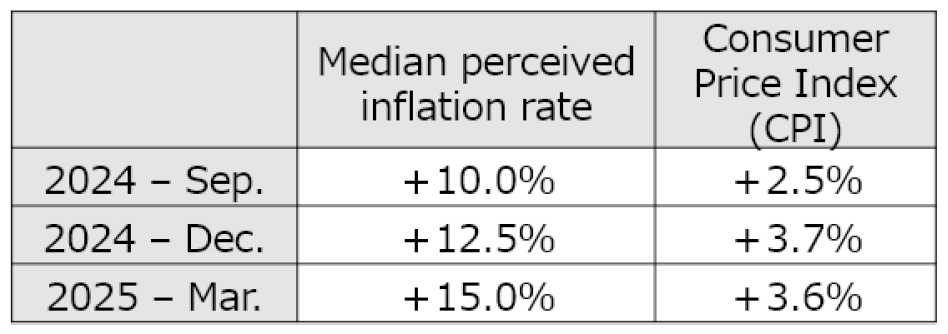
Source: Bank of Japan “Opinion Survey on the General Public’s Views and Behaviors” (101st round, March 2025) and Statistics Bureau Consumer Price Index (CPI); compiled by Dai-ichi Life Research Institute
Material 2: Comparison of Perceived Inflation and the Consumer Price Index
Source: Bank of Japan “Opinion Survey on the General Public’s Views and Behaviors” (101st round, March 2025) and Statistics Bureau Consumer Price Index (CPI); compiled by Dai-ichi Life Research Institute
The concept of “appropriate price,” lacks a universally accepted definition, as perceptions of it vary depending on the positions of consumers and producers. In such cases, it is essential to consider the concept of “fair price,” which, akin to fair trade, takes into account production costs and sustainability. The challenge lies in the lack of transparency in rice markets, making it difficult to grasp the actual price formation process.
Current Status of Production Costs and Cost Pass-Through
According to the Ministry of Agriculture, Forestry and Fisheries’ agricultural price index, the rice price index reached 156.9 in April 2025 (fiscal year 2020 = 100), while the agricultural production materials price index stood at 124.4, indicating progress in passing through production costs to prices (Material 3).
Material 3: Trends in Price Indices for Rice and Agricultural Production Inputs (2020 = 100)

Source: Ministry of Agriculture, Forestry and Fisheries “Agricultural Price Statistics Survey”; compiled by Dai-ichi Life Research Institute
Note: 2015–2023 are annual averages; 2024 figures are approximate; 2025 figures are monthly.
Material 3: Trends in Price Indices for Rice and Agricultural Production Inputs (2020 = 100)
Source: Ministry of Agriculture, Forestry and Fisheries “Agricultural Price Statistics Survey”; compiled by Dai-ichi Life Research Institute
Note: 2015–2023 are annual averages; 2024 figures are approximate; 2025 figures are monthly.
Government rice reserves released for price suppression are effective in reducing consumer burden in the short term. However, in the long term, they risk accelerating the weakening of food security through reduced farmer incomes. This has once again highlighted the structural challenges requiring attention to agricultural sustainability along with the need for scaling up and efficiency improvements.
Against this backdrop, it is important to consider not only appropriate price but also what constitutes fair price. The Food System Law enacted in June 2025 established frameworks for creating and publishing cost indicators and information disclosure in wholesale markets. Building on these measures, it has become urgent to construct fair and transparent price formation mechanisms and secure price levels that support sustainable agricultural reproduction for the realization of sustainable food systems.
Original in Japanese:
https://www.dlri.co.jp/report/dlri/485497.html
Disclaimer:
This report has been prepared for general information purposes only and is not intended to solicit investment. It is based on information that, at the time of preparation, was deemed credible by Daiichi Life Research Institute, but it accepts no responsibility for its accuracy or completeness.