



- Report Index
- Crisis of Diversity in U.S. Academia under the Trump Administration
- Flash Insight
-
2025.6
Crisis of Diversity in U.S. Academia under the Trump Administration
- Deciphering the Source of U.S. Competitiveness from Nobel Prizes in the Natural Sciences -
Masumi Ishizuki
1.DEI Setback under the Trump Administration and Frequent Visa Revocations for International Students at U.S. Universities
The Trump administration has made combating illegal immigration one of its top priorities, rapidly tightening immigration policies. This has also affected international students enrolled at U.S. universities. According to reports from May 2025, more than 4,700 international students have had their visas revoked since the administration took office (*1). In many cases, no specific explanation is given for these revocations, causing confusion and anxiety among students and university officials.
Behind this tightening are factors such as the expansion of campus protests against Israeli military actions in Gaza (*2) and the deepening of social and political divisions. The administration has ramped up unprecedented pressure on universities that allow pro-Palestinian demonstrations or implement DEI (Diversity, Equity & Inclusion) programs, including cutting grants and reconsidering tax-exempt status. It has taken a particularly hardline stance against elite institutions like Harvard University, warning of federal grant freezes if they do not comply with government policy (*3).
Universities have advised international students to refrain from traveling abroad (*4). Some institutions have made accommodations so that students contesting visa revocations can continue attending classes. The government has also occasionally indicated a willingness to temporarily reinstate visas, resulting in a fierce tug-of-war between universities and the administration (*5). Meanwhile, cuts to DEI-related research and educational funding are ongoing (*6), undeniably putting the diversity and academic freedom of U.S. universities at risk.
2.Is Diversity the Source of U.S. Academia’s Competitiveness? Insights from Nobel Prizes in the Natural Sciences
What has enabled U.S. academia to maintain its global competitiveness? Especially in the natural sciences, the U.S. has attracted outstanding researchers and students from around the world, fusing diverse backgrounds and perspectives to produce original and advanced research outcomes. According to data for the 2015–2024 Nobel Prizes in the three natural sciences (Physics, Chemistry, Physiology or Medicine), U.S. institutions accounted for an overwhelming 56.1% share, far exceeding the U.S.-born share of 34.2%. This is clear evidence of the country’s ability to attract top talent from abroad- “diversity” is unmistakably the key word. In fact, 38.6% of Nobel laureates affiliated with U.S. institutions during this period were born outside the United States.
A symbolic recent example is Dr. Katalin Karikó, who won the 2023 Nobel Prize in Physiology or Medicine. Born in Hungary, Dr. Karikó moved to the U.S. in search of a freer and more advanced research environment after conducting basic research in her home country. Her work on mRNA technology culminated in the development of mRNA vaccines during the COVID-19 pandemic, playing a crucial role in the global response. Dr. Karikó’s achievement symbolizes how U.S. academia has provided an environment where researchers from diverse backgrounds can realize their full potential, demonstrating to the world that diversity drives innovation.
Material 1: Country Share of Nobel Prizes in the Three Natural Sciences (2015–2024)
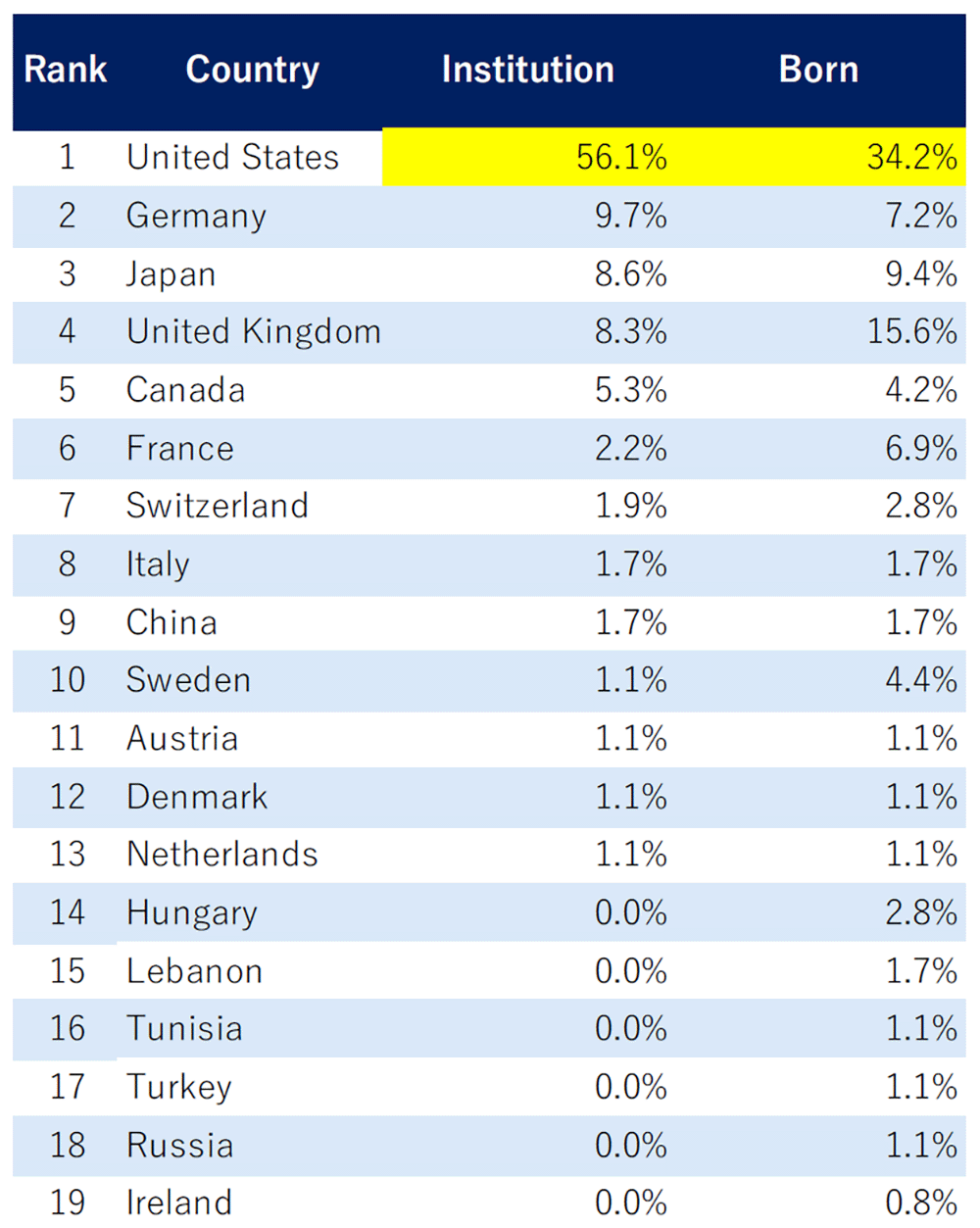
Note: Ranked by the share of research institutions at the time of the award. In cases of joint recipients, the prize is allocated according to the published share for each recipient. For example, if three recipients have shares of 1/2, 1/4, and 1/4, the calculation is made in accordance with those proportions. If the recipient was affiliated with institutions in two countries at the time of the award, the institution where the recipient was primarily based during the research is counted.
Source: Compiled by Dai-ichi Life Research Institute based on the Nobel Foundation website
Material 1: Country Share of Nobel Prizes in the Three Natural Sciences (2015–2024)
Note: Ranked by the share of research institutions at the time of the award. In cases of joint recipients, the prize is allocated according to the published share for each recipient. For example, if three recipients have shares of 1/2, 1/4, and 1/4, the calculation is made in accordance with those proportions. If the recipient was affiliated with institutions in two countries at the time of the award, the institution where the recipient was primarily based during the research is counted.
Source: Compiled by Dai-ichi Life Research Institute based on the Nobel Foundation website
3.Strong Correlation between Nobel Prize Institutional Shares and Citation Shares from 15–25 Years Ago
A scatter plot of the top 10 countries by Nobel Prize institutional share (2015–2024) and their share of top 10% cited papers from 2000–2002 shows an extremely strong correlation (correlation coefficient: 0.995). Even excluding the U.S. as a statistical outlier, the correlation remains strong at 0.887. However, the correlation with the most recent (2020–2022) citation shares drops significantly to 0.319, indicating that it often takes 15–25 years for research to be eventually recognized with a Nobel Prize.
As shown in the latest data, China now leads in top 10% citation share for 2020–2022, suggesting that the country rankings for Nobel Prizes could look very different in 15–25 years. In this context, any loss of diversity in U.S. academia could further undermine its competitiveness.
Material 2: Correlation between Country Share of Nobel Prize-Winning Institutions in the Three Natural Sciences (2015–2024, Top 10 Countries) and Country/Region Share of Top 10% Most-Cited Papers
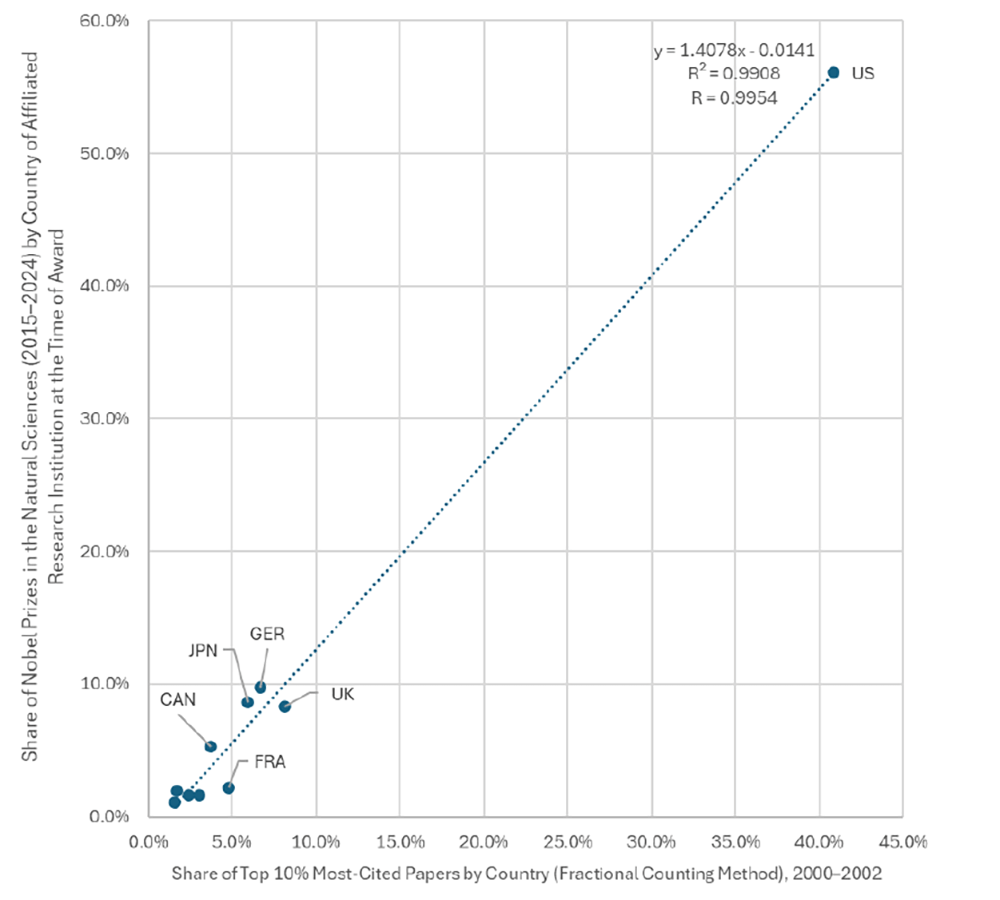
Source: Compiled by Dai-ichi Life Research Institute based on data from the Nobel Foundation website and the National Institute of Science and Technology Policy, Ministry of Education, Culture, Sports, Science and Technology (2024)
Material 2: Correlation between Country Share of Nobel Prize-Winning Institutions in the Three Natural Sciences (2015–2024, Top 10 Countries) and Country/Region Share of Top 10% Most-Cited Papers
Source: Compiled by Dai-ichi Life Research Institute based on data from the Nobel Foundation website and the National Institute of Science and Technology Policy, Ministry of Education, Culture, Sports, Science and Technology (2024)
Material 3:Share of Top 10% Most-Cited Papers in the Natural Sciences by Country/Region (2000–2002, 2010–2012, 2020–2022)
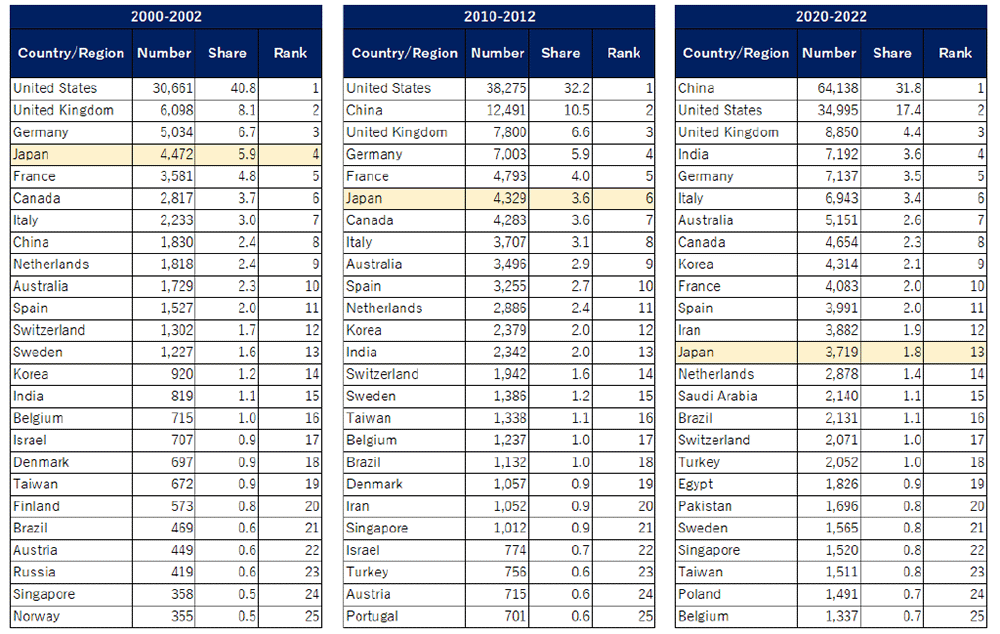
Note: Fractional counting method: For co-authored papers, contributions are allocated to each country based on weighted fractions.
Source: Excerpt from p.139 of the full report, "Science and Technology Indicators 2024," National Institute of Science and Technology Policy, Ministry of Education, Culture, Sports, Science and Technology (2024)
Material 3:Share of Top 10% Most-Cited Papers in the Natural Sciences by Country/Region (2000–2002, 2010–2012, 2020–2022)
Note: Fractional counting method: For co-authored papers, contributions are allocated to each country based on weighted fractions.
Source: Excerpt from p.139 of the full report, "Science and Technology Indicators 2024," National Institute of Science and Technology Policy, Ministry of Education, Culture, Sports, Science and Technology (2024)
4.Japan’s Declining Share of Scientific Publications and the Need for Proactive Talent Recruitment Amid Population Decline
Japan’s share of scientific publications continues to decline, while China and the U.S. dominate the international research landscape. Given the strong correlation between citation share and future Nobel Prizes, Japan faces a challenging outlook for Nobel recognition in the natural sciences.
This is due to multiple factors, including a shrinking pool of young researchers resulting from population decline, persistently low numbers of PhD graduates, and greater constraints on research funding and time compared to other countries. The U.S. has maintained its academic competitiveness by proactively accepting researchers and students with diverse values and backgrounds. The overwhelming share of Nobel laureates affiliated with U.S. institutions, regardless of birthplace, attests to this.
However, as noted earlier, the Trump administration’s stricter immigration policies and growing social divisions have led to a surge in visa revocations for international students, exposing a crisis of inclusivity and diversity in U.S. universities. Japan should learn from both the successes and current challenges of the U.S., and, even amid population decline, proactively welcome talented researchers and students from both domestic and international sources, building a research environment rich in diversity and inclusion. This will be essential for enhancing Japan’s overall scientific and economic strength.
[Annotations]
- NHK (May 2025).
- BBC (April 2024).
- CNN (May 2025).
- NBC (April 2025).
- BBC (April 2025).
- CNN (May 2025).
[References]
- National Institute of Science and Technology Policy, Ministry of Education, Culture, Sports, Science and Technology (2024). "Science and Technology Indicators 2024", NISTEP RESEARCH MATERIAL, No.341. DOI:https://doi.org/10.15108/rm341
Original in Japanese:
https://www.dlri.co.jp/report/ld/449046.html
Disclaimer:
This report has been prepared for general information purposes only and is not intended to solicit investment. It is based on information that, at the time of preparation, was deemed credible by Daiichi Life Research Institute, but it accepts no responsibility for its accuracy or completeness.