




- Report Index
- World Economic Outlook (May 2025)
- Economic Trends
-
2025.5
World Economic Outlook (May 2025)
Yoshiki Shinke, Seiji Katsurahata, Osamu Tanaka, Toru Nishihama
1. Japan Economy
Current state of the economy: The Japanese economy lacks a driving force
Real GDP(Quarter-on-Quarter Annualized Rate,Contribution)

Source: Cabinet Office.
The real GDP growth rate for Q1 2025 declined by −0.7% quarter-on-quarter on an annualized basis, marking the first negative growth in four quarters. This reflects, in part, a reaction to the positive growth seen in 4Q 2024. On average, it appears that Japan's economy continues its gradual recovery trend, but the pace of improvement remains extremely sluggish.
In Q1 2025, exports declined by -0.6% compared to the previous quarter, and imports increased significantly by +2.9% due to a backlash from the previous quarter, resulting in a large negative contribution from external demand of -0.8 percentage points, significantly lowering the growth rate. Exports were boosted in part by last-minute demand for automobiles to the United States, so this point needs to be discounted. Meanwhile, domestic demand increased by +0.6% over the previous quarter, but this was not enough to offset the negative impact on net exports. Domestic demand is also lacking in strength, with a large boost in inventory investment (annualized contribution rate of +1.3% points compared to the previous quarter) and personal consumption remaining almost flat compared to the previous quarter. Real wages have turned downward due to the rise in prices in Q1, especially for food products, and personal consumption has been weak.
In addition to weaker exports, personal consumption remained almost flat for the second consecutive quarter, highlighting a lack of momentum in both domestic and external demand. This indicates that Japan’s economy was already lacking a growth driver, even before the full implementation of the Trump tariffs.
Economic outlook: The economy is on the verge of recession
In 2Q 2025, the negative impact of the Trump tariffs is expected to become apparent, and the economy is expected to experience two consecutive quarters of negative growth. Although the additional reciprocal tariffs have been temporarily suspended, the basic tariff rate of 10% remains in place, and item-specific tariffs—such as the 25% rate on automobiles—are being maintained. In addition to the likely decline in exports to the U.S., particularly automobiles, exports to countries other than the United States are also expected to remain weak in light of the anticipated slowdown in the global economy. Furthermore, with the rapid and frequent changes in the tariff environment, uncertainty about the outlook has increased significantly, which is likely to result in restrained capital investment both domestically and overseas. In addition, real wages are expected to continue declining in 2Q, mainly due to rising prices, and consumer sentiment is deteriorating. As a result, personal consumption is likely to remain subdued following the stagnation observed in 1Q.
For FY2025, we forecast real GDP growth at +0.4%, and for CY2025 at +0.7%. However, excluding the statistical carryover effect, growth for FY2025 is expected to be just +0.1%, and for CY2025, −0.1%, meaning both are likely to be essentially flat. Owing to the impact of Trump’s tariffs, the Japanese economy is expected to stagnate and remain below its potential growth rate in 2025. While a sharp recession is not our main scenario, a downturn cannot be ruled out depending on the extent of downward pressure from the tariff situation.
Amid pronounced downward pressure on the economy, one of the few supporting factors is the anticipated deceleration of inflation. While inflation will remain high in the near term, the upward pressure on costs is expected to gradually lighten due to falling crude oil prices and stabilization of the yen. Government measures to mitigate rising prices should also help curb inflation. As prices moderate, real wages are projected to turn positive from autumn 2025 onwards. Consequently, personal consumption is expected to increase moderately, and we anticipate that the Japanese economy will narrowly avoid slipping into recession.
The economy is expected to recover moderately in FY2026. In the United States, the Federal Reserve is expected to resume interest rate cuts in the second half of 2025 to counter the economic slowdown and a weakening labor market, which will, with a lag, help support growth in 2026. Tax cuts should also provide a boost to the U.S. economy. As U.S. economic conditions stabilize, Japanese exports are expected to rebound, helping to halt the deterioration in corporate earnings. For the 2026 spring wage negotiations, wage growth is expected to slow substantially compared with 2025, reflecting weaker earnings in FY2025 and slower inflation. However, structural factors such as persistent labor shortages are likely to result in some degree of wage growth. With inflation projected to remain below +2%, real wages are expected to maintain a moderate upward trajectory
Japan's Economic Outlook
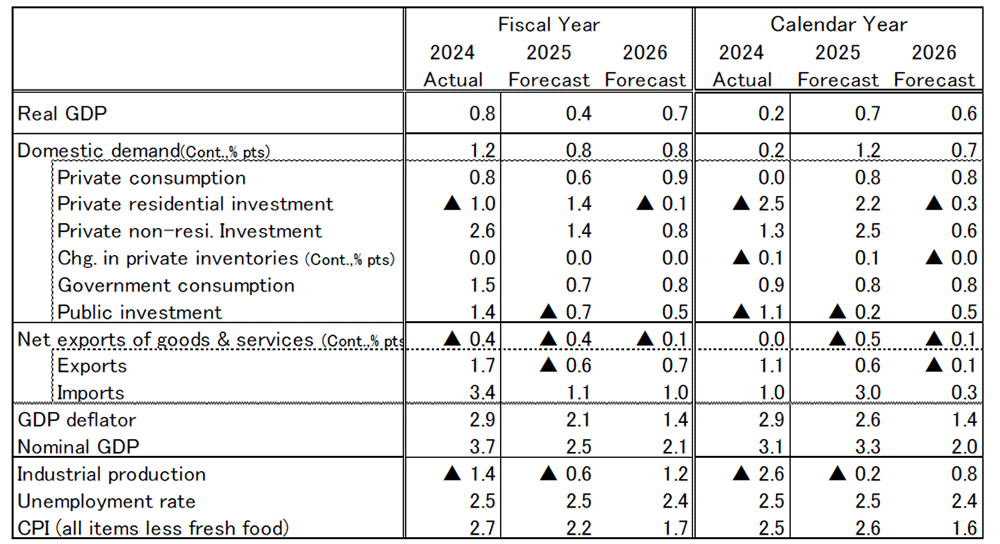
Note: Forecasts are by the Dai-ichi Life Research Institute.
Source: Cabinet Office, Ministry of Economy, Trade and Industry, Ministry of Internal Affairs and Communications.
Japan’s Economic Outlook(Quarterly)
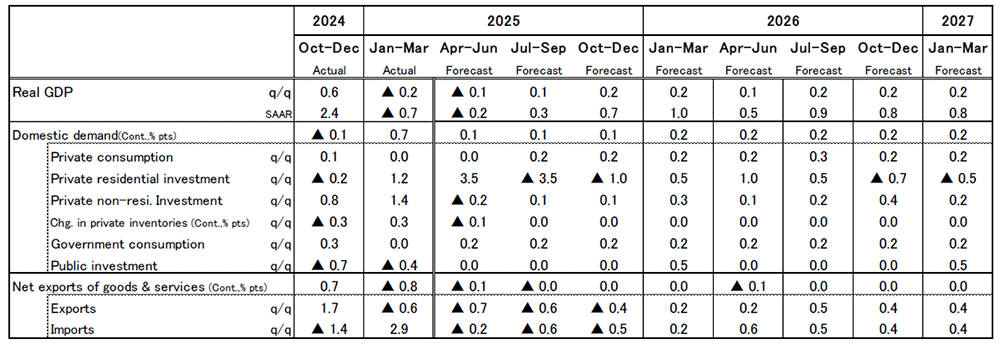
Note: Forecasts are by the Dai-ichi Life Research Institute.
Source: Cabinet Office.
2. US Economy
Current state of the economy: Economy and labor market remain strong amid growing uncertainty
In the US, the economy and labor market remain strong and inflation is reluctant to fall amid growing uncertainty over Trump 2.0 policies. Real GDP growth rate (initial estimate) for 1Q 2025 was -0.3% quarter on quarter annualized rate (+2.4% quarter on quarter annualized rate for 4Q 2024), the first negative growth since 1Q 2022, -1.0% quarter on quarter annualized rate. However, negative growth in 1Q 2025 was due to a surge in imports due to a rush to buy before tariffs were imposed and a temporary downturn in personal consumption due to a snowstorm, while private domestic final demand grew at a high rate of +3.0% quarter on quarter annualized rate due to expansion of capital investment, and the US economy is judged to have remained strong.
Looking at the economic situation in 2Q 2025, the ISM Business Confidence Index showed that the manufacturing sector in April was 48.7 (49.0 in the previous month), below the 50 mark, which is the dividing line between expansion and contraction, for the second consecutive month, indicating a contraction in the US manufacturing sector. Meanwhile, the non-manufacturing sector rose 0.8 points from the previous month to 51.6 (50.8 in the previous month). However, in response to the disruptive policy management of Trump 2.0, companies have become more cautious, and the non-manufacturing sector is on a gradual slowdown trend. In this environment, the labor market maintained high growth in nonfarm payrolls in April, up 177,000 from the previous month (up 185,000 from the previous month). The government sector increased despite a decrease in the number of federal government employees, and the private sector maintained high growth, up 167,000 from the previous month. In addition, the trend of employment growth accelerated with the three-month moving average increasing by 155,000 from the previous month (133,000 from the previous month) and the six-month moving average increasing by 193,000 from the previous month (171,000 from the previous month), maintaining a steady pace. Furthermore, the unemployment rate in April was 4.2% (4.2% in the previous month), which is gradually rising from the bottom of 3.4% in April 2023, but it still remains at a low level, indicating a good and stable labor market.
In terms of inflation, the upward momentum of the core CPI fell significantly in April to +2.1% on an annualized basis compared to three months ago (+3.0% in the previous month), but is expected to rise from May onwards due to the impact of the tariffs, and remains at a high level of +3.0% on an annualized basis compared to six months ago (+3.0% in the previous month), indicating a reluctance to lower inflation.
At the FOMC meeting held on May 6th and 7th, the Fed unanimously decided to keep the policy interest rate unchanged for the third consecutive meeting and to maintain the FF rate target range at 4.25% to 4.50%. It also decided to continue the balance sheet reduction policy. Fed Chairman Powell emphasized that the economy and labor market are in good condition, saying, "Despite increasing uncertainty, the economy remains strong, and the labor market is at or near maximum employment." Regarding inflation, he maintained his view that "the inflation rate has fallen significantly but remains slightly above our long-term target of 2%." In this situation, the Fed explained that Trump 2.0 has further increased uncertainty about the economic outlook, and the risk of increased unemployment and accelerating inflation has increased and indicated that it is appropriate to wait and see for the time being.
US labor situation
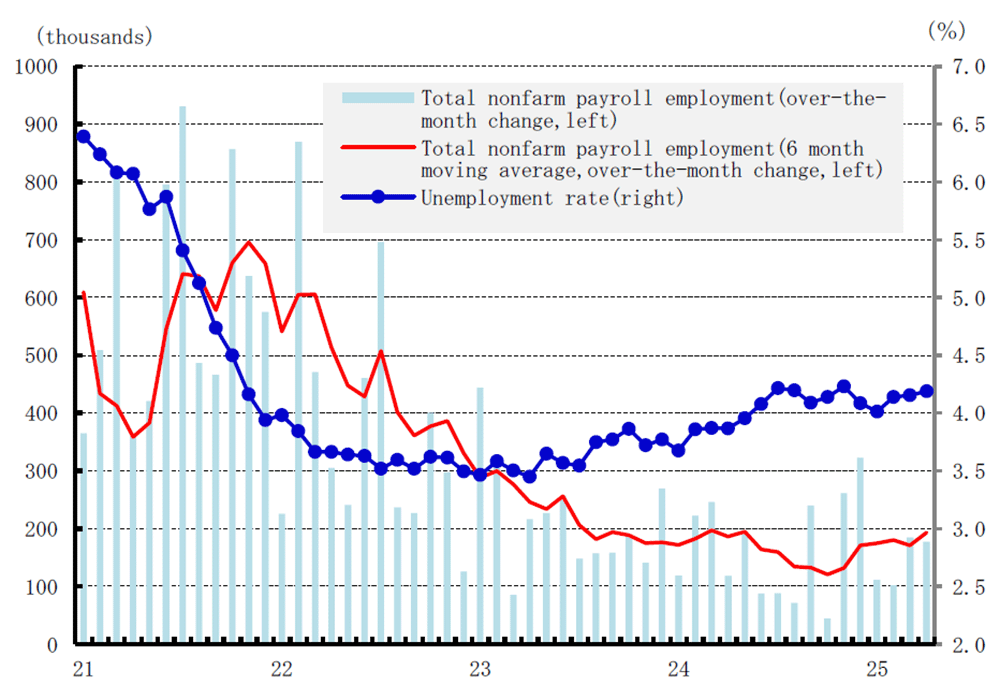
Source: US Department of Labor
US core CPI
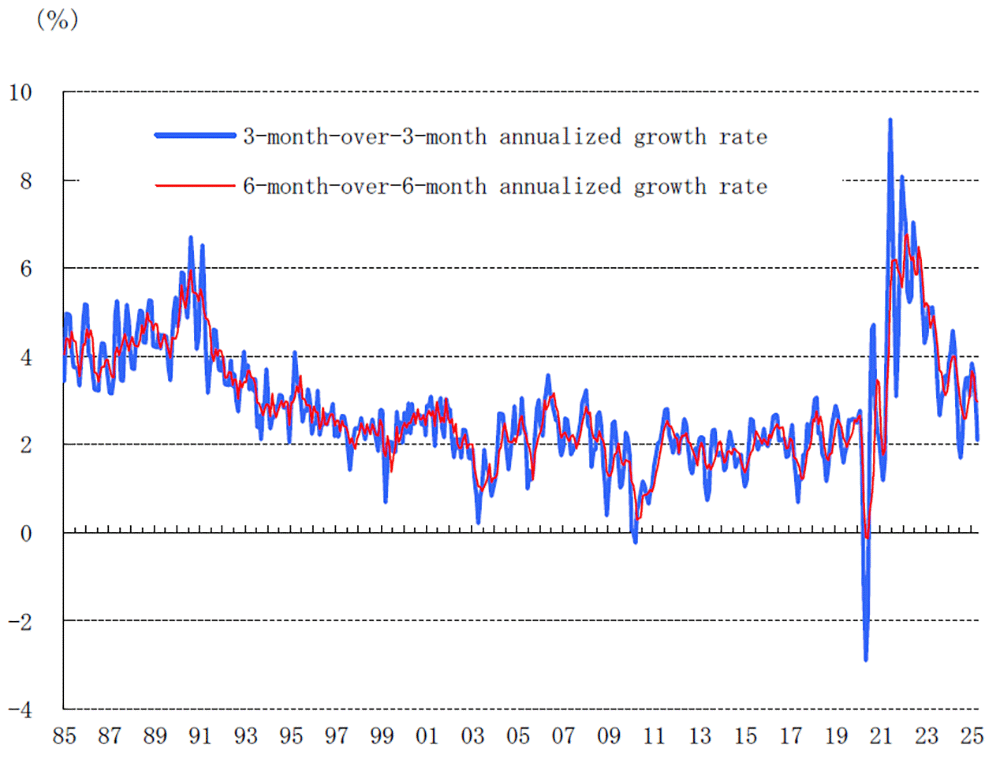
Source: US Department of Labor
Economic Outlook: Trade agreements with other countries to avoid recession
In the Trump 2.0 tariff policy, in February, a 25% tariff was imposed on some imports from Canada and Mexico, and a 10% tariff was imposed on imports from China. In March, an additional 10% tariff (total of 20%) was imposed on China, and a 25% tariff was also imposed on steel and aluminum imports. In April, a 10% reciprocal tariff and a 25% tariff on automobile imports were imposed, and an additional 125% tariff was imposed on imports from China. However, the additional reciprocal tariff was suspended for 90 days until July 9th. In May, while tariffs were imposed on automobile parts, the United States and the United Kingdom agreed to trade negotiations that included tariff reductions and increased imports, and both the United States and China agreed to a 115% tariff reduction and a 90-day suspension of the 24% reciprocal tariff until August 12th, and there were positive developments in trade negotiations. In the future, tariffs are planned for pharmaceuticals, semiconductors, copper, lumber, etc., and although increasing uncertainty remains, many countries are expected to have no choice but to make unfair trade agreements with the United States, like the UK, in order to avoid tariffs or reduce tariffs that have already been imposed, toward the July 9 deadline for the suspension of reciprocal tariffs, and we can expect an expansion of U.S. agricultural and energy exports. In addition, although there is a high possibility that a 24% tariff will be imposed due to no progress in negotiations between the United States and China, price hikes and supply cuts will be avoided by indirect exports from China via countries that have avoided the tariffs.
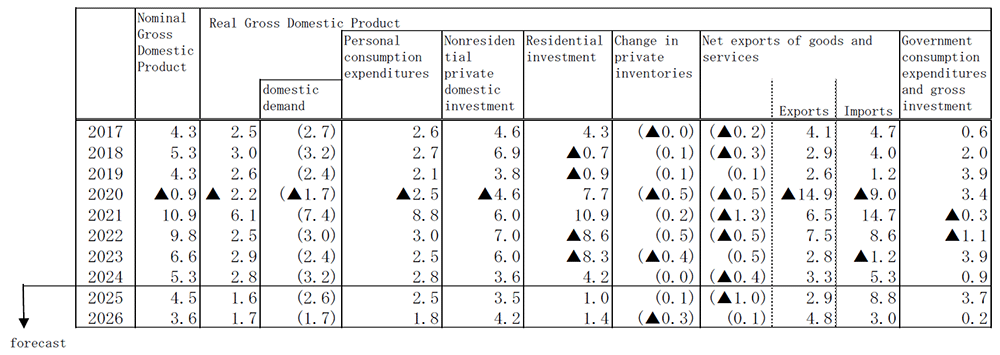
In the 2Q 2025, capital investment is expected to slow down due to increasing uncertainty. On the other hand, imports are expected to decline due to a reaction to the sharp increase before the Trump tariffs were imposed, boosting GDP. In addition, although personal consumption will slow down due to the impact of rising prices, it is expected to accelerate to the high +2% range in the 2Q 2025 due to the high growth in March. As a result, real GDP for the 2Q 2025 is expected to grow from the previous quarter.
In the second half of the year, capital investment is expected to expand moderately as uncertainty due to the trade agreement eases. On the other hand, despite an increase in asset balances and a fall in borrowing costs, growth in personal consumption is likely to be restrained due to slowing employment and income growth and rising prices, and the U.S. economy is likely to slow to a growth rate below its potential growth rate.
Fed Chairman Powell is expected to maintain a hawkish stance to assess the impact of the tariffs on inflation and is likely to continue to wait and see until August when uncertainty about tariff policy will decrease. However, if a significant economic slowdown or a softening labor market becomes evident, interest rate cuts are expected to resume in July.
US economic outlook (YoY,%)
Source: US Department of Commerce,Our forecast
Note: Contribution is in parentheses
3. Eurozone Economy
Current state of the economy: Fiscal turnaround raises expectations of recovery
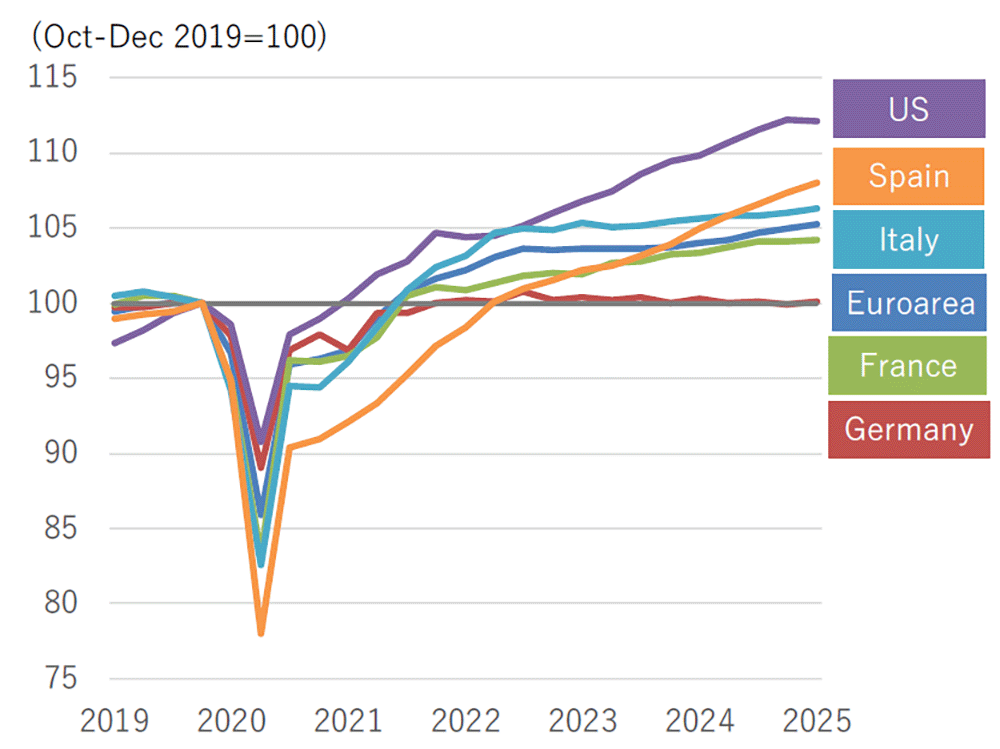
Over the past few years, the eurozone economy has remained stagnant, with Germany, the largest country in the region, dragging its feet while southern European countries such as Spain and Portugal have continued to expand strongly. In Southern European countries, economic expansion has been supported by a recovery in travel demand after the outbreak of the new coronavirus has been contained, as well as by contributions from the Recovery Fund, which provides financial resources to EU member states for the post-Covid economic recovery. On the other hand, in Germany, the discontinuation of the use of Russian energy resources following the Russian invasion of Ukraine has resulted in high energy prices, loss of industrial competitiveness and hollowing out of the country. In France, the worsening fiscal situation and the instability of the political environment have also affected economic activity, with the economy putting the brakes on after the special demand for the Paris Olympics fell off. While annual growth in 2024 remains solid with +3.2% for Spain, +1.9% for Portugal and +2.3% for Greece, Germany recorded negative growth for the second year in a row at -0.2%, while France also recorded only moderate growth at +1.2%. The euro area posted +0.9%, below its potential growth rate.
With the Trump administration's reluctance to support Ukraine in the US, European countries are being asked to play a more active role in supporting Ukraine and defending the region. European countries are now seriously considering increasing their defence spending, and the EU has decided to exclude defence spending from the scope of fiscal rule. Among other things, Germany, which has traditionally emphasised fiscal discipline, has steered a major shift in fiscal policy, and there is a growing view that fiscal expansion will support economic recovery. Germany, which held Bundestag elections ahead of schedule in February following the collapse of the coalition government, began amending a constitutional provision after the election that requires the balanced budget (debt brake), enabling an increase in spending on defence, infrastructure-related and climate change measures.
During this period, consumer prices in the euro area, which had previously been hit by historically high inflation, have fallen to the low 2% range year-on-year. In response to subdued inflation, the European Central Bank (ECB), which is responsible for monetary policy in the region, began cutting interest rates in mid-2024 and has continued to cut rates in smaller increments since then. The ECB sees a neutral interest rate of around 1.75-2.25% that will neither overheat nor suppress the eurozone economy. Additional rate cuts in April brought the lower policy rate (deposit facility rate) to 2.25%, reaching the upper limit of the ECB's assumed neutral rate.
Real GDP in Major Advanced Countries/Regions
Source: Dai-ichi Life Research Insitute
Conumer Prices in Euroarea (YoY)
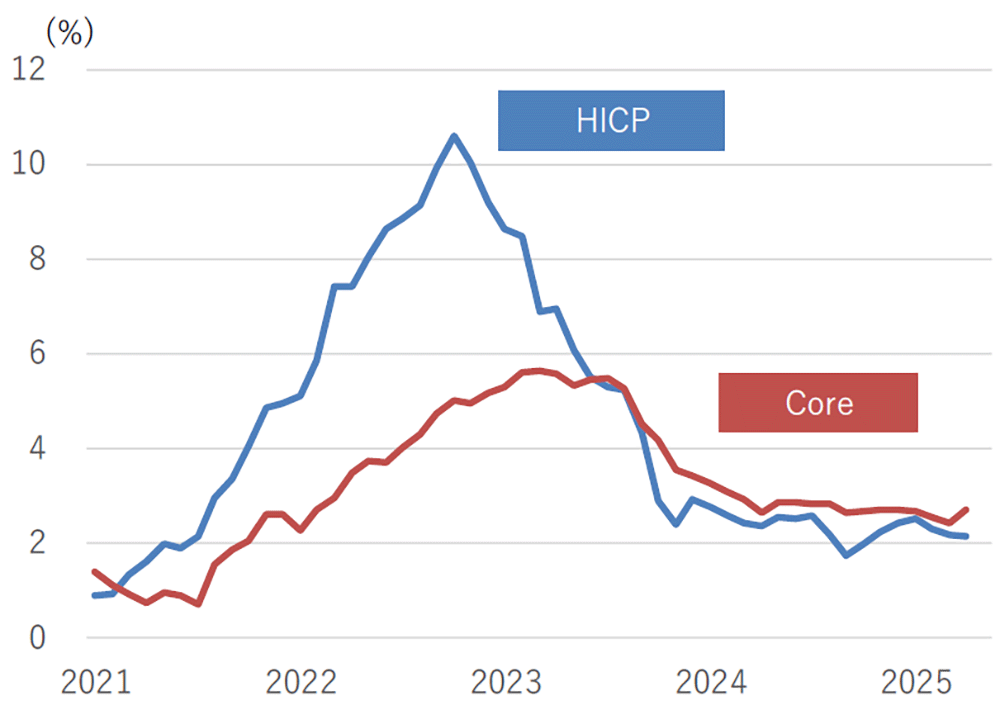
Note: Core prices exclude energy, food, alochol, and tobacco.
Source: Eurostat, Dai-ichi Life Research Insitute
Economic outlook: US tariff hikes to put a brake on the economy
The US Trump administration has announced its intention to impose reciprocal tariffs of 20% on EU countries and sector-specific tariffs of 25% on steel, aluminium, automobiles and their parts. The EU is the second largest trade deficit partner of the US after China, and talks on tariff reductions are expected to be difficult. The EU intends to prioritise negotiations with the US on tariff reductions but is also preparing for retaliatory measures in the event of a breakdown of negotiations. There is a growing likelihood that exports to the US will be sluggish due to higher tariffs on pharmaceuticals, automobiles, chemical products and other products.
Looking ahead, the economy is expected to slow down again in the second half of 2025, as the deteriorating export environment caused by the tariff hikes will put downward pressure on the economy. Thereafter, the economy is expected to return to a moderate recovery path as economic activity, which had been held back, resumes following the agreement on tariff talks between the US and the EU. The combination of subdued inflation and rising wages, with households' real purchasing power beginning to improve, and the pervasive effect of the ECB's interest rate cuts, will also support the economic recovery. Annual growth in the euro area in 2025 is expected to be only +0.8% due to the economic slowdown in the second half of the year. Entering 2026, increased defence spending and other fiscal spending will boost the pace of quarterly growth, but annual growth will accelerate only slightly to +0.9%, as low growth in the second half of 2025 lowers the starting point for 2026.
The ECB is likely to continue to cut interest rates to support the economy in the near term, while monitoring the negative impact of tariffs and the course of talks between the US and the EU. With an escalation of retaliatory measures between the US and China averted, uncertainty is receding, and we expect the ECB to take a wait-and-see approach after cutting its policy rate to 1.75%.
Euroarea Purchasing Mangers Index (PMI)
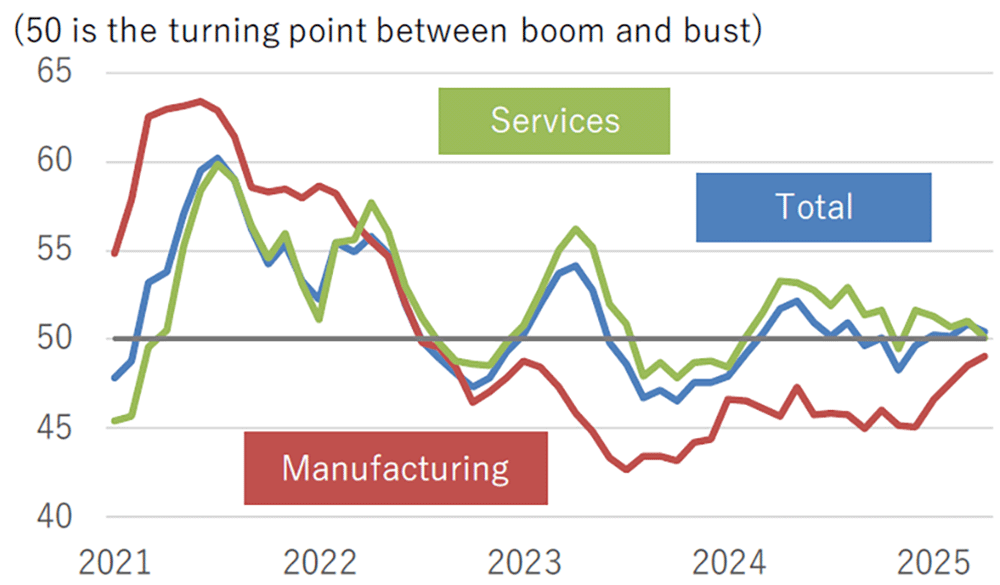
Note: Total is a composite of the mfg output and the services PMI.
Source: S&P Global, Dai-ichi Life Research Institute
Euroarea Purchasing Mangers Index (PMI)
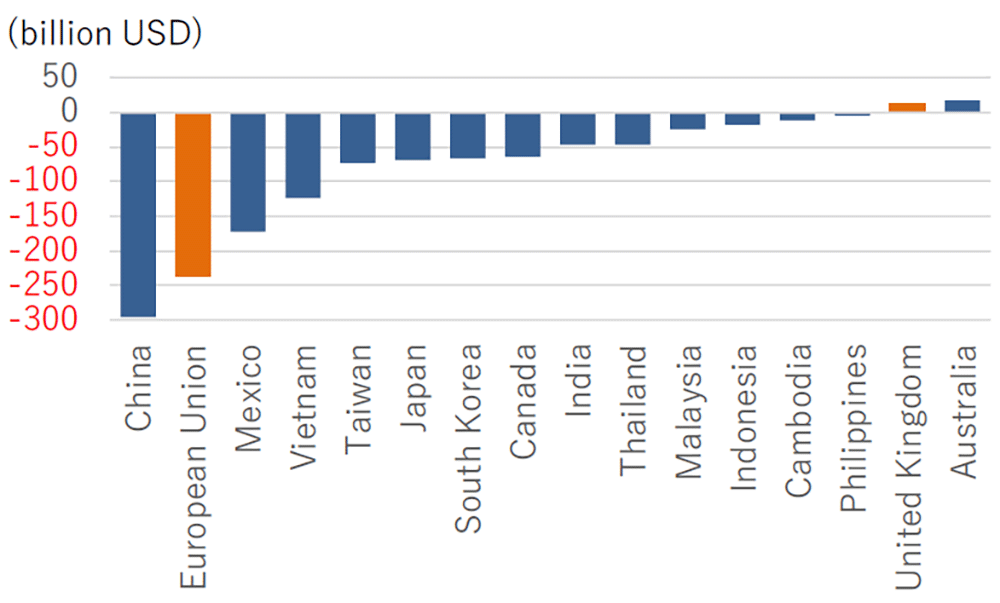
Source: US Census, Dai-ichi Life Research Institute
outlook of the Euroarea Economy (YoY,%)
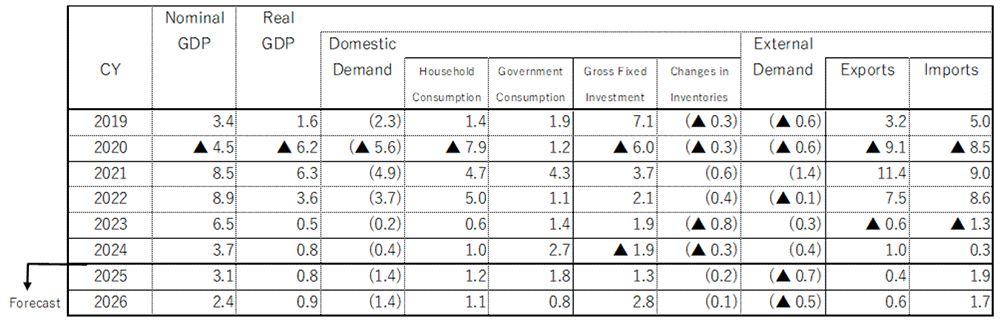
Note: Figures in brackets are contributions to real GFP growth.
Source: Dai-ichi Life Research Institute
4. China and Emerging Asian Economies
Current state of the economy: Asian Countries Face Uncertainty due to “Trump Tariffs”
Despite concerns over the negative impact of escalating US-China trade tensions, Chinese economy showed resilience in the first quarter. The real GDP growth rate stood at +5.4%(YoY) and +4.9%(QoQ annual rate), confirming steady performance. Since the latter half of last year, the Chinese government has stepped up efforts to stimulate domestic demand, through promoting the replacement of durable consumer goods and encouraging capital investment. In addition, the Chinese government has shifted its monetary policy for the first time since the global financial crisis, reflecting its strong intention to support the economy. At the National People's Congress in March, amid growing concerns about further deterioration in US-China relations and increasing uncertainty to external demand, the government reaffirmed its commitment to mobilize both fiscal and monetary policies to boost domestic demand.
In addition, US has imposed additional tariffs on Chinese imports for addressing the fentanyl problem. This prompted a rush in exports to the US ahead of further tariff hikes, which is considered to support the economic performance. However, it is important to note that recent efforts to stimulate domestic demand may simply be pulling future demand forward, especially given the sluggish recovery in employment and lingering concerns about asset deflation stemming from a sluggish real estate market.
In Asian economies other than China, they have been facing the inflationary pressure, particularly stemming from rising prices of essential goods like food, in recent years. However, the situation has changed, and inflation in Asian countries has remained moderate. As a result, worries about declining real purchasing power for households have diminished. Furthermore, in international financial markets, uncertainty over the Trump administration’s tariff policies has contributed to a weakening of the US dollar. This marks a significant shift from the past few years, during which a strong US dollar and corresponding local currency depreciation had served as a barrier to interest rate cuts. Therefore, there is room for monetary easing for central banks in Asian countries.
On the other hand, Asian countries, especially ASEAN bordering China, have benefited from the escalation in US-China trade tensions by increasing their exports to the US through acting as alternative routes for Chinese goods. However, in an effort to block such circumvention, the US has indicated plans to impose high reciprocal tariffs on many Asian countries. In some of these countries, last-minute export surges similar to those seen in China have also provided short-term economic support. However, rising uncertainty over external demand is dampening business investment and raising employment concerns, which in turn is weighing on personal consumption. As a result, some countries are starting to see economic slowdowns even before the Trump tariffs are fully implemented. It should be noted that these differences over the current economic situation may be influenced by differences in the degree of macroeconomic impact of the Trump tariffs.
Export to the US/Nominal GDP Ratios and Reciprocal Tariff Rates among Asian Countries
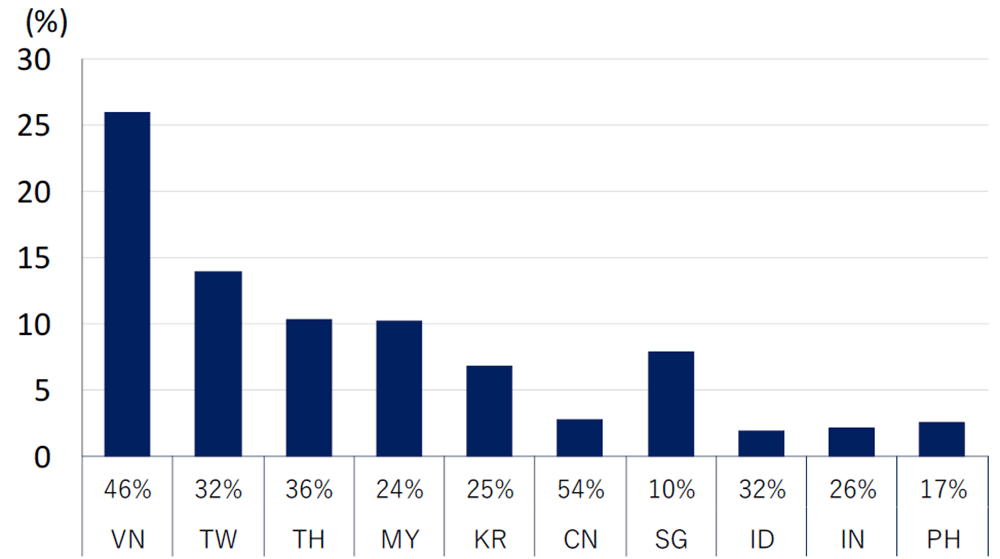
Source: CEIC and IMF. From the left side, the degree of influence is higher. Reciprocal tariffs combining both the standard and deferred amounts.
Economic Outlook: Worst-Case Scenario Averted by trade talks, but Volatility remains
At the beginning of the year, the Chinese economy experienced a temporary boost in external demand due to a rush in exports to the US ahead of the implementation of Reciprocal tariffs. This has raised concerns about a subsequent backlash that could weigh on external demand. However, recent export movements show that while exports to the US have sharply declined, increased exports to non-US destinations have offset the impact. At the National People’s Congress in March, the government signaled its intent to diversify export destinations based on further trade tensions between US and China. With little prospect of resolving Chinese overcapacity problem, China will continue to actively pursue its strategy of diversifying its exports.
US and China had once entered a “trade war”, imposing high tariffs, up to 145% by the US and up to 125% by China. However, after the trade talk held in May, they reached an agreement to lift retaliatory measures. As a result, the US has abolished the retaliatory tariffs and has suspended the top-up portion (24%) of the reciprocal tariffs (34%) for 90 days. In addition, China will also suspend its top-up (24%) of retaliatory tariffs (34%) on US reciprocal tariffs for 90 days. And, during which time the US and China will proceed with trade talks. Accordingly, the US tariff rate will remain at 30% (additional tariffs implemented to combat fentanyl problem (20%) + basic portion of reciprocal tariffs (10%)), and China's at 10% for the time being, suggesting that the immediate impact of tariffs will be relatively limited.
Looking ahead, it is expected that the decline in exports to the US will bottom out due to the agreement with the US and China, while exports to other countries will continue to grow. Moreover, the Chinese government plans to sustain efforts to stimulate domestic demand, including personal consumption and capital investment. Consequently, the government is expected to further strengthen its policy measures toward achieving its annual growth target of around 5%.
As for other Asian countries, the US has indicated an intention to impose relatively high reciprocal tariffs preventing an effort of Chinese entities to prevent circumvention of US tariffs. While the US has suspended the additional tariffs for 90 days and is conducting bilateral trade talks with each country, there are reports that negotiations with some countries are progressing ahead of schedule. However, given that the US has reached a basic agreement with the UK and unexpectedly agreed to resume negotiations with China, the urgency for concluding talks with other nations may have diminished.
For countries heavily dependent on exports to the US, the imposition of full reciprocal tariffs could have significant macroeconomic consequences and severely impact their economies. On the other hand, even for countries with relatively low dependence on US exports, the risk of "exported deflation" from increasing imports from China is rising. As a result, they may face the price competitive pressures with China.
In countries with high dependence on domestic demand, slowing inflation and a pause in the strengthening the US dollar are expected to expand room for interest rate cuts and other moves to support the economy. On the other hand, it should be noted that in many emerging Asian economies, post -pandemic fiscal situation in each country has deteriorated, and limited room for fiscal spending may constrain the economic recovery.
Economic Growth Rates in China, India, NIES, and ASEAN5 Countries
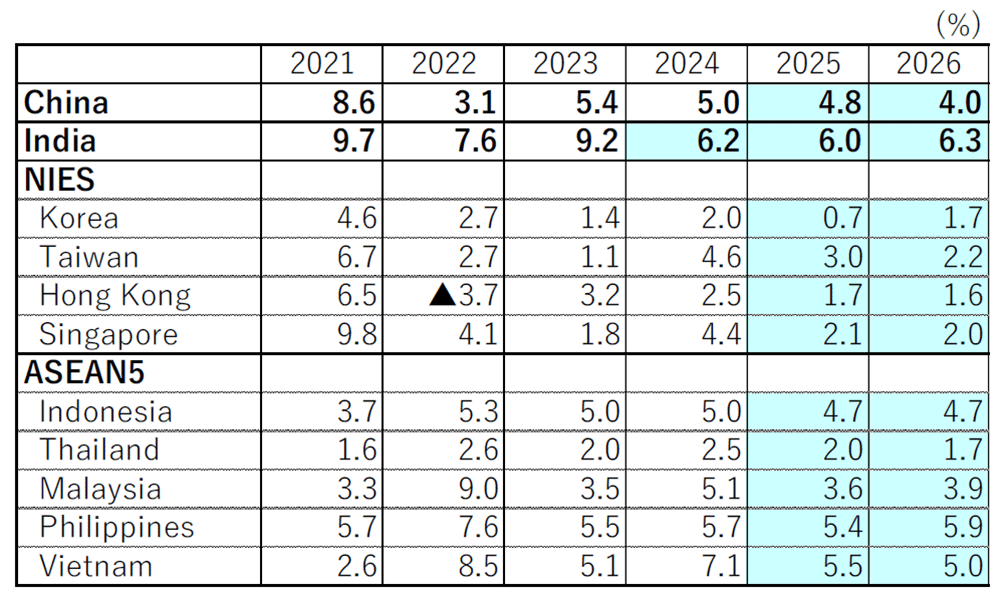
Source: CEIC data. The light blue areas indicate our forecasts. For India, data are based on the fiscal year (From April to March).
Original in Japanese
Disclaimer:
This report has been prepared for general information purposes only and is not intended to solicit investment. It is based on information that, at the time of preparation, was deemed credible by Daiichi Life Research Institute, but it accepts no responsibility for its accuracy or completeness. Forecasts are subject to change without notice. In addition, the information provided may not always be consistent with the investment policies, etc. of Daiichi Life or its affiliates.