




- Report Index
- My visit to the second floor of the Helsinki Central Library
- Illuminating Tomorrow
-
2025.02
My visit to the second floor of the Helsinki Central Library
Longing for open, exciting and useful public facilities in Japan
Masaaki Shigehara
The second floor of Helsinki Central Library (Oodi)
In September 2024, I visited Helsinki, Finland, on my way to an international conference. On that trip, I visited the Helsinki Central Library, known as “Oodi” (Material 1).
Oodi stands right next to Helsinki Central Station, facing the Parliament Building across the square. Although it is a facility of the City of Helsinki, it was built with government support as a project to commemorate the 100th anniversary of Finland's independence, and opened on Finnish Independence Day, December 5, 2018. The unique building has become a tourist attraction, and when I visited, I saw many groups of children passing by, presumably on a school trip.
Material 1: Panoramic view of Helsinki Central Library ( Oodi )
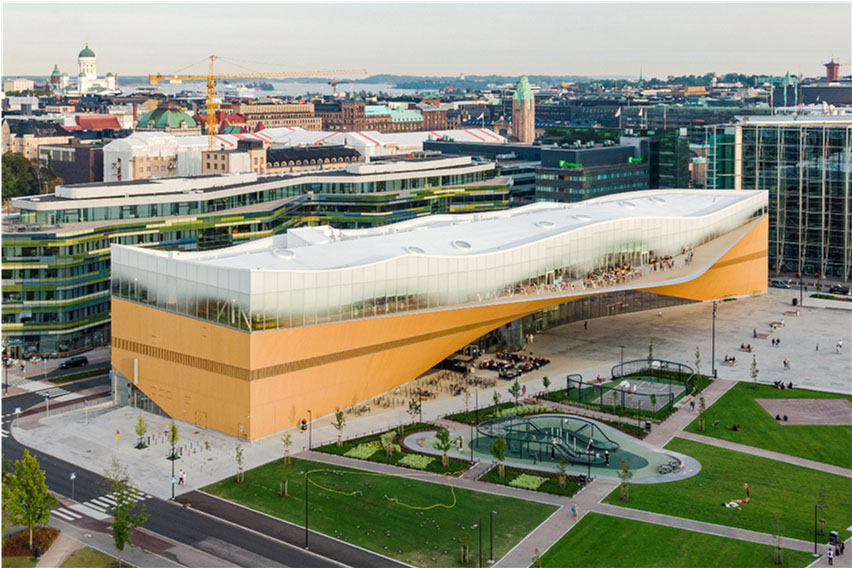
(Note) The Parliament Building is on the right side of the foreground square.The brown square tower a little to the right behind Oodi is Helsinki Central Station
(Source) Kuvio / City of Helsinki
Material 1: Panoramic view of Helsinki Central Library
( Oodi )
(Note) The Parliament Building is on the right side of the foreground square. The brown square tower a little to the right behind Oodi is Helsinki Central Station
(Source) Kuvio / City of Helsinki
The building has three floors. The reception, tourist information desk, video hall, and multipurpose hall are on the first (or ground) floor. The second floor is a social education facility with workspaces, a music studio, and machines such as 3D printers. The third floor is an open-shelf library.
Oodi is not only unique in its appearance, but also its interior. There were many surprising and funny experiences, such as the large ramps on both ends of the third floor, the self-driving robots that carry books intelligently and slowly between the bookshelves, and the unisex private toilets (Note 1). In this report, however, I will write about the second floor of Oodi from the perspective of a social education facility.
A corridor where 3D printers and other equipment are placed casually
The center of the second floor is a wide corridor, with various manufacturing machines such as 3D printers and large-format printers lined up on both sides, each with its own instruction manual. You can also find a large desk with sewing machines. Users seem to be using these machines in their own way to create what they want. Oodi calls this space Kaupunkiverstas (Urban Workshop).
According to the Oodi homepage, the items listed in Material 2 can be used at Oodi.
Material 2: Equipment at Oodi
(Source) Quoted from the Oodi official website (notes in parentheses by the author)
Though it is not listed on the Oodi official website, there was a variety of mannequins, including children's. I got the impression that Oodi has everything you need when you want to make something. In other words, it feels like you can find here things that are useful but cannot own personally.
Many of them are lined up in the open space of the corridor. Laser cutters and other machines that are subject to noise and odors seem to be in separate rooms, but many of the machines are lined up in the corridor, and visitors are forced to see them whether they are interested in them or not. The corridor is designed to naturally allow visitors to become familiar with the latest technology.
Another thing that caught my eye is that each machine had its own instruction manual hanging up. If you have any problems, the library staff will be happy to help you, but basically you will be responsible for your own use. Looking at it from another perspective, you can use the machines freely, so when an idea suddenly pops into your head and you want to make something, you can make it right away. Existence of such place is more than just convenient in terms of creating something new.
The workroom entirely glass-walled
Around the corridor are various meeting rooms, both large and small, individual workspaces, and a reading room that can be used for quiet work. All these rooms, except for the kitchen and a music studio, are fully glass-walled (Document 3).
Material 3: Corridor and workroom
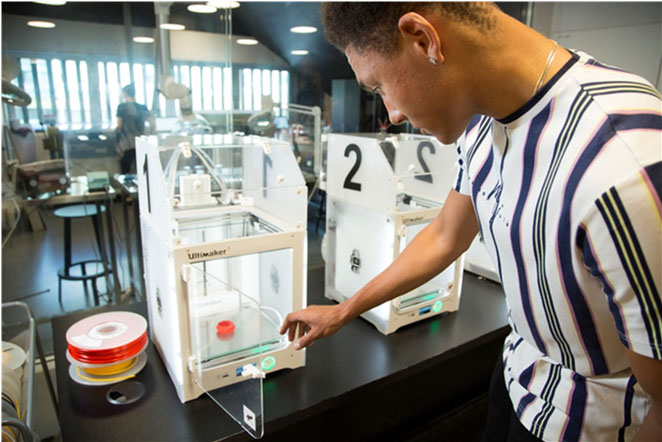
(Note) At backside of 3D printer (in the corridor) glass-walled workroom is seen.
(Source) Jonna Pennanen / City of Helsinki
Material 3: Corridor and workroom
(Note) At backside of 3D printer (in the corridor) glass-walled workroom is seen.
(Source) Jonna Pennanen / City of Helsinki
I asked Oodi why they have glass walls for the workrooms and other areas. They answered that there are two main reasons: "transparency" and "openness." One reason is to ensure transparency of work and transparency in public institutions. Another reason for openness is having our facilities easily visible to the public. It has the effect of lowering the threshold for others to use the spaces and equipment themselves.
The sentence in the answer, "When people see other people, just like themselves, using the meeting rooms, studios, urban workshop equipment, they are more likely to try and use the facilities themselves.", is exactly what I felt on my visit. In other words, I think that seeing other people trying to make something or taking on a new challenge will have a great educational effect as a social education facility. There are other examples of glass-walled incubation facilities, such as The Watershed in Cape Town. I think that it is possible to expect mutual improvement and collaboration, and that the advantages outweigh the disadvantage of not keeping your own ideas confidential.
A relaxing place that could also be used as a meeting place
One end of the corridor leads to a large place. Much of the space is occupied by large steps, and there are several chairs on the flat area in front of it. It is a good place to take a break and relax between work. I took a break here too. Oodi makes extensive use of wood, and the impressive placement of wood in this place also seems to prevent the whole floor from feeling inorganic.
A relaxing place is effective for promoting interaction between users. It is probably a place for discussion and networking. It seems useful for making new friends and creating an ecosystem.
"Oodi is for All of Us"
It is written on the back cover of Oodi's English pamphlet that "Oodi is for all of us." The idea of a facility for "all of us" seems to be incorporated throughout.
There is no checkpoint upon entry, so even tourists can easily go to the library on the third floor. Not only books but also board games are lined up on the third floor. There is also a game room on the second floor.
In addition, anyone can use the equipment on the second floor, as mentioned above, free of charge, excluding the cost of materials. If you would like to reserve the use of the facilities or equipment, you can do so online at the reservation site of City of Helsinki.
I asked Oodi about allowing non-residents to use facilities built with tax money for free. The answer was that the direct reason is legal requirement (Finnish libraries are free by law), but that Finnish public libraries (as well as Finnish public education) have long been seen as pillars of Finnish democracy, and, as such, one cannot make democracy dependent on a fee. (however, there is some criticism of free services. But this is usually related to the scope of free services offered.)
In fact, people of all ages use the facility: young people creating sculptures on digital devices, middle-aged women at computers, and groups of seniors doing yoga or something similar. There is also consideration given to foreigners and immigrants, like books in various languages, including Japanese. On Oodi 's official website (English version), an announcement about ICT instruction by seniors for other seniors (Note 2) states, "We cannot guarantee that there is a fluent English-speaker present every time, but you are welcome to come and ask us!" This hospitality was heartwarming.
Conclusion: Longing for "open, exciting, and useful" places in Japan
The impression I got from Oodi could be summed up as "open, exciting, and useful." By making it an open facility that anyone can enter and use, it broadens the range of users. And the glass-walled rooms and machines in the corridors create an exciting feeling in visitors, making them want to try using and making things. And, by providing equipment and facilities that allow users to make what they want to make, they can make it actually. I think that the existence of such a system (and probably other functions as well) is the reason why it has become a facility visited by a total of 2.5 million people a year (Finland's population is about 5.5 million). It seems that Finns love reading, but I think that's not all.
When building Oodi, the opinions of local residents were collected in various ways. For example, in 2012, when the building competition was in progress, a campaign was held to solicit suggestions from Helsinki residents, which resulted in 2,300 ideas. The name of the library was also open to the public, with a jury choosing the name from over 1,600 submissions. Perhaps it is the reason of such circumstances that the library is not just a library with books and a reading room, but has a glass-walled second floor, a video hall, and other facilities, making it a building that is used by many people.
Finland has consistently ranked first in the world happiness rankings despite its high tax burden (the ratio of taxes and social security contributions to national income). This may be due to its thoroughgoing commitment to democracy, as seen in the construction of Oodi.
It seems common in Japanese public facilities, such as community centers, that even the printing press cannot be used unless one is a member of some registered community circle, and that there are closed doors which make it difficult to know what kind of activities are taking place.
In Japan, only 12% of community centers have computers available for users to use in 2021, and only 10% have internet-connected computers. (Note 3) Even among libraries, only 46% have computers that allow users to search external databases that the library has contracted with. (Note 4)
On the other hand, there are also some examples of public libraries installing 3D printers and making them available to users. (Note 5) I hope that public social education facilities which are "open, exciting, and useful", like Oodi, will increase in Japan, even if they are small.
[Notes]
- There were no gender-specific markings, only signs of "WC" (except for wheelchair access), so I got a little lost looking for the "men's toilet."
- ICT (Information and Communication Technology) is a term that refers to all technologies related to information and communication. The event featured in this article seems to provide guidance and consultation on how to use digital devices such as computers and tablets, including online services.
- “Community Center Survey (Community Centers)” In the Ministry of Education, Culture, Sports, Science and Technology (2021).
- "Library Survey (Libraries)" in the Ministry of Education, Culture, Sports, Science and Technology (2021).
- An online search by the author revealed that libraries and library-like facilities with permanent 3D printers include Ishikawa Prefectural Library, Prefectural Nagano Library, Urayasu City Library, Tagawa City Library, Anjo City Library and Information Center, and JTL (Kita-ku, Tokyo) (searched on December 5, 2024, includes cases where the 3D printers are installed in separate facilities within the same building).
[References]
- Ministry of Education, Culture, Sports, Science and Technology (2021) “Social Education Survey for 2021”
- Oodi official website : https://oodi.fi/
- 2024 Oodi - Helsinki Central Library (English pamphlet) Helsinki Central Library Oodi
Original in Japanese:
https://www.dlri.co.jp/report/ld/399980.html
Disclaimer:
This report has been prepared for general information purposes only and is not intended to solicit investment. It is based on information that, at the time of preparation, was deemed credible by Daiichi Life Research Institute, but it accepts no responsibility for its accuracy or completeness.