




- Report Index
- Value-based Healthcare: Trends of Changes from Quantity to Quality
- DLRI Report
-
2024.12
Value-based Healthcare: Trends of Changes from Quantity to Quality
Hiroki Tamura
Trends of Changes from Quantity to Quality
We have been enjoying substantial prosperity and wealth thanks to the industrial revolution and high-economic-growth. However, these have led us to the consequences of today’s planetary challenges, such as natural resource depletion and environmental pollution. Due to the growing number of people prioritizing sustainability, the mainstream value of society has been shifting from quantity to quality.
Trends prioritizing quality over quantity can be seen across various sectors. For instance, there is a shift in consumer preference in the apparel industry from so-called “fast fashion,” which can be explained by the massive production and consumption cycle of low-price products, to so-called “slow fashion,” which is durable, comfortable, and fit-for-own styles.
Healthcare sector cannot be an exception in this regard. The concept of “Value-Based Healthcare (VBHC),” which prioritizes qualitative value or outcomes brought to patients rather than the quantity of healthcare services provided, is gaining attention.
Towards the implementation of Value-Based Healthcare (VBHC)
The key to realizing VBHC in the health sector is to transform the reward-payment scheme. To be more specific, transforming from “Fee-for-service (FFS)” to “Pay-for-Performance (P4P)” plays a key role here. FFS is a reward-payment scheme on the pay-as-quantitative value of healthcare services provided to patients. Conversely, P4P is on the pay-as-qualitative value/outcome experienced by patients based on the healthcare services provided.
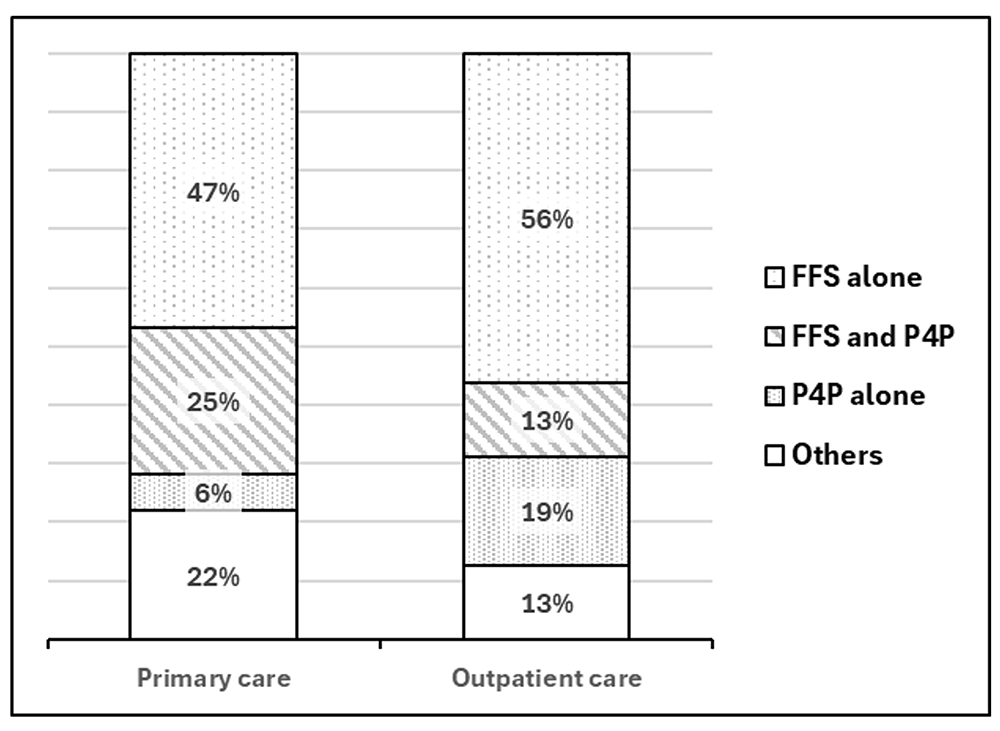
According to a survey conducted by the OECD among its 32 member countries, 47% use FFS alone for the reward-payment scheme in primary care, and 56% use FFS alone in outpatient care (Figure). In other words, this indicates that FFS remains the international mainstream of the reward-payment scheme, even today. On the other hand, the total number of countries using P4P alone or P4P with FFS has been increasing, achieving 31% in primary care and 32% in outpatient care.
Japan was one of the countries using FFS as a mainstream scheme while gradually adopting P4P in practice recently. For instance, Japan started to adopt a new payment system, DPC (Diagnosis Procedure Combination), which combines FFS and P4P in selected fields.
Realizing VBHC means transforming from quantity to quality - a healthcare system in which less intervention and high effectiveness receive a higher valuation. By leveraging resources such as public health expenditure or healthcare workers more efficiently, it is expected to contribute to building a sustainable health system.
Figure: Payment scheme of primary and outpatient care (as of 32 countries, %)
(Source)OECD Health Working Paper No.154 “Innovative providers’ payment models for promoting value-based health systems: Start small, prove value, and scale up”
(Source)OECD Health Working Paper No.154 “Innovative providers’ payment models for promoting value-based health systems: Start small, prove value, and scale up”
The future of the role of insurance companies
These changes from Quantity to Quality in the healthcare sector might significantly impact the role of insurance companies.
Insurance companies have been supporting customers/patients in obtaining the healthcare services they wish (quantitative aspect) by providing insurance payments such as medical benefits. However, this might now have been changed to support customers’/patients’ experiences of healthcare services (qualitative aspect). Therefore, insurance companies might be required to expand their business scope from not just their conventional business model, “supporting the cure of disease,” but also to “supporting the prevention of disease” with an emphasis on improving customers’ and patients’ health and QOL (Quality of life), in the near future.
Some pioneering examples include an insurance product for which customers will be rewarded with a discount based on a positive annual health check-up result or a service that proposes a tailor-made physical activity program through apps depending on their health conditions.
Original in Japanese:
https://www.dlri.co.jp/report/dlri/399970.html
Disclaimer:
This report has been prepared for general information purposes only and is not intended to solicit investment. It is based on information that, at the time of preparation, was deemed credible by Daiichi Life Research Institute, but it accepts no responsibility for its accuracy or completeness.