




- Report Index
- TSE Initiatives Requiring Management Awareness of Capital Costs and Stock price
- DLRI Report
-
2024.11
TSE Initiatives Requiring Management Awareness of Capital Costs and Stock price
Yoshio Kawatani
TSE initiatives
At the end of March 2023, the TSE launched initiatives requiring all companies listed on the TSE Prime and Standard markets to manage their businesses with an awareness of their cost of capital and stock price. After exchanging views with investors and other stakeholders in June and July 2024, the TSE summarized its efforts over the past year in August and prepared a proposal for future measures. Based on this, additional measures were announced in late September.
This report reviews the status of companies' responses to these initiatives, introduces the TSE's summary and proposed future measures, and provides personal opinions on the TSE's initiatives.
Status of companies' responses to the TSE Initiatives
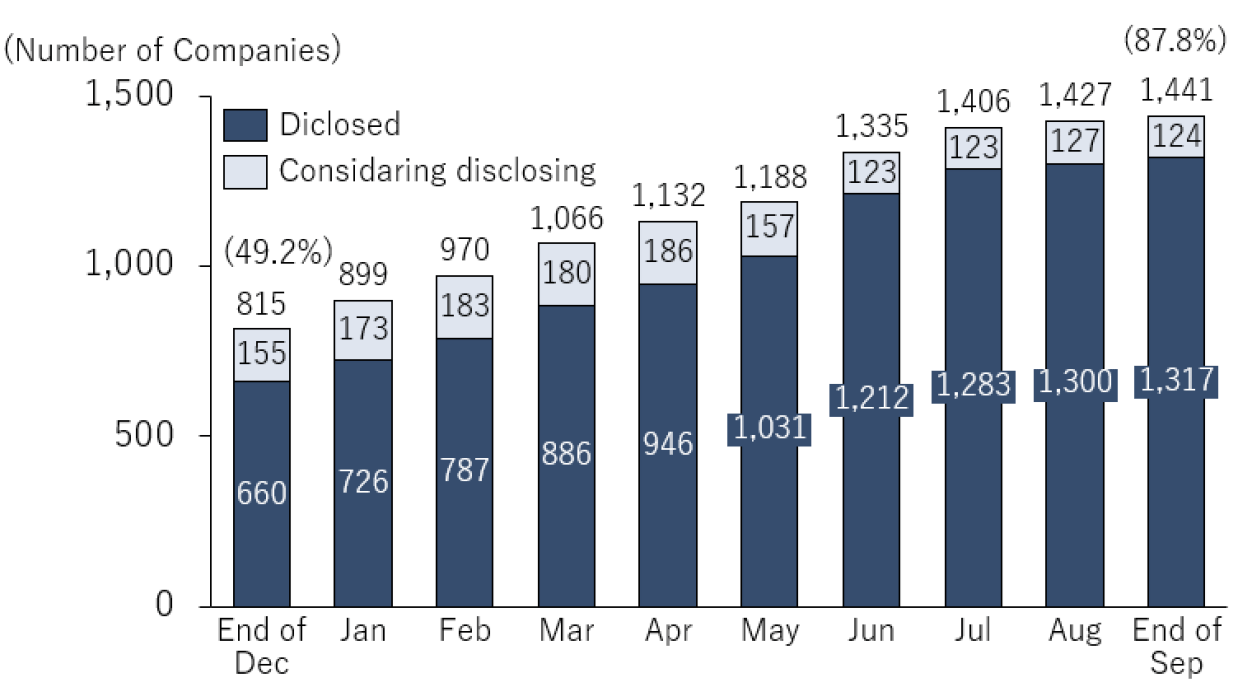
Since January 2024, the TSE has published a monthly list of companies that have disclosed their perceptions of capital efficiency and stock prices, as well as their improvement measures, in response to the TSE’s request. Figure 1 shows the increase in the number of companies
in the Prime market that have disclosed or are considering disclosure of their information in response to the TSE's request.
Figure 1: The number of companies in the Prime market that have disclosed or are considering disclosing their information in response to the TSE requests.
(from the end of Dec, 2023, to the end of Sep,2024)
(Source)Compiled by Dai-ichi Life Research Institute from TSE Data
(Source)Compiled by Dai-ichi Life Research Institute from TSE Data
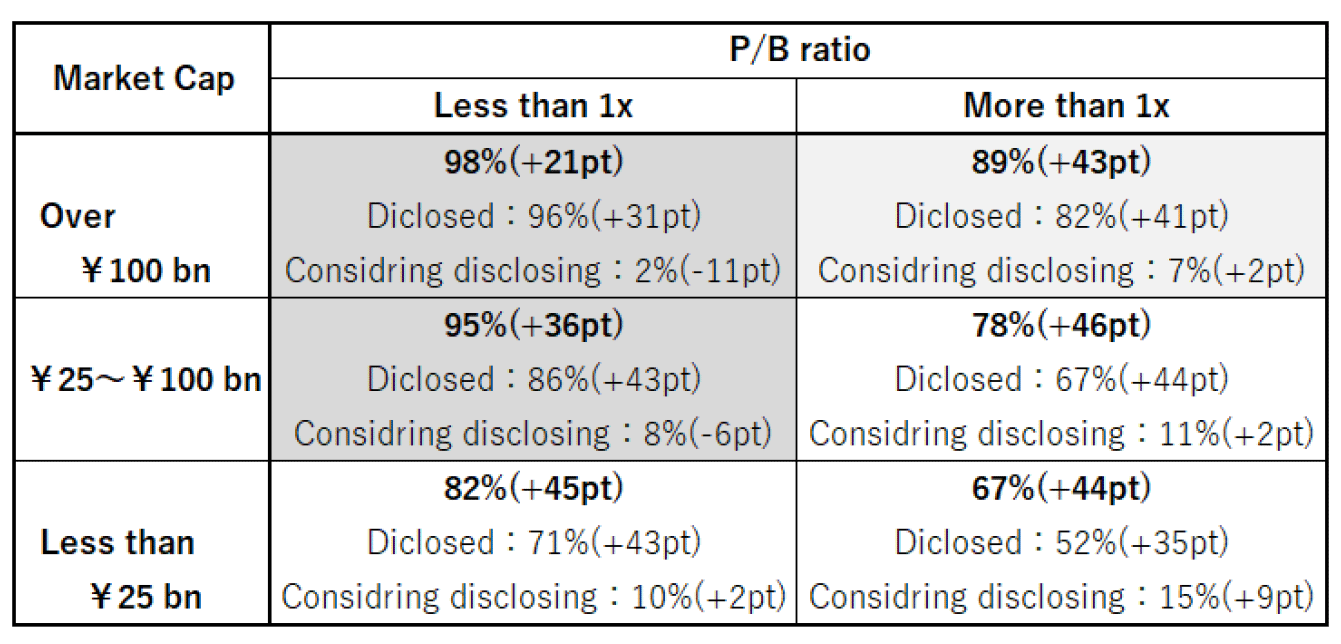
In the Prime market, the number of companies that have either disclosed or are considering disclosing has already reached just under 90%. As shown in Figure 2, the disclosure rate is higher for companies with a P/B ratio of less than 1x and for companies with large market capitalisation. The disclosure rate has also increased considerably for companies with a P/B ratio of more than 1x and small market capitalisation.
Figure 2: Disclosure rates by P/B ratio and market capitalization
(The Prime market As of the end of Sep 2024)
(Source)Compiled by Dai-ichi Life Research Institute from TSE public documents
(Source)Compiled by Dai-ichi Life Research Institute from TSE public documents
Summary of the results of TSE initiatives to date
The TSE's initiatives have been successful in terms of disclosure rates. However, while the P/B ratio level has improved, partly due to the overall rise in stock prices over the past year, the ROE level, an indicator of capital efficiency, has not improved as much.
In light of this situation, the TSE presented a summary draft of the year's initiatives at the “Follow-up Meeting on the Review of Market Segmentation” held in August 2024.
The TSE noted that the reforms were still a "work in progress," as it would take some time for these initiatives to bear fruit in the form of increased medium- to long-term corporate value. The TSE also stated that it aims to create a market where it is "normal" for companies to improve their corporate value by managing with awareness of the cost of capital and stock prices, and through constructive dialogue with investors.
On the other hand, the TSE has also indicated that it is not concerned about the number of listed companies, even though information disclosure and other factors might increase listing costs and cause some listed companies to go private. Therefore, It can be said that the TSE has declared its intention to emphasize quality over quantity with regard to listed companies.
The TSE also stated that it would encourage institutional investors to engage in constructive dialogue with companies to support medium- and long-term improvements in corporate value rather than being biased towards a short-term perspective.
TSE's proposed future measures
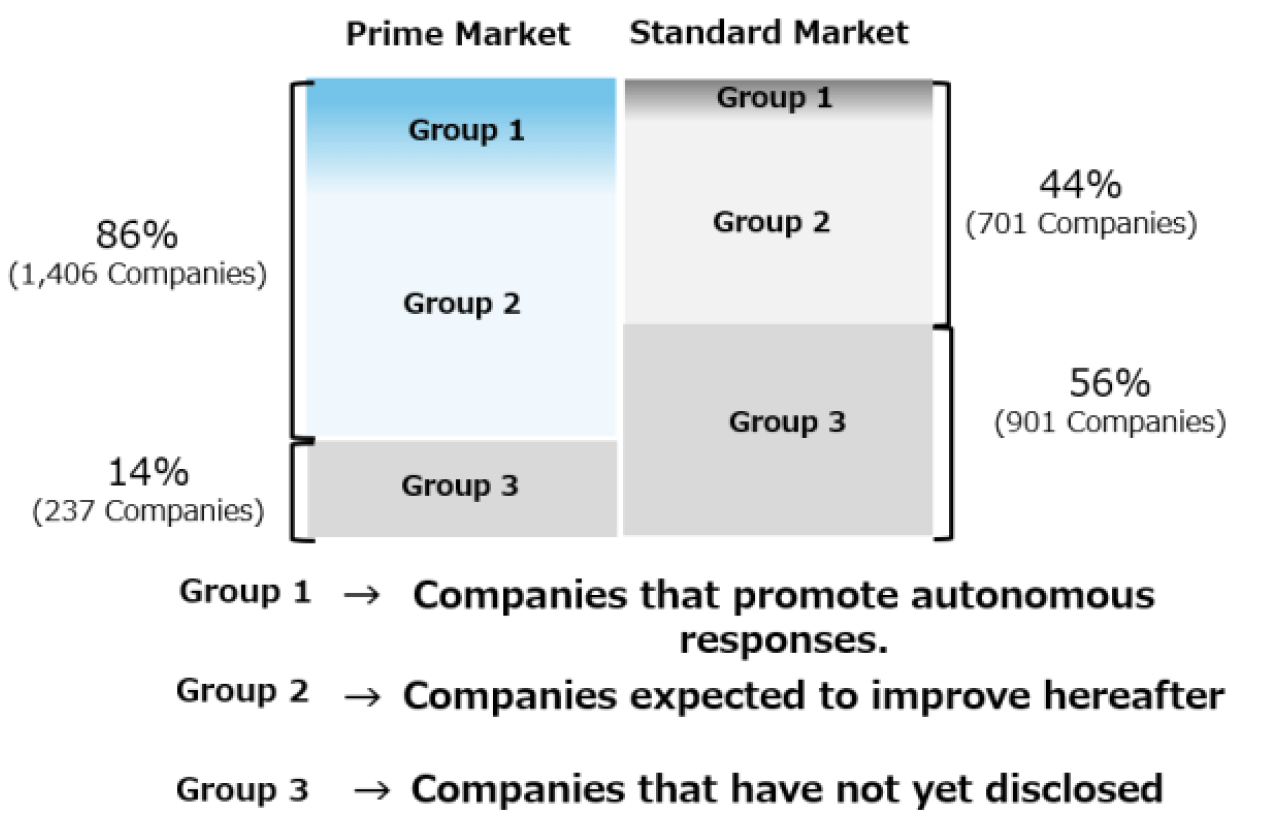
As shown in Figure 3, based on the status of listed companies' responses, the TSE divided companies into three groups. From June to July 2024, the TSE exchanged views on the current situation and measures to be adopted in the future with more than 60 stakeholders, including domestic and foreign institutional investors, securities companies, trust banks, consulting firms, and think tanks. During the exchange of views, there were no objections to this grouping, but a domestic institutional investor pointed out that there is a significant difference in the level of response between Group 1, which is autonomously improving its response and updating its disclosure through dialogue with investors, and Group 2, which does not.
Figure 3: Grouping of companies by TSE
(Source)Compiled by Dai-ichi Life Research Institute from TSE public documents
(Source)Compiled by Dai-ichi Life Research Institute from TSE public documents
The TSE considered it important to continue supporting the measures taken by companies in Group 1 and to take promotional and support measures specifically focused on companies in Group 2. For Group 3, the TSE also considered it necessary to encourage listed companies to improve their approach and systems to respond to the market.
In particular, the companies in Group 2 were found not to meet investor expectations because their corporate goals and responses were focused on sales, profits and losses. This gap in perspective between the companies and the investors led to insufficient communication. The TSE identified these issues as significant challenges. As the companies in Group 2 form a significant part of the Prime Market, overcoming this challenge is key to the sustainable growth of the overall market.
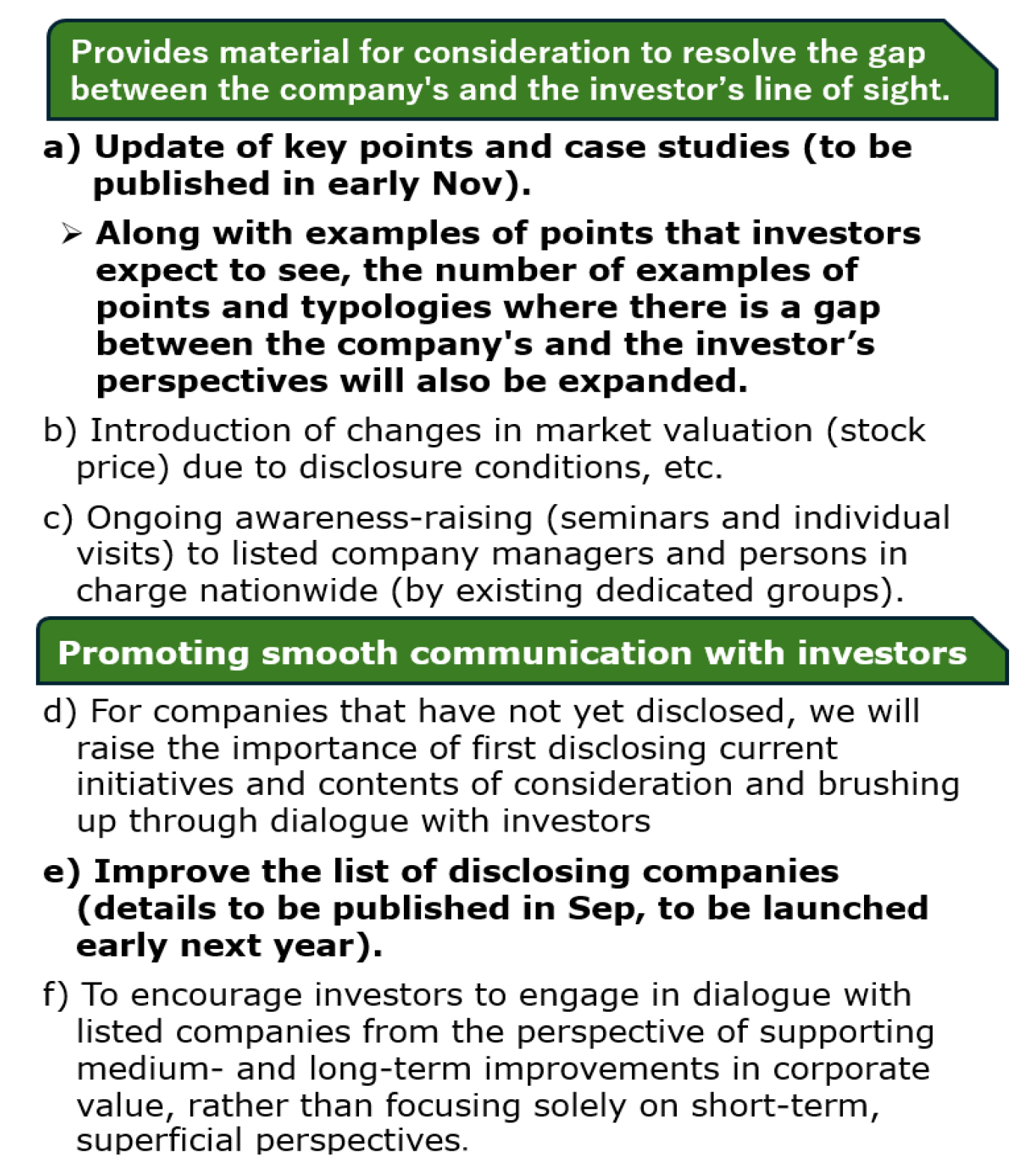
Based on this awareness of the issues, the TSE published a proposal for future measures in August 2024. An overview of the proposed future measures for companies in Group 2 is provided in Figure 4.
Figure 4: TSE's proposed future measures for companies in Group 2
(Overview, published Aug 2024.)
(Source)Compiled by Dai-ichi Life Research Institute from TSE public documents
(Source)Compiled by Dai-ichi Life Research Institute from TSE public documents
Below is an explanation of points a) and e), where the timing of implementation is explicitly stated in the TSE's proposed future measures.
Regarding a), the TSE has already published a collection of points and examples in February 2024, which will be updated in November to present points and typical examples addressing the gap between investors' and companies' perspectives.
Regarding e), the TSE published the details at the end of September, and these will be implemented starting from January 2025. The current list shows only the names of companies that have already “disclosed” or are “considering disclosing,” along with the changes in their disclosure status from the previous month. Additionally, "the date the disclosure update and "contact information for the company when it wishes to have more active engagement with institutional investors" will be added. Furthermore, companies that have been under consideration for longer than six months will be removed from the disclosure list.
All of these measures are aimed at supporting companies that are willing to respond proactively, with the hope that this will lead to more active disclosure and dialogue.
Expectations for TSE initiatives
These proposed measures show that the TSE is taking a dedicated approach to boosting medium- and long-term corporate value through disclosure and constructive dialogue. During the "Lost 30 Year", Japan's stock market also failed to grow sustainably and has been significantly outperformed by the US and Europe. The differences that have emerged over the long term are difficult to resolve in the short term.
It is essential for the TSE, companies, and investors to align their efforts to enhance corporate growth potential without being influenced by short-term stock price movements, and it is hoped that steady progress will be made in the TSE's initiatives.
Original in Japanese:
https://www.dlri.co.jp/report/dlri/388316.html
Disclaimer:
This report has been prepared for general information purposes only and is not intended to solicit investment. It is based on information that, at the time of preparation, was deemed credible by Daiichi Life Research Institute, but it accepts no responsibility for its accuracy or completeness.