




- Report Index
- A look back at the power reserve ratio during the summer of 2024
- DLRI Report
-
2024.11
A look back at the power reserve ratio during the summer of 2024
Mei Makinouchi
Frequent abnormalities with negative reserve ratios
In March 2022, a power supply-demand emergency alert was issued, followed by a warning in June. There were no alerts or warnings issued in 2023, and none had been issued up to October 2024. However, was there sufficient power reserve ratio (the surplus supply capacity relative to peak electricity demand) during the summer of 2024?
In general, a reserve ratio of 7-8% with a minimum of 3% is required to ensure a stable supply of electricity. When the reserve ratio falls below 5%, a warning is issued. However, according to data from the Organization for Cross-regional Coordination of Transmission Operators, in the Tokyo area from June to September 2024, there were 29 days when the reserve ratio was expected to be below 8% one week in advance (Fig. 2), whereas in 2023, there were only five such days (Fig. 1).
Figure 1: June-September 2023 Reserve Ratio for Tokyo Area as of the previous week

(Source)Compiled by Dai-ichi Life Research Institute from “kks-web-public” , the Organization for Cross-regional Coordination of Transmission Operators.
(Source)Compiled by Dai-ichi Life Research Institute from “kks-web-public” , the Organization for Cross-regional Coordination of Transmission Operators.
Figure 2: June-September 2024 Reserve Ratio for Tokyo Area as of the previous week
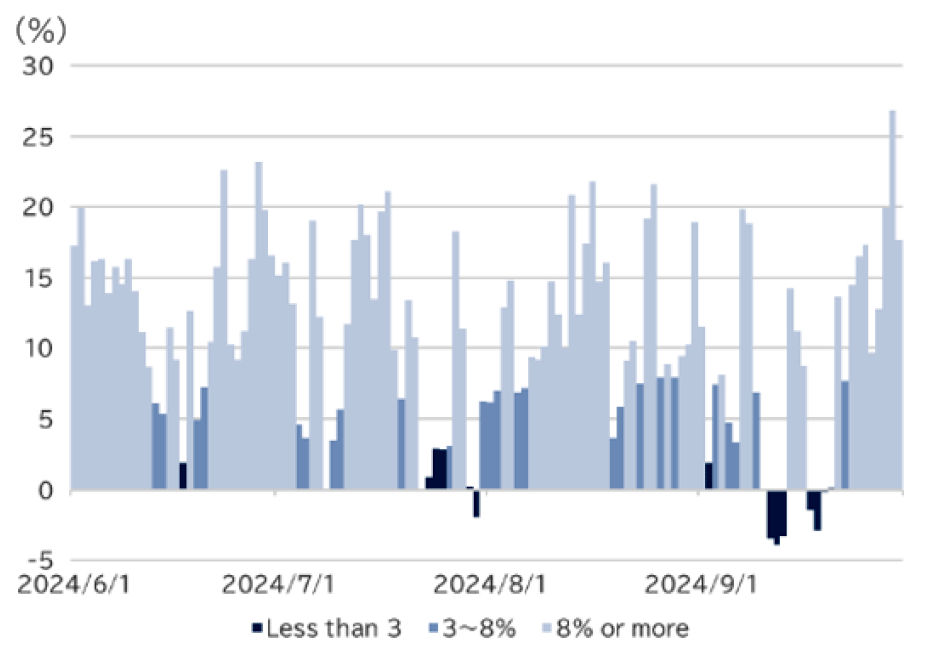
(Source)Same as Figure 1.
(Source)Same as Figure 1.
Furthermore, as of two days in advance, there were 35 days with reserve ratios of 8% or less in 2024, an increase compared to one week ago. Given that power producers are expected to increase their supply capacity based on reserve ratio forecasts, what led to this situation?
Insufficient bids in the supply-demand adjustment market
As reported by the Agency for Natural Resources and Energy, a significant contributing factor is the insufficient number of bids in the supply-demand adjustment market. Previously, general transmission and distribution companies primarily addressed the shortfall through public bidding. However, beginning in FY2024, the market transitioned to full procurement. However, in the Tokyo area and elsewhere, the volume of bids received is insufficient to meet demand, resulting in a persistent shortage of procurement.
Figure 3: April-September 2024 Primary Adjustment Power Volume of Offers and Bids
in Tokyo Area

(Source)Compiled by Dai-ichi Life Research Institute based on the data from Electric Power Reserve Exchange.
(Source)Compiled by Dai-ichi Life Research Institute based on the data from Electric Power Reserve Exchange.
Some types of adjusting power have bidding price caps. In some cases, it is more economically advantageous to respond to additional activation through contracts to utilize excess capacity in the capacity market. This may have reduced the willingness to bid. In the event that the number of bids received is low, the bidding price will increase significantly, which may result in an increased burden on the public. While the shortages are procured outside the market, if the market is unable to function, the objective of the market, namely efficient procurement, will not be met. It is essential to implement a range of measures to ensure a reliable electricity supply, such as replacing thermal and other power sources that can adjust their supply capacity, maintaining existing facilities, and expanding reserve power sources.
Original in Japanese:
https://www.dlri.co.jp/report/dlri/388325.html
Disclaimer:
This report has been prepared for general information purposes only and is not intended to solicit investment. It is based on information that, at the time of preparation, was deemed credible by Daiichi Life Research Institute, but it accepts no responsibility for its accuracy or completeness.