




- Report Index
- What are "Yuru Black Companies" ? : the Reality of Not Being Chosen Solely for Ease of Work
- DLRI Report
-
2024.9
What are "Yuru Black Companies" ? : the Reality of Not Being Chosen Solely for Ease of Work
Saki Takamiya
What are "Yuru Black Companies"?
Black Companies" in Japan generally refer to companies where long working hours and harassment are prevalent, and labor exploitation is practiced. "Yuru Black Companies" appear to be "White Companies" because there are no long working hours or harassment. However, employees do not receive proper guidance or communication regarding their work because their supervisors are afraid of accusations of harassment. As a result, employees do not have opportunities to demonstrate their abilities in their assigned tasks, and so on. Therefore, employees working for such a company are less likely to feel a sense of job satisfaction. The term "yuru" in "Yuru Black Companies" derives from the Japanese word for "loose" or "lenient", indicating a seemingly relaxed environment but lacks proper structure and guidance.
What makes "Yuru Black Companies" different from "White Companies" and" Black Companies"?
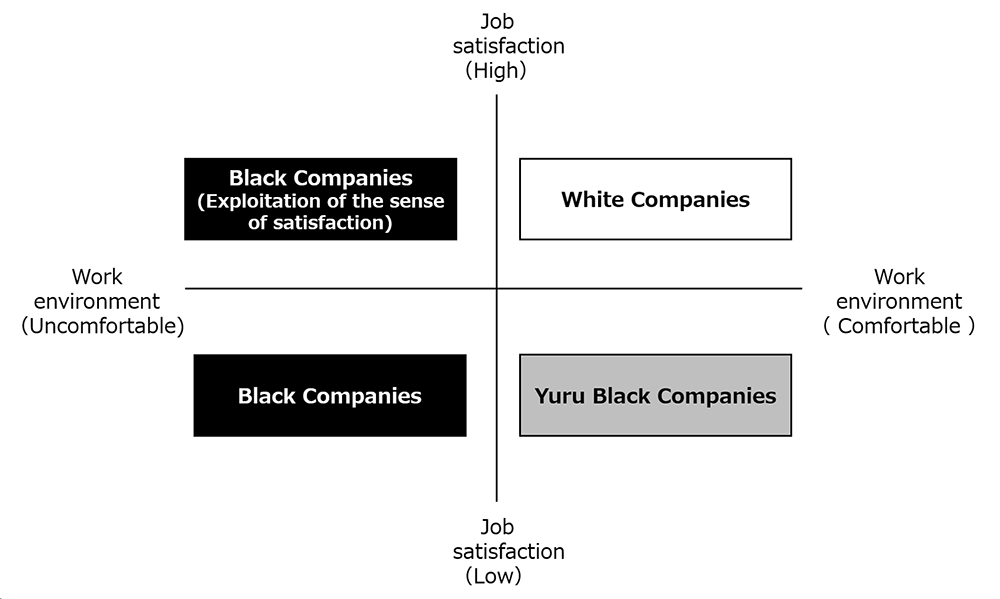
Figure 1 shows the classification of White Companies, Black Companies, and Yuru Black Companies. The horizontal axis represents "work environment" and the vertical axis represents "job satisfaction". Companies with high scores in both dimensions are classified as White Companies.
The Ministry of Health, Labour and Welfare's "Analysis of the Labor Economy in Fiscal Year 2019" defines "Comfortable work environment" as "an environment in which workers can continue to work with peace of mind". Specifically, it includes the ease of taking paid leave, the flexibility of working styles, the ability to balance work with childcare and nursing care, and the smoothness of human relations and communication in the workplace.
On the other hand, "job satisfaction" is also academically referred to as "work engagement (= positive psychological state related to work)”. Specifically, it refers to the state of being engaged in one's work, i.e., being absorbed in one's work with liveliness and enthusiasm.
In the previous analysis, a "comfortable work environment" where employees can work comfortably and safely is pointed out as a prerequisite and foundation for "job satisfaction". Companies with "uncomfortable work environment" in the left quadrant, even if individual employees feel "job satisfaction", find it not sustainable and only temporary. Such work environments are considered to be categorized as so-called "Black Companies", which exploit the sense of satisfaction.
On the other hand, the "Yuru Black Companies" in the lower right quadrant have "comfortable work environment", the foundation of their business, but their employees do not have "job satisfaction", and do not work with enthusiasm and vigor.
Why are "Yuru Black Companies” a Problem?
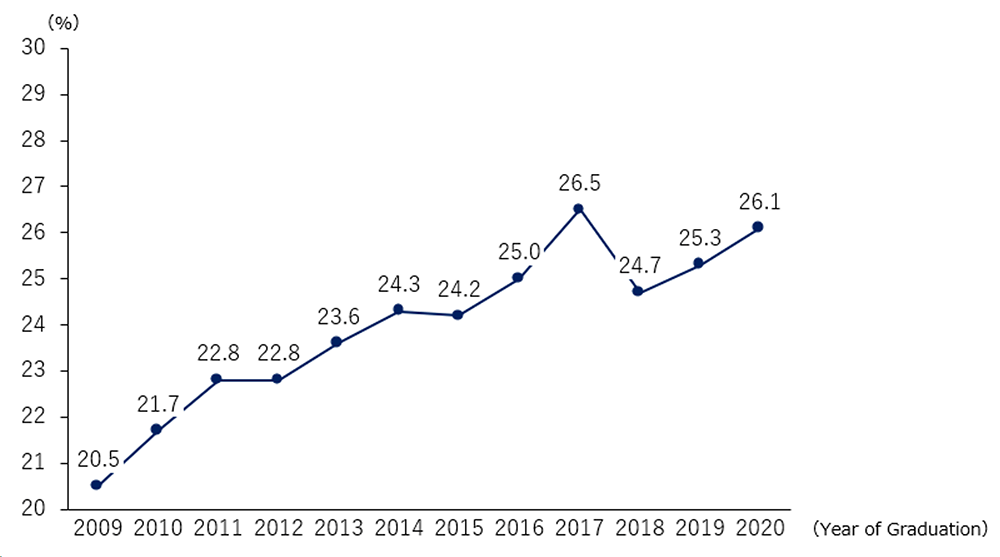
In 2013, the term "Black Companies" was nominated for the New Word of the Year Award. Overwork deaths became a significant issue in Japan, leading the United Nations to call for the correction of long working hours and the prevention of overwork deaths. Particularly since 2015, labor laws have been improved, and as a result, overtime hours have been reduced, paid leave has become easier to take, and the working environment has been improved regardless of industry or sector. However, according to a survey by the Ministry of Health, Labor and Welfare, the turnover rate of university graduates from large companies with 1,000 or more employees is currently on the rise, and the turnover rate among young people has not improved (Figure 2).
It has also been pointed out that one of the reasons for this is due to Yuru Black Companies. Media reports have also voiced the opinions of young people who have retired early because of lax workplaces, saying that their workplaces are concerned about their working hours and only assign them tasks that can be completed in a short time, or that they cannot develop their skills and feel threatened that they will not be accepted in other departments or companies if they continue to work like this.
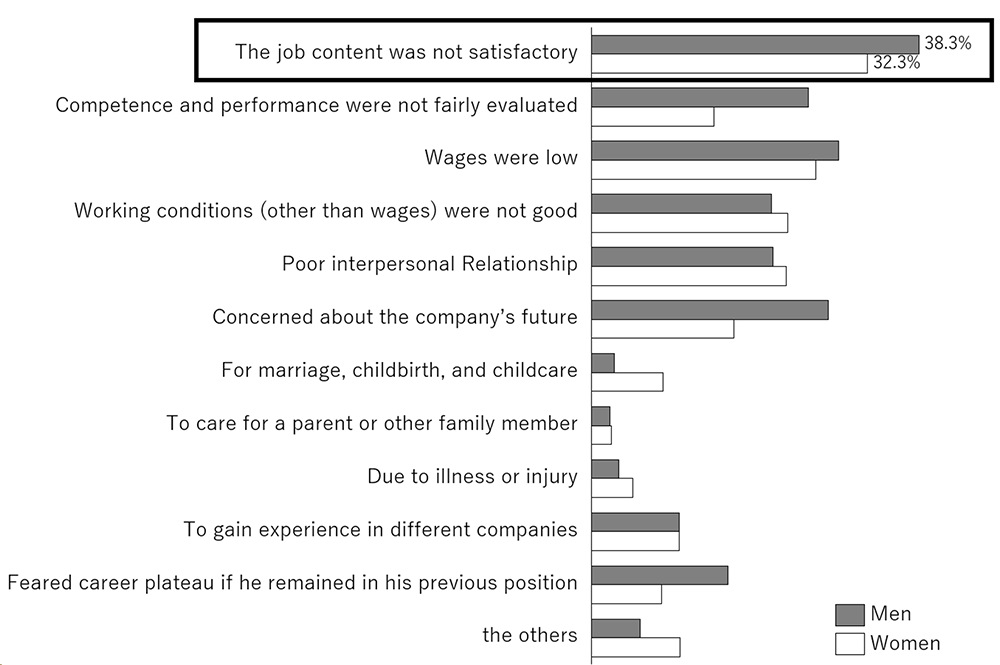
On the other hand, let us look at the reasons for job turnover among middle-aged workers. According to a survey conducted by the Japan Institute for Labor Policy and Training targeting full-time employees aged 30 to 54, the highest percentage of respondents, regardless of gender or age group, chose "unsatisfactory job content" as the reason for leaving their jobs (Figure 3). Dissatisfaction with job content can be thought of in a variety of ways, such as "job content is too loose" or "the job is not what I want", but as a result, it is believed that the employees are not engaged in their work (i.e., "job satisfaction" has declined) and choose to leave their jobs.
Recently, the assumption of lifetime employment at the same company until retirement is collapsing in Japan. Many people want to increase their own market value with a view to changing jobs, or seek an environment where they can acquire useful skills throughout their lives as their professional lives are lengthened in preparation for the 100-year life era.
As a company, there is a risk of leaving a "Yuru Black Companies" status. If employees' "job satisfaction" and motivation are left unchecked, business productivity and efficiency will decline, and overall business growth will be hindered. To avoid such risks, a work environment that improves employee "job satisfaction" is required.
Aiming to be "True White Companies"
One of the important factors for improving "job satisfaction ≒ work engagement" is "Protean Career" (*).
Protean Career is a career view that values individual values and does not necessarily stay in the organization, but manages and shapes one's career on one's own responsibility (HALL, 1996), and has been proposed as a new career view in recent years.
In the conventional career perspective, the "organization" is in charge of career development, so transfers and job assignments are performed under the initiative of the organization. In other words, there is no sufficient communication between the company and the individual regarding the "individual employee's career". As a result, employees are likely to accumulate dissatisfaction and anxiety about their assigned duties, which lowers the job satisfaction index.
In order to increase employee job satisfaction, it is first important for companies to recognize that it is the individual, not the organization, that shapes their career. Based on this premise, it is necessary to provide employees with career information, career coaching and other forms of communication, as well as support in the form of job offers that help individual employees develop their careers and promote personal relationships that contribute to their career development. As a result, employees will be able to work with a sense of conviction that their jobs are necessary for their careers, and their enthusiasm for their work will increase. By creating such an environment, the company will be able to break free of the "Black Companies" mentality and become a "True White Companies".
Figure 1: Concept of “White Companies” “Black Companies” and “Yuru Black Companies”
(Source) Dai-ichi Life Research Institute
(Source) Dai-ichi Life Research Institute
Figure 2: Turnover rate of new college graduates within 3 years of employment
(*1,000+ size companies)
(Source) Ministry of Health, Labour and Welfare "Turnover of new graduates"
(Source) Ministry of Health, Labour and Welfare "Turnover of new graduates"
Figure 3: Reasons for leaving previous job (personal reasons, multiple answers)
(Source) Ministry of Health, Labour and Welfare "Health, Labour and Welfare" (2021.4)
(*) In Akkermans et al. (2013), career competencies (consisting of items such as being proactive about career, having a clear career orientation, etc.) were found to have a positive impact on work engagement.
(References)
Akkermans,J.,Schaufeli,W.B.,Brenninkmeijer, V. and Blonk,R.W.B.(2013)“The Role of Career Competencies in the Job Demands-Resources Model”
(Source) National Institute for Labour Policy and Training (NILPT) "Job Change, Skills Development, and Career Formation of Middle-Aged People: Results of a Questionnaire Survey of Job Changers"
HALL,D.T.(1996) “Protean career of the 21st
Original in Japanese:
https://www.dlri.co.jp/report/dlri/341051.html
Disclaimer:
This report has been prepared for general information purposes only and is not intended to solicit investment. It is based on information that, at the time of preparation, was deemed credible by Daiichi Life Research Institute, but it accepts no responsibility for its accuracy or completeness.