


- Report Index
- The Peak of Death: Preparing for the "Post Aging Society"
- DLRI Report
-
2024.7
The Peak of Death: Preparing for the "Post Aging Society"
Hiroki Tamura
What lies beyond the aging society?
Japanese society is one of the most rapidly aging societies, with about 30% of the population being over 65 years old. This is mainly driven by increased life expectancy due to improvements in public health and advancements in medical technology. However, recent research indicates the possibility of a biological limit to human life expectancy.
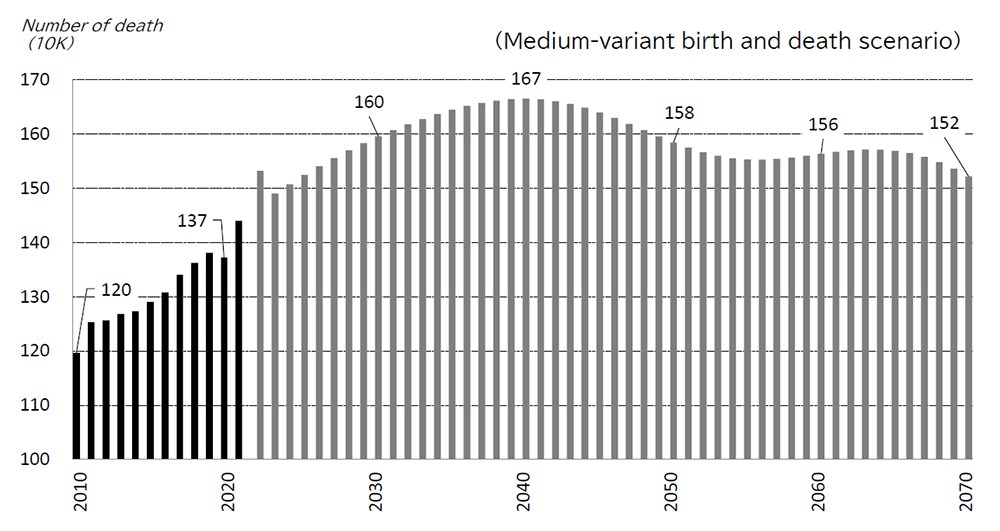
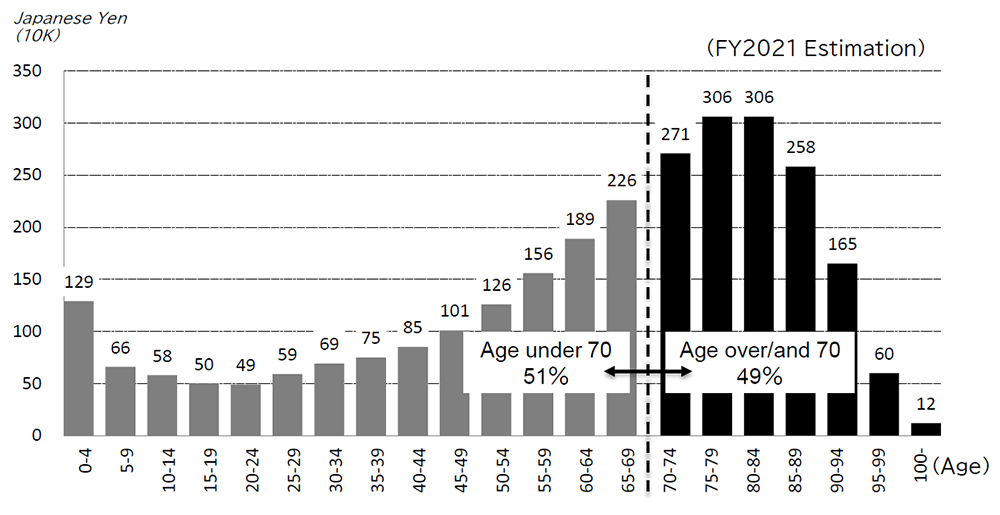
Against this backdrop, Japan may experience a significant rise in the death toll reaching its peak in the next few decades (hereafter “post aging society”) as a result of many elderlies reaching their maximum age. Currently, Japan’s annual death toll has reached 1.4 million and is expected to continue rising until 2040 (Figure 1). Moreover, statistics suggests that half of lifetime health expenditures occur after the age of 70, indicating that further aging and increasing death toll may lead to a rapid increase in health expenditures (Figure 2). Therefore, it is crucial for Japanese society to prepare for the “post aging society.”
Social-economic transformation is needed
The peak in the death toll may significantly impact the economy and society. For instance, there may be a shortage of funeral and cemetery spaces or an increased demand for services to manage inheritance, property ownership, or vacant houses. In addition, given the high prevalence of cremation in Japan, the environmental impact of increased carbon emissions and other harmful effects cannot be overlooked.
Japan may need to consider drastic changes in its economic and social systems to prepare for this transformation. For instance, reforming existing regulations or systems to enable more innovative approaches or implementing policies to support the development of new services or products are potential options.
From fee-for-service to value-based health system
End-of-life care is a care provided right before one's end of life, with the purpose of sustaining life expectancy or mitigating pain. The anticipated increase in end-of-life care demand may change societal expectations of how the health system should work. For example, the concept of Quality-of-Death (QOD), which means respecting or considering individual decision or preference during the end-of-life period, is gaining attention. This trend highlights that extending life expectancy does not always improve the Quality-of-Life (QOL) for patients or their close relatives. Moreover, it also questions the current fee-for-service health system, which has been evaluated only based on the types and amounts of services provided.
In this context, the healthcare system in a post aging society might shift from a fee-for-service to a value-based model, focusing on qualitative aspects such as how much the provided health services improved the QOL of patients or close relatives. Moreover, the system will be expected to provide various options to mitigate patients' pain and anxiety, including choices with whom, where, and how they spend their end-of-life period. It is important for society to form a system that embraces the new values allowing patients to choose their preferred options.
Figure 1: Number of death toll in Japan (Actual and Estimate)
(Source)National Institute of Population and Social Security Research「Population Projections for Japan: 2021 to 2070 (With long-range Population Projections: 2071 to 2120)」, Ministry of Health, Labour and Welfare「Vital Statistics」
(Source)National Institute of Population and Social Security Research「Population Projections for Japan: 2021 to 2070 (With long-range Population Projections: 2071 to 2120)」, Ministry of Health, Labour and Welfare「Vital Statistics」
Figure 2: Individual Lifetime Health Expenditure
(Source)Ministry of Health, Labour and Welfare「Lifetime Health Expenditure(FY2021)」
(Source)Ministry of Health, Labour and Welfare「Lifetime Health Expenditure(FY2021)」
Original in Japanese:
https://www.dlri.co.jp/report/dlri/351140.html
Disclaimer:
This report has been prepared for general information purposes only and is not intended to solicit investment. It is based on information that, at the time of preparation, was deemed credible by Daiichi Life Research Institute, but it accepts no responsibility for its accuracy or completeness.