




- Report Index
- Similar but Different "Energy Savings" and "Decarbonization"
- DLRI Report
-
2024.5
Similar but Different "Energy Savings" and "Decarbonization"
Mei Makinouchi
The difference between "power saving" and "decarbonizing".
The World Meteorological Organization (WMO) has identified 2023 as the hottest year in recorded history. 2024 will be another summer that we cannot live without air conditioning, and we cannot stop worrying about our electricity bills.
Figure 1 shows the percentage of CO2 emissions per capita in households by use. Cooling (2.2%) is lower than heating (16.9%). The majority of cooling is used for air conditioning, while heating emits CO2 from various devices such as air conditioners, fan heaters, and stoves. Using gas heaters instead of air conditioners in winter is a way to "save electricity," but not "decarbonizing" because it uses gas, a fossil fuel.
Figure 1: Percentage of CO2 emissions from households (by use)

(Source) Compiled by Dai-ichi Life Research Institute from “Japan's Greenhouse Gas Emissions Data” compiled by the Greenhouse Gas Inventory Office, National Institute for Environmental Studies.
Figure 2 shows the percentage of CO2 emissions from households by fuel type. The data indicates that approximately half of CO2 emissions are attributable to electricity. In order to achieve decarbonization, it is essential to reduce energy consumption by promoting energy efficiency and shifting to power generation methods that emit less CO2.
Figure 2: Percentage of CO2 emissions from households (by fuel type)

(Source) Same as Figure 1
Decarbonizing Electricity is Critical
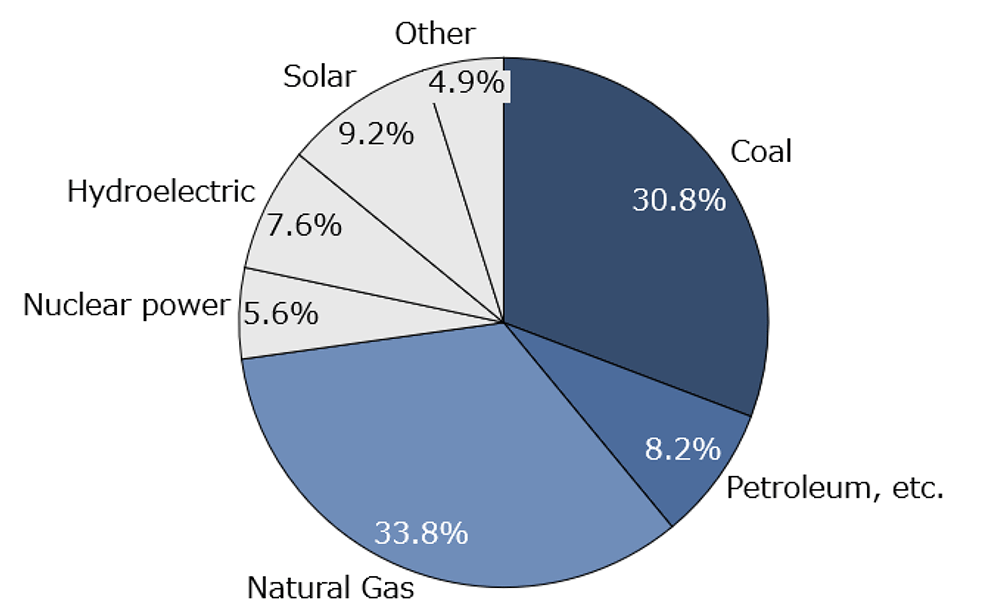
As shown in Figure 3, approximately 70% of electricity generated in Japan is derived from fossil fuels such as coal, oil, and natural gas. Japanese thermal power plants are among the most efficient in the world, but conventional coal-fired power plants emit 0.867 kg/kWh of CO2, and even Integrated Coal Gasification Combined Cycle (IGCC), an example of high-efficiency technology, emits 0.733 kg/kWh of the same. The emissions standard for gas-fired power generation to be considered green is 0.1 kg/kWh (with mitigation conditions). The sixth report of the Intergovernmental Panel on Climate Change (IPCC) states that coal-fired power plants must achieve a significant reduction of 90% or more of CO2 emissions to be considered "mitigated," and international scrutiny is extremely strict, with coal-fired power generation often being the tip of the spear.
The 7th Basic Energy Plan of Japan, which is expected to be formulated by the end of FY2024, will focus on the restart of nuclear power plants and the expansion of the use of renewable energy sources in order to decarbonize electric power.
Figure 3: Japan's Electricity Generation by Source Composition
(Source) Same as Figure 1
Original in Japanese:
hhttps://www.dlri.co.jp/report/dlri/339939.html
Disclaimer:
This report has been prepared for general information purposes only and is not intended to solicit investment. It is based on information that, at the time of preparation, was deemed credible by Daiichi Life Research Institute, but it accepts no responsibility for its accuracy or completeness.