




- Report Index
- Verification of Non-Adoption of Reflationary Policies in the Takaichi Administration's Economic Policy
- Economic Trends
-
2026.10
Verification of Non-Adoption of Reflationary Policies in the Takaichi Administration's Economic Policy
— Based on the Summary of Minutes and Main Discussion Directions of the Council on Economic and Fiscal Policy —
Toshihiro Nagahama
- Executive Summary
-
- At least based on the discussions held so far at the Council on Economic and Fiscal Policy (CEFP), the Takaichi administration is not pursuing traditional reflationary policies characterized by monetary easing combined with large-scale demand creation.
- First, the macroeconomic environment has shifted from deflation to a phase of inflation and rising interest rates. Consequently, demand-stimulating reflationary measures risk exacerbating inflation and driving up interest rates.
- Second, in terms of monetary policy, the administration respects the Bank of Japan’s interest rate hikes and monetary policy normalization, actively adapting to a "world with interest rates."
- Third, regarding fiscal policy, the administration is departing from quantitative demand creation that relies on supplementary budgets, shifting its focus toward "supply-capacity enhancement investments in specific areas (structural investment)," such as AI, semiconductors, and economic security.
- Overall, the current administration's stance has evolved away from reflationary policies aimed at overcoming deflation, turning instead toward "structural policies that enhance supply capacity through targeted investments in growth sectors while adapting to an environment of interest rates and inflation."
1. Introduction
Based on information from the Council on Economic and Fiscal Policy (CEFP) and the key directions of its main discussions, this report evaluates and analyzes the validity of the view that the Takaichi administration is not adopting traditional reflationary policies (i.e., promoting monetary easing combined with fiscal spending to induce inflation).
In conclusion, although Prime Minister Takaichi was previously often discussed as an advocate of expansionary fiscal policy or as a successor to Abenomics, the actual deliberations at the CEFP during her administration demonstrate a significant shift in policy priorities in response to changes in the macroeconomic environment.
2. Comparison between Traditional Reflationary Policies and the Current Administration's Stance
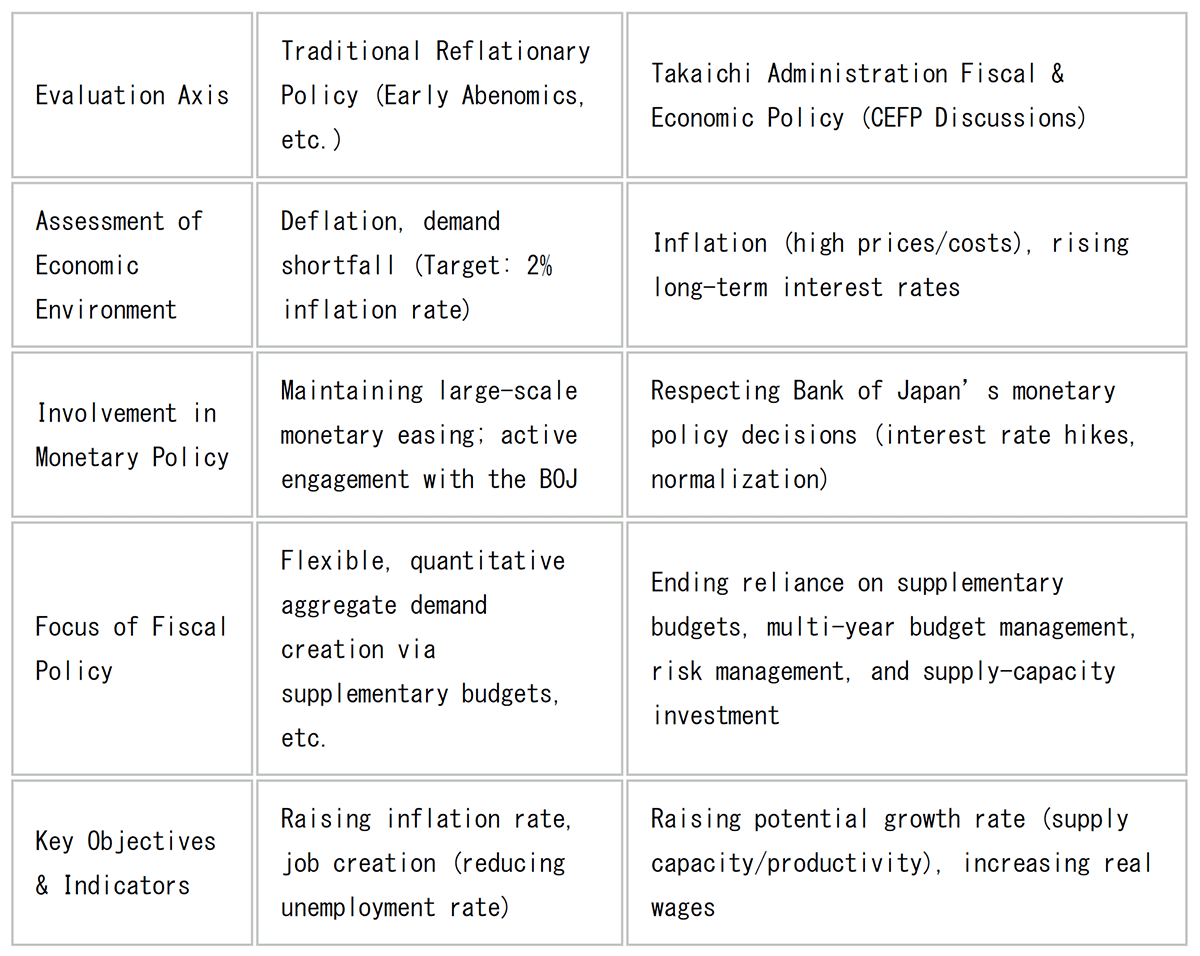
Comparing traditional reflationary policies (represented by the early phase of Abenomics) with the recent CEFP discussions under the Takaichi administration reveals a clear divergence in policy direction (Figure 1).
Figure 1: Comparison between Early Abenomics Reflationary Policy and Takaichi Administration CEFP Discussions
Source: Compiled by the author based on Council on Economic and Fiscal Policy documents
3. Background and Analysis of Non-Adoption of Reflationary Policies
Based on the deliberations at the CEFP, three main factors explain why the Takaichi administration is not adopting reflationary policies:
1. Structural Shifts in the Macroeconomic Environment (From "Deflation" to "High Inflation and Rising Interest Rates")
Reflationary policies serve as a remedy for severe demand shortfalls and deflationary cycles. However, the Japanese economy currently faces inflationary pressures driven by high crude oil prices, foreign exchange movements, supply constraints, and rising long-term interest rates. In this environment, continuing simple demand-creation reflationary measures carries significant risks of accelerating inflation and spiking yields; thus, a demand-stimulating framework has not been pursued within the CEFP.
2. Adaptation to Monetary Policy Normalization and Consideration for Interest Rates
In the minutes of the CEFP, discussions do not impede the Bank of Japan’s rate hikes or monetary policy normalization. Instead, the main focus has centered on structural adaptation to a "world with interest rates" (scrutinizing impacts on households, corporations, and public finances), with no pressure observed for unlimited quantitative expansion.
3. Shift from "Quantitative Fiscal Expansion" to "Supply Capacity Enhancement (Structural Investment)"
The focus has shifted away from quantitative demand-addition measures toward "crisis management investment" and "supply-capacity enhancement investment" in specific advanced and growth sectors, such as AI, semiconductors, energy, and economic security. Furthermore, discussions center on reducing reliance on annual large-scale supplementary budgets and maintaining medium- to long-term fiscal discipline to stabilize the debt-to-GDP ratio.
4. Conclusion
From the above analysis, the economic policy of the Takaichi administration (Takaichinomics) is not a "deflation-exit strategy via monetary easing + large-scale demand creation" as advocated by reflationists.
The reality of current policy execution has transformed into a "structural economic policy aimed at bolstering supply capacity and productivity through targeted investments in cutting-edge sectors, while adapting to an environment of interest rates and inflation." Therefore, the assertion that "the Takaichi administration is not pursuing reflationary policies" is a valid conclusion aligned with the actual discussions at the Council on Economic and Fiscal Policy.
Reference Materials: Council on Economic and Fiscal Policy Information
https://www5.cao.go.jp/keizai-shimon/english/2026_agenda.html
Disclaimer:
This report has been prepared for general information purposes only and is not intended to solicit investment. It is based on information that, at the time of preparation, was deemed credible by Daiichi Life Research Institute, but it accepts no responsibility for its accuracy or completeness. Forecasts are subject to change without notice. In addition, the information provided may not always be consistent with the investment policies, etc. of Daiichi Life or its affiliates.