




- Report Index
- Enhancing the Effectiveness of Japan’s Growth Strategy and the New PDCA Approach
- Economic Trends
-
2026.08
Enhancing the Effectiveness of Japan’s Growth Strategy and the New PDCA Approach
— Lessons from the Cool Japan Fund Case —
Toshihiro Nagahama
- Executive Summary
-
- Essential Governance & Evaluation: Strong governance and robust evaluation methods are indispensable to raising potential growth rates through public-private strategic investment. Learning from past failures such as the Cool Japan Fund, this report proposes measures to enhance policy effectiveness based on advanced international best practices.
- Four Main Causes of Failure in the Cool Japan Fund:
- Ambiguity of goals and responsibilities.
- One-time/unconditional lump-sum funding allocations.
- Lack of explicit exit rules.
- Over-concentration on single individual projects rather than portfolio management.
- Advanced International Practices:
- United States: Under the CHIPS Act and ARPA-E, funding is disbursed in stages based on multi-tier interim targets (capex, production volume, etc.), with clawback provisions for underperformance or immediate termination of underperforming projects.
- United Kingdom: The Industrial Strategy Advisory Council operates as an independent body that publicly discloses KPIs and evidence to provide objective monitoring, evaluation, and corrective recommendations.
- France: "France 2030" tracks 16 clear national-level KPIs via a public dashboard to maintain strict progress control.
- Canada & Italy: Under SIF (Canada) and PNRR (Italy), funding is tied to quantitative/qualitative milestones (employment, R&D spend, structural reforms), releasing funds in installments/reimbursements or withholding funds upon non-achievement.
- Key Recommendations under the New PDCA Framework: While taking risks and accepting failure in cutting-edge investment is inevitable and acceptable, "continuing to pour budget into underperforming projects" must be strictly eliminated. Based on the Basic Policy (Honeboto), Japan should implement:
- Milestone-Linked Phased Funding with clear 5W1H specification.
- Portfolio-Based Dynamic Budget Reallocation across 17 sectors and 62 key technologies.
- Establishment of an Independent Third-Party Advisory and Monitoring Body.
- Conclusion: Establishing governance capable of dynamically reallocating budgets according to changing circumstances and swiftly realizing rigorous mechanisms comparable to global standards is urgently required.
1. Introduction: Background and Purpose
Japan’s economic and fiscal management is shifting towards boosting the potential growth rate through strategic public-private investments. However, no matter how large a budget frame is secured, if governance and evaluation methods remain weak, policy effectiveness could be severely compromised.
Therefore, this report derives lessons from the issues seen in past public-private funds and support programs—such as the Cool Japan Fund—and proposes measures to enhance policy effectiveness drawing on advanced cases from the US, UK, France, and other nations.
2. Structural Causes of Failure in the Cool Japan Fund and Lessons Learned
The issues that arose in the Cool Japan Fund and similar entities can be summarized into four primary points:
- Ambiguity of Goals and Responsibilities: In the Cool Japan Fund, the relationship and priority between policy objectives and profitability were never properly organized, leaving quantitative KPIs and target end-points unclear. Consequently, financial viability assessments were loose, and while the core policy goal was initially "developing overseas demand," the definition of "Cool Japan" expanded over time without clear decision-making authorities or accountability.
- Method of Funding Allocation: Rather than releasing funds incrementally based on project progress, funding was disbursed almost unconditionally in upfront lump sums, despite initial plans.
- Lack of Exit Rules: Across public-private funds represented by the Cool Japan Fund, exit rules—such as defining the degree of cumulative loss deviation from plans that should trigger a freeze on new investments or deliberations on liquidation—were vague, leading to inert, prolonged support for non-performing ventures.
- Lack of Portfolio Management: Investments were evaluated individually rather than managed comprehensively as a "portfolio," lacking a mechanism to dynamically reallocate capital according to risk profiles and ongoing progress.
Summary Table: Failure Factors and Directions for Reform
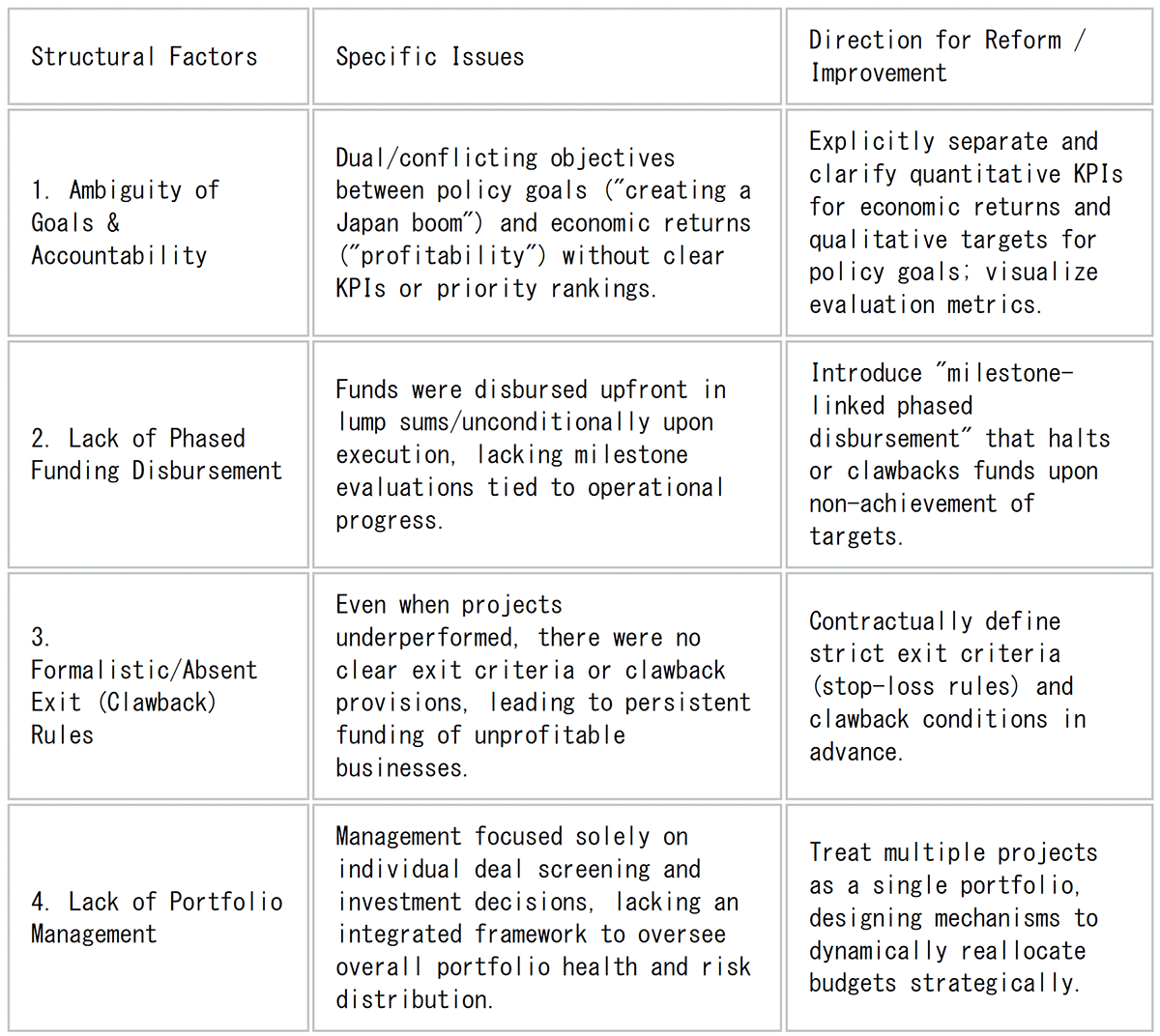
Source: Created by Dai-ichi Life Asset Management Economic Research Institute based on various sources
3. Analysis of Advanced Cases in Major Countries
In contrast, industrial policies abroad incorporate advanced institutional designs to enhance the effectiveness and discipline of government support.
- United States ("CHIPS and Science Act" & "ARPA-E"):
- CHIPS Act: Enacted in August 2022 to promote domestic semiconductor manufacturing and R&D, providing ~$52.7 billion in direct subsidies, loan guarantees, and tax credits. As a governance mechanism, subsidy disbursement requires multi-tiered "interim targets" (capex, production capacity, actual output, employment). Phased funding is the rule, and strict "clawback provisions" apply to withhold or recover funds in cases of significant target failure or national security concerns.
- ARPA-E: Operating under the US Department of Energy, ARPA-E supports high-risk, high-impact early-stage energy technology development that private investment struggles to reach. It sets strict, quantitative monthly and quarterly milestones for technical achievement and commercial viability, conducting rigorous portfolio management that immediately terminates funding for severely lagging projects mid-research.
- United Kingdom ("Industrial Strategy Advisory Council"):
- Established in December 2024 as an independent advisory body, it oversees medium-to-long-term industrial strategy design, implementation advice, and objective monitoring/evaluation. It visualizes economic indicators, KPIs, and implementation evidence for key sectors, publicly publishing progress regularly. Operating independently of political influence, it verifies policy effectiveness and issues corrective recommendations for underperforming policies.
- France ("France 2030"):
- Announced by President Macron in October 2021, this €54 billion long-term national investment plan targets growth areas such as decarbonization, semiconductors, space, biotech, and future mobility. It establishes 16 explicit national-level KPIs, managing progress strictly via a public dashboard (reporting that 14 of 16 indicators were on or ahead of schedule within three years of operation).
- Canada ("Strategic Innovation Fund - SIF"):
- Managed by Innovation, Science and Economic Development Canada, SIF is the country’s largest industrial innovation framework, targeting large-scale R&D, manufacturing expansion, and technology demonstration. Its agreements mandate milestones for job creation/retention, R&D spend, and IP retention, disbursing funds in installments or retroactively based on achievement levels.
- Italy ("National Recovery and Resilience Plan - PNRR"):
- A €200+ billion investment and reform plan funded by the EU post-pandemic recovery fund, aiming at green transition, digitalization, and competitiveness. Funding requests to the European Commission require strict fulfillment of highly detailed quantitative targets and qualitative/institutional reforms; failure to meet targets immediately results in withheld or reduced disbursements.
Source: Created by Dai-ichi Life Asset Management Economic Research Institute based on various sources
4. "New PDCA" and Recommendations for Enhancing Effectiveness Based on the Basic Policy
In Japan’s growth strategy investments in cutting-edge fields, the "risk of failure" is inevitable and should be tolerated; however, "continuing to pour budget into failed projects" must be strictly eliminated.
As stated in the Basic Policy 2026 (Honeboto 2026), Japan must thoroughly enforce:
- Contractually specify "Who, What, and By When" targets must be achieved.
- Establish clear milestones across R&D stages, capex execution, employment, and actual production volume, tying funding releases strictly to achievement levels.
- Avoid fixating on the success or failure of individual technologies.
- Treat the entire strategic domain as a single "portfolio," making early decisions to downsize or exit fields where achieving results becomes difficult, and rapidly shifting recovered financial resources toward thriving sectors or emerging technologies.
- Modeled after the UK Industrial Strategy Advisory Council, establish an independent third-party institution to regularly publish evidence and visualize policy effectiveness, thereby raising the precision of the PDCA cycle.
Conclusion
As Japan’s growth strategy enters the full-scale implementation stage, failure is an inherent part of investing across 17 sectors and 62 key technologies. The occurrence of underperforming projects is a natural assumption and should not itself be overly criticized.
What is paramount is establishing governance that executes a rigorous PDCA cycle, manages strategic domains as a unified portfolio, and effectively reallocates budgets in response to changing circumstances. To strongly back the direction of the Basic Policy and guarantee responsible, proactive fiscal management, the prompt realization of strict mechanisms comparable to global standards is urgently required.
Disclaimer:
This report has been prepared for general information purposes only and is not intended to solicit investment. It is based on information that, at the time of preparation, was deemed credible by Daiichi Life Research Institute, but it accepts no responsibility for its accuracy or completeness. Forecasts are subject to change without notice. In addition, the information provided may not always be consistent with the investment policies, etc. of Daiichi Life or its affiliates.