




- Report Index
- Commentary on the Council on Economic and Fiscal Policy (July 21, 2026)
- Economic Trends
-
2026.07
Commentary on the Council on Economic and Fiscal Policy (July 21, 2026)
–Draft Japan Growth Strategy & Draft Basic Policy on Economic and Fiscal Management and Reform 2026 –
Toshihiro Nagahama
- Executive Summary
-
- Shift to "Responsible Proactive Fiscal Policy": Breaking away from past investment shortages and deflationary mindsets, Japan aims to reach a "Nominal GDP scale approaching 1,100 trillion yen" and "Domestic private capital investment of 250 trillion yen" by FY2040, with FY2027 designated as the first year. While securing financial resources by creating a "Strong and Prosperous Japan Investment Framework" (free from conventional expenditure caps) and utilizing Special Accounts, the government aims to break away from reliance on supplementary budgets and achieve a stable reduction in the ratio of national and local government debt to GDP.
- Portfolio Support for 17 Strategic Fields: Support will be provided for 62 key products/technologies across 17 strategic fields (such as AI/Semiconductors, GX, Defense, Advanced Healthcare, etc.) managed as a portfolio across 3 phases aligned with timeframes: ① Commercialization & Mass Production, ② Demonstration/Proof of Concept, and ③ R&D.
- 8 Cross-Sectoral Issues: To extend investment spillover nationwide, specific targets and policies are set for: ① New Technology Nation/Competitiveness, ② Startups (Target: 100,000 companies), ③ Financial Utilization, ④ Human Resource Development (50% science/tech university capacity), ⑤ Labor Market Reform, ⑥ Reduction of Household/Care Burden, ⑦ Wage Increase Environment (Real wages +1%/year target), and ⑧ Cybersecurity.
- Regional Future Strategy: To spread the growth strategy's impact across Japan, three plans will be promoted: "Strategic Industrial Clusters," "Regional Industrial Clusters," and "Local Industry Growth Plans," backed by expanded grants and dedicated human resource development frameworks.
- Author's Proposal: Drawing lessons from past cumulative losses like the Cool Japan Fund, the author emphasizes guarding against funding without clear discipline or exit strategies. By incorporating global standards seen in Western nations (e.g., US CHIPS Act, UK Industrial Strategy Advisory Council, France 2030) such as strict KPI management, clawback/return provisions, and progress monitoring, Japan must ensure "5W1H-based PDCA" and "portfolio management" to reallocate budgets dynamically, thereby guaranteeing a "Responsible Proactive Fiscal Policy."
1. Introduction
At the Council on Economic and Fiscal Policy held on July 21, 2026, the Draft Japan Growth Strategy and the Draft Basic Policy on Economic and Fiscal Management and Reform 2026 (commonly known as Honefuto / Basic Policy) were presented and discussed.
Based on the meeting documents, this paper outlines the discussions held during the Council meeting and presents the author's opinions.
2. Overview of the Growth Strategy & "Responsible Proactive Fiscal Policy"
Japan is shifting to a "Responsible Proactive Fiscal Policy" that aims to strengthen supply capacity, expand economic scale, and generate natural tax revenue increases by breaking away from past "investment shortages" and deflationary mindsets. Setting FY2027 as the inaugural year, the policy targets reaching a "Nominal GDP approaching 1,100 trillion yen" and "Domestic private capital investment of 250 trillion yen" by FY2040.
First, under the establishment of the "Strong and Prosperous Japan Investment Framework," traditional spending ceilings (uniform cuts) will not be applied. Instead, a mechanism will be introduced to appropriately secure required funds based on multi-year plans. Furthermore, fields critical to economic security will be managed separately under Special Accounts, leveraging bridge bonds to secure adequate scale.
Second, regarding fiscal sustainability, while prioritizing a stable reduction in the national/local debt-to-GDP ratio, the policy seeks to phase out dependence on supplementary budgets by funding permanent measures within initial annual budgets.
3. Promoting 17 Strategic Fields and Public-Private Investment
The strategy identifies 62 "Key Products and Technologies" across 17 strategic fields, estimating a cumulative public-private investment exceeding 370 trillion yen by FY2040.
To ensure sustainable growth through timeframe-aware portfolio management, the 62 items are categorized into three development phases:
- Commercialization & Mass Production Phase (Current Revenue Sources / 37 items): Semiconductors, Vertical AI, Gaming, Biopharmaceuticals, Data Centers, etc.
- Demonstration Phase (Next Earnings Drivers / 20 items): Physical AI, Autonomous Driving Technology, Quantum Computing, Hydrogen, Offshore Wind, etc.
- Research & Development Phase (Future Seeds of Growth / 5 items): Next-Generation Wireless, Fusion Energy, Quantum Communication & Networks, etc.
Note: The 17 Strategic Fields are:
AI & Semiconductors / Digital & Cybersecurity / Info-Communications / Quantum / Defense Industry / Aerospace / Maritime / Shipbuilding / Advanced Materials / Synthetic Biology & Bio / Drug Discovery & Advanced Healthcare / Resource & Energy Security & GX / Fusion Energy / Disaster Prevention & National Resilience / Port Logistics / Foodtech / Content.
4. Addressing "8 Cross-Sectoral Issues" to Expand Investment Nationwide
To consolidate the foundation for domestic investment and spread its impact nationwide, key issues and targets have been set as follows:
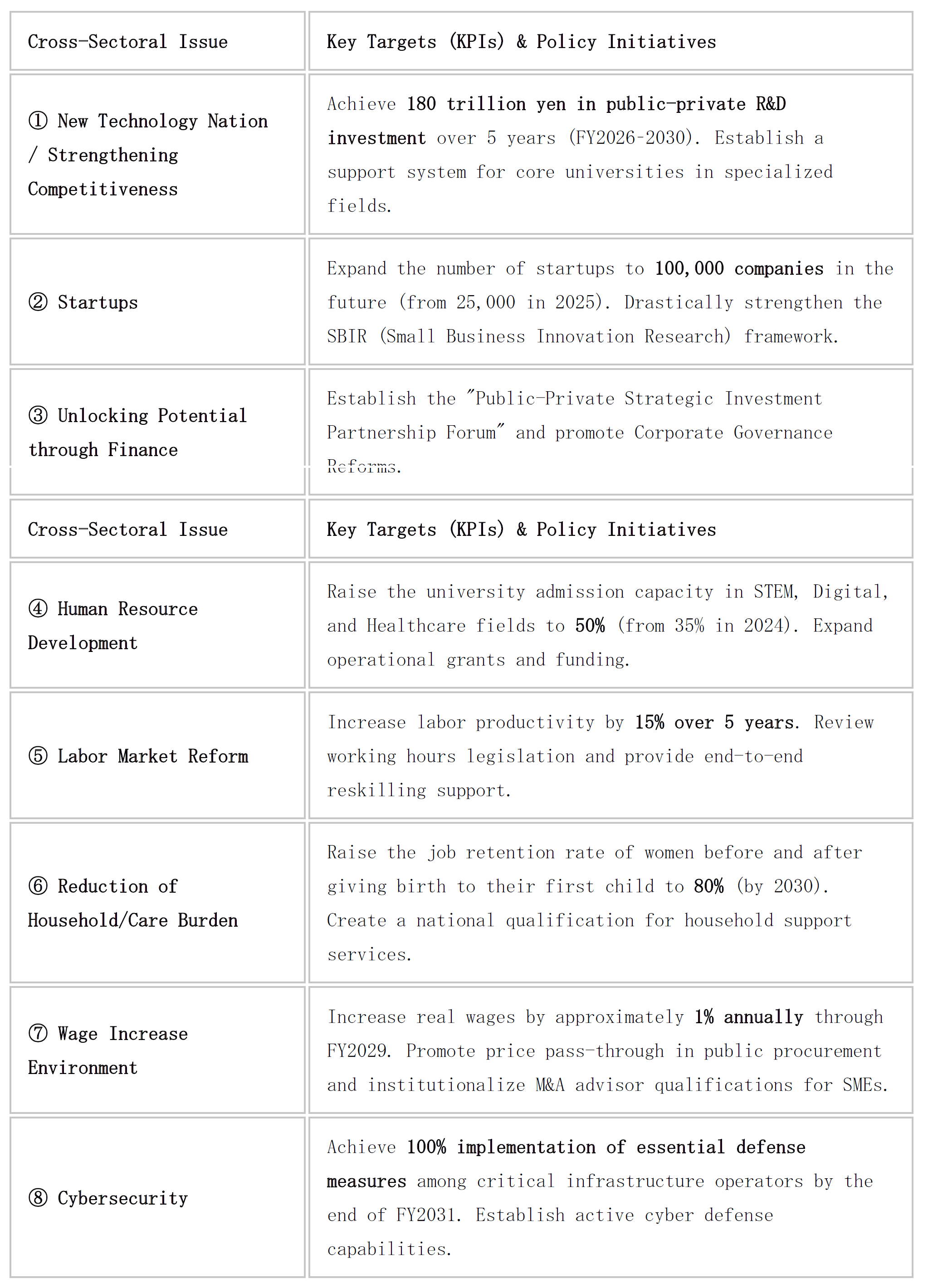
Source: Cabinet Office
5. Alignment with the "Regional Future Strategy" (Industrial Clusters)
To deliver the growth strategy's investment benefits nationwide, three types of regional plans will be supported:
- Strategic Industrial Cluster Plan: Initiated by large-scale investments in the 17 strategic fields, national-level special budget frameworks will prioritize infrastructure (roads, ports) and site development.
- Regional Industrial Cluster Plan: Prefectural-led initiatives promoting investment in supply chain enterprises.
- Local Industry Growth Plan: Municipal-led programs aimed at nurturing local industries.
Common Support Mechanisms: Expanding "Regional Future Grants," enacting local fiscal measures, and establishing industry-academic-government talent development quotas utilizing practical educational institutions (technical colleges, specialized high schools, etc.).
6. Author's Proposals
Based on the above, the author submitted proposals at the Council meeting concerning the Japan Growth Strategy from three perspectives: "Enforcing Past Lessons & Systemic Discipline," "Global Standard Case Studies," and "Portfolio-Based Governance."
- Enforcing Past Lessons & Systemic Discipline: Taking past failures like the Cool Japan Fund's cumulative losses as a warning, Japan must prevent fiscal damage caused by capital provision lacking clear discipline or exit strategies. Under the Takaichi Administration, the government must strictly execute the "5W1H-focused PDCA" and "Strategic Field Portfolio Management" explicitly stated in the Honefuto policy.
- Global Standard Case Studies: In major overseas nations, strict progress management mechanisms are delivering results—such as milestone-linked funding and clawback clauses under the US CHIPS Act, evidence verification by the UK Industrial Strategy Advisory Council, and 16 KPI management systems under France 2030.
- Portfolio-Based Governance: Across advanced investments in 17 fields and 62 technologies, not all projects will succeed; underperforming fields during the process are acceptable. The crucial point is to manage the entire strategic spectrum as a single portfolio, maintaining the governance to dynamically reallocate budget allocations based on changing circumstances through strict PDCA. The author recommended implementing overseas-standard discipline and oversight frameworks early on to guarantee a truly "Responsible Proactive Fiscal Policy."
Disclaimer:
This report has been prepared for general information purposes only and is not intended to solicit investment. It is based on information that, at the time of preparation, was deemed credible by Daiichi Life Research Institute, but it accepts no responsibility for its accuracy or completeness. Forecasts are subject to change without notice. In addition, the information provided may not always be consistent with the investment policies, etc. of Daiichi Life or its affiliates.