




- Report Index
- Why “Support for People’s Livelihoods” and National Security should not be Treated as a Trade-off in Japan’s General Election
- Flash Insight
-
2026.1
Why “Support for People’s Livelihoods” and National Security should not be Treated as a Trade-off in Japan’s General Election
Masumi Ishizuki
1. National security should not be overlooked in an election where “support for people’s livelihoods” is a key issue
On January 23, 2026, Prime Minister Takaichi dissolved the House of Representatives, triggering a general election for Japan’s lower house. In this election, policy debate is expected to center primarily on measures to address rising prices and support people’s livelihoods. Inflation directly affects everyday life—food, clothing, and housing—and it is natural for such issues to emerge as key electoral themes in a healthy democracy. At the same time, however, the national security environment has become dramatically more severe compared with just a few years ago, or even with the previous House of Representatives election held in October 2024. If national security attracts relatively little attention as an electoral issue, this should be a cause for concern.
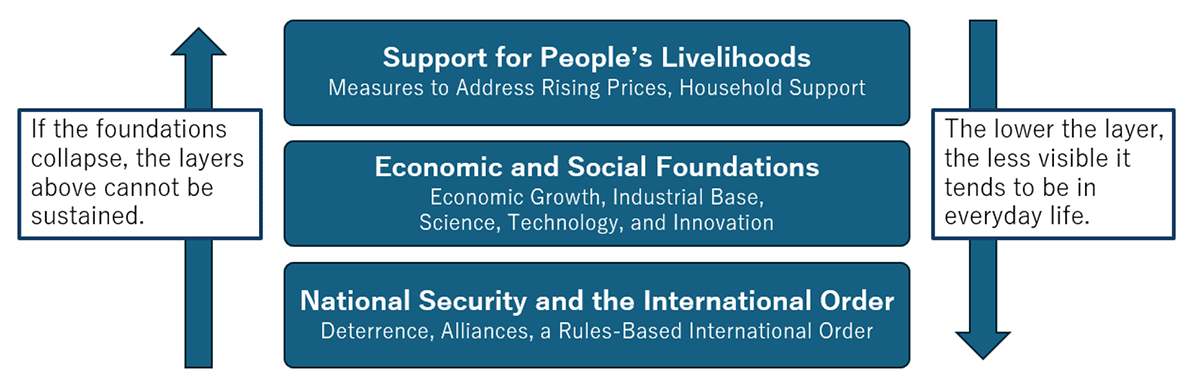
We have witnessed how Ukrainian society was fundamentally transformed by Russia’s invasion. Yet for those of us living in Japan, where economic and social foundations remain relatively stable, national security can be difficult to perceive as an immediate issue (see Material). In particular, as an island nation, Japan’s public sense of crisis regarding national security is, in reality, lower than that observed in many European countries.
Support for people’s livelihoods and national security should not be viewed as a binary opposition. To protect people’s lives and daily living, national security must remain a stable premise. Neglecting national security risks overlooking this premise.
In this paper, the term “national security” is used with primary emphasis on military security. At the same time, it reflects the reality that, as discussed later, national security is increasingly and inseparably connected to economic security and growth strategies through dual-use technologies and science and technology policy.
Material: Conceptual illustration of the relationship between support for people’s livelihoods and national security — not a binary trade-off
Source: Dai-ichi Life Research Institute
2. The world is increasingly shaped by the “power” of major states
The current international order is gradually shifting from the rule of law toward the rule of power.
As noted above, the global security environment has changed profoundly over the past several years. Russia’s invasion of Ukraine in February 2022 represents a case in which a permanent member of the United Nations Security Council openly disregarded Ukraine’s sovereignty and attempted to alter the status quo by force. Since President Trump assumed office in January 2025, this harsh environment has further intensified. President Trump has asserted claims over the Panama Canal and Greenland, and in January 2026 dispatched troops to Venezuela and detained its president—actions and statements that appear to show little regard for the sovereignty of other states.
The United States National Security Strategy released in December 2025 adopts an unprecedentedly assertive tone. With respect to Europe, it portrays inclusive values and increased immigration as factors that could weaken alliances. Against the “rules-based international order” grounded in international law, including the United Nations Charter—that is, the rule of law—militarily powerful states such as the United States and Russia are now openly advancing challenges based on the rule of power.
For a time following Russia’s invasion of Ukraine, the term “Yalta 2.0” emerged in Russian discourse, evoking the post–World War II Yalta Conference and implying a world order shaped by the United States, China, and Russia. While no such framework formally exists today, are we not beginning to hear its footsteps growing louder? The United States, China, and Russia rank as the world’s top three countries in terms of military expenditure. Should these three powers attempt to reshape the international order by placing “power” above existing rules, the situation would be deeply troubling.
3. Japan’s choice: maintaining deterrence while working with middle powers to uphold a rules-based international order
Japan cannot confront military great powers solely through its own strength and must therefore rely on alliances. As argued in my previous work, alliance-dependent Japan, in particular, needs to demonstrate enhanced deterrence in relative terms compared with other U.S. allies. While maintaining its relationship with the United States, Japan requires a certain level of “power” sufficient to contribute to deterrence. Free-riding on the military capabilities of other countries—seeking a “free lunch”—will not be tolerated by partners.
At the same time, this does not imply disregarding the rule of law in any way. Japan must maintain deterrence while continuing to emphasize the importance of the rule of law and demonstrating that commitment through concrete actions. The trust Japan has earned since World War II as a peace-oriented nation—particularly among Southeast Asian countries—is a valuable diplomatic asset.
Japan should pursue both deterrence and the rule of law by working with other middle powers—such as European countries, Australia, Canada, and South Korea—for whom the rule of law is existentially important and which, like Japan, cannot compete with great powers single-handedly. This is the path Japan should take. Such an approach is also effective in strengthening relations with the Global South.
4. Support for people’s livelihoods and national security are structurally inseparable— Defense investment should be viewed as growth investment, not merely as a cost
While consumption tax cuts are being debated as concrete measures to support people’s livelihoods, planned tax increases to fund defense spending may appear contradictory at first glance. However, this is a matter of policy design, which is distinct from the issue addressed in this paper: how to secure national security as a prerequisite for sustaining people’s livelihoods.
The narrative that prioritizing national security leads to reduced support for people’s livelihoods may be intuitively appealing. The logic is straightforward: when resources are limited, emphasizing one priority tends to come at the expense of the other. However, two points deserve particular attention.
First, as discussed above, national security is a prerequisite for daily life and cannot be separated from it. If a country is invaded or threatened by force, the very foundation of support for people’s livelihoods collapses. Second is whether defense investment is regarded merely as a cost or instead as an investment in growth.
While some weapons systems must inevitably be procured from abroad, it is important to produce as much as possible domestically, broaden the industrial base of the defense sector, and foster it as a growth industry—one that also considers exports in cooperation with allies and like-minded countries. This requires positioning defense as part of a broader growth strategy that includes science and technology and dual-use applications.
The draft of Japan’s Seventh Science, Technology, and Innovation Basic Plan (FY2026–2030) clearly emphasizes the importance of national security, economic security, and dual-use technologies. National security and science and technology budgets are increasingly being placed “on the same map.” If this approach strengthens research and development, industrial competitiveness, and employment, it will contribute to Japan’s economic growth and reinforce its fiscal foundation. Positioning national security as growth investment and linking it to economic and fiscal strength would also help create the conditions for sustainable—not merely temporary—support for people’s livelihoods.
Rather than framing support for people’s livelihoods and national security as a binary opposition, national security should be understood as a prerequisite for sustaining daily life. On this basis, it is hoped that Japan’s general election will see a mature and constructive debate.
Original in Japanese:
https://www.dlri.co.jp/report/ld/565819.html
Disclaimer:
This report has been prepared for general information purposes only and is not intended to solicit investment. It is based on information that, at the time of preparation, was deemed credible by Daiichi Life Research Institute, but it accepts no responsibility for its accuracy or completeness.