




- Report Index
- How Can We End the Perception That Becoming a Manager Is a Punishment?
- DLRI Report
-
2025.11
How Can We End the Perception That Becoming a Manager Is a Punishment?
Saki Takamiya
Why Management Positions Are Perceived as Punishment
Recently, it has been reported in Japan that many people feel that being promoted to a managerial position is more of a punishment than a reward.
In the past, promotion to managerial positions was considered a symbol of financial stability and social status in Japan. At that time, lifetime employment and seniority-based promotion were common, and there was an implicit assumption that if you put in the effort, you would eventually become a manager. At that time, managers enjoyed better pay and benefits and held significant authority, making the position highly desirable among employees.
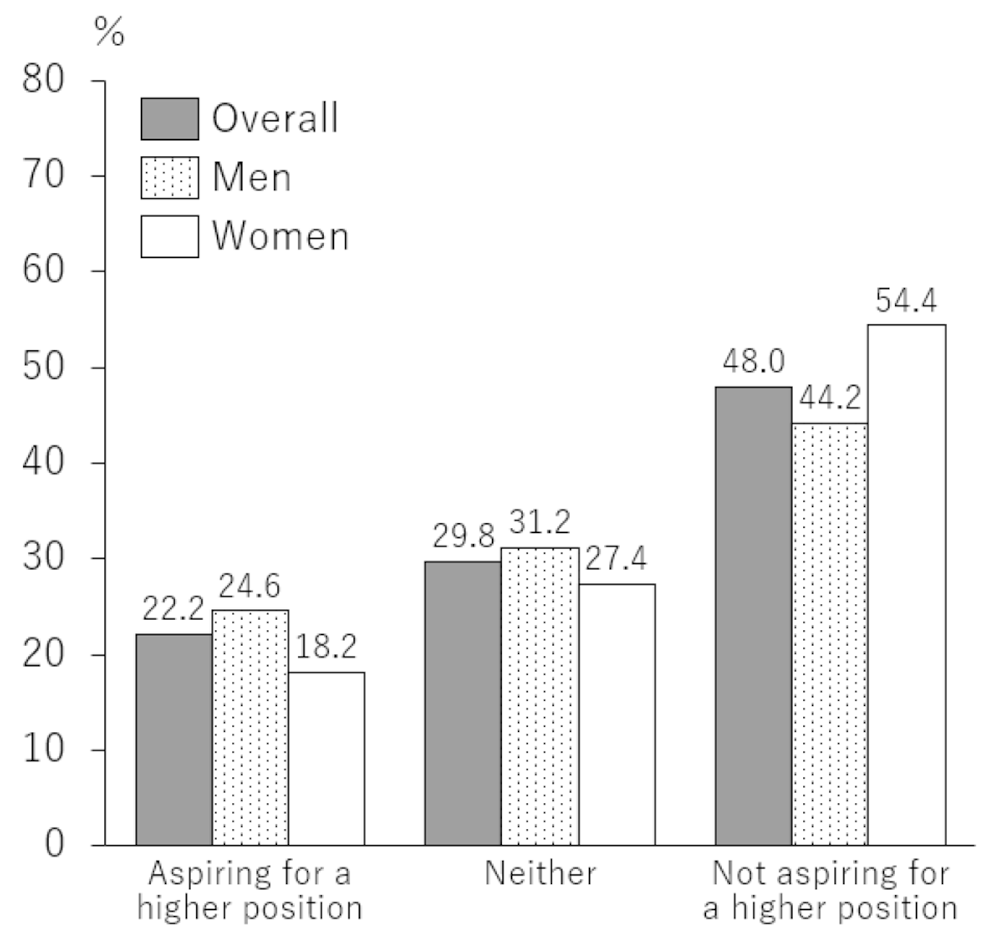
In March 2025, our research institute surveyed 2,927 non-managerial employees, asking whether they aspired to a higher position such as manager or executive. As a result, 22.2% of respondents said they were aspiring to a higher position, while 48% said they did not wish to be promoted, indicating that a significant number of employees are reluctant to take on managerial roles (Figure).
Figure: Aspiration for Promotion to Managerial or Executive Positions Among Non-Managerial Employees
Source: Dai-ichi Life Research Institute
Note: "Aspiring" combines "Strongly agree" and "Somewhat agree"; "Not aspiring" combines "Somewhat disagree" and "Disagree".
Possible reasons for this include the expansion of diverse career paths outside managerial positions — such as working across organizational boundaries, engaging in side jobs, freelancing, and starting one’s own business — which may have made managerial roles relatively less attractive.
Another possible reason is that, in addition to the work style reforms promoted by many companies in recent years, the workload and responsibilities of managers have increased, partly due to the need to address issues such as harassment prevention, and the mental health and engagement of their subordinates. In addition, when employees are promoted to managerial positions, they no longer receive allowances such as overtime or holiday pay that general employees are entitled to.
As a result, in some cases, managers may earn less than general employees. Despite the increased workload and responsibilities, limited salary increases, and insufficient allowances may contribute to the decreased attractiveness of managerial positions.
How Can We Reduce the Burden on Managers?
As digital transformation (DX) progresses, parts of managerial duties related to operational management, such as monitoring work progress, are expected to be replaced by AI and other technologies in the future. However, human resource management — such as developing subordinates, providing mental health support, boosting motivation, and fostering organizational culture — requires tailored approaches for each individual. It is unlikely that AI will be able to replace these tasks in the near future, potentially leading to a future shortage of managers.
As a measure to reduce the burden on managers, a certain Japanese company has introduced a personnel policy that splits managerial roles — such as project management and human resource development — among multiple people (management sharing), effectively increasing the number of managerial positions.
In Germany, some companies have introduced a tandem system, also known as job sharing, in which two people share a single managerial position. This system was introduced to enable full-time employees who work shorter hours due to childcare or caregiving responsibilities to remain in managerial positions. It is generally applied only in specific cases.
Reducing the burden on managers is not just about alleviating their existing workload. By redefining the role of managers within the overall organizational structure, companies can ultimately strengthen the organization and are expected to contribute to medium- to long-term growth.
Original in Japanese:
https://www.dlri.co.jp/report/dlri/534664.html
Disclaimer:
This report has been prepared for general information purposes only and is not intended to solicit investment. It is based on information that, at the time of preparation, was deemed credible by Daiichi Life Research Institute, but it accepts no responsibility for its accuracy or completeness.