




- Report Index
- Shifts in the Preferred and Actual Places of Life’s Final Moments in Japan: The Influence of Public Attitudes Since 2010 (Summary)
- Flash Insight
-
2025.7
Shifts in the Preferred and Actual Places of Life’s Final Moments in Japan: The Influence of Public Attitudes Since 2010 (Summary)
Tomoya Sudo
1. Introduction
Our research institute is strengthening its research on demographic issues. This report examines how Japanese public attitudes influence the changing proportions of the "place to spend one's final moments" since around 2010.
It should be noted that the end-of-life experience of life ought to be determined based on each individual's will and dignity. While this report presents general trends in changes in the actual places of death, we neither intend to praise nor criticize any particular way of spending one's final days.
2. Japanese Public Attitudes Towards the "Place to Spend One's Final Moments"
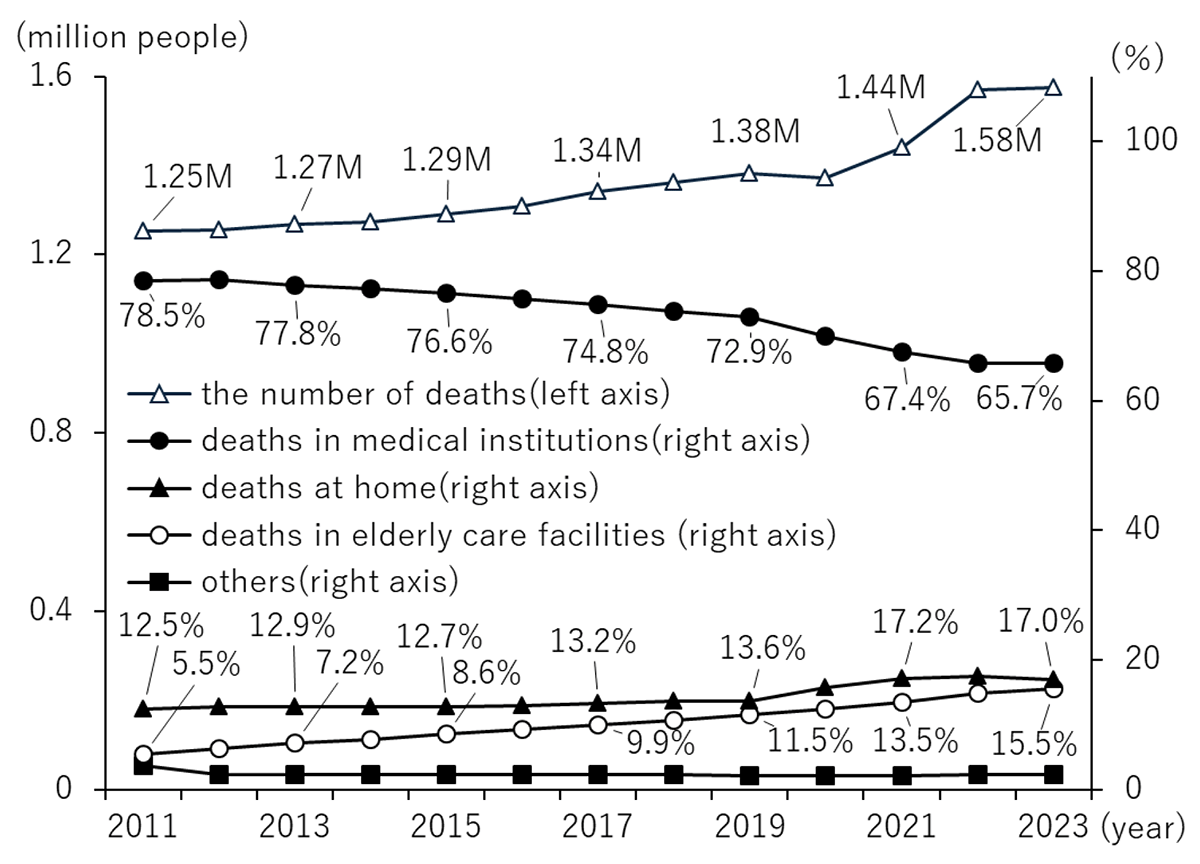
Material 1 summarizes, based on surveys by the Ministry of Health, Labour and Welfare (the MHLW), changes in the number of deaths from 2011 to 2023 in Japan, as well as changes in the breakdown of actual places of death.
Material 1: Changes in the Number of Deaths & Changes in the Breakdown of Actual Places of Death in Japan
Source: Compiled by Dai-ichi Life Research Institute based on materials published by the MHLW.
Material 1: Changes in the Number of Deaths & Changes in the Breakdown of Actual Places of Death in Japan
Source: Compiled by Dai-ichi Life Research Institute based on materials published by the MHLW.
Examining the changes in the number of deaths, we see a year-on-year increase. Additionally, examining the changes in the breakdown of actual places of death, we see that the proportion of deaths in elderly care facilities has increased, as has the proportion of deaths at home. Meanwhile, the proportion of deaths in medical institutions has decreased.
This report examines how Japanese public attitudes may have influenced these changes.
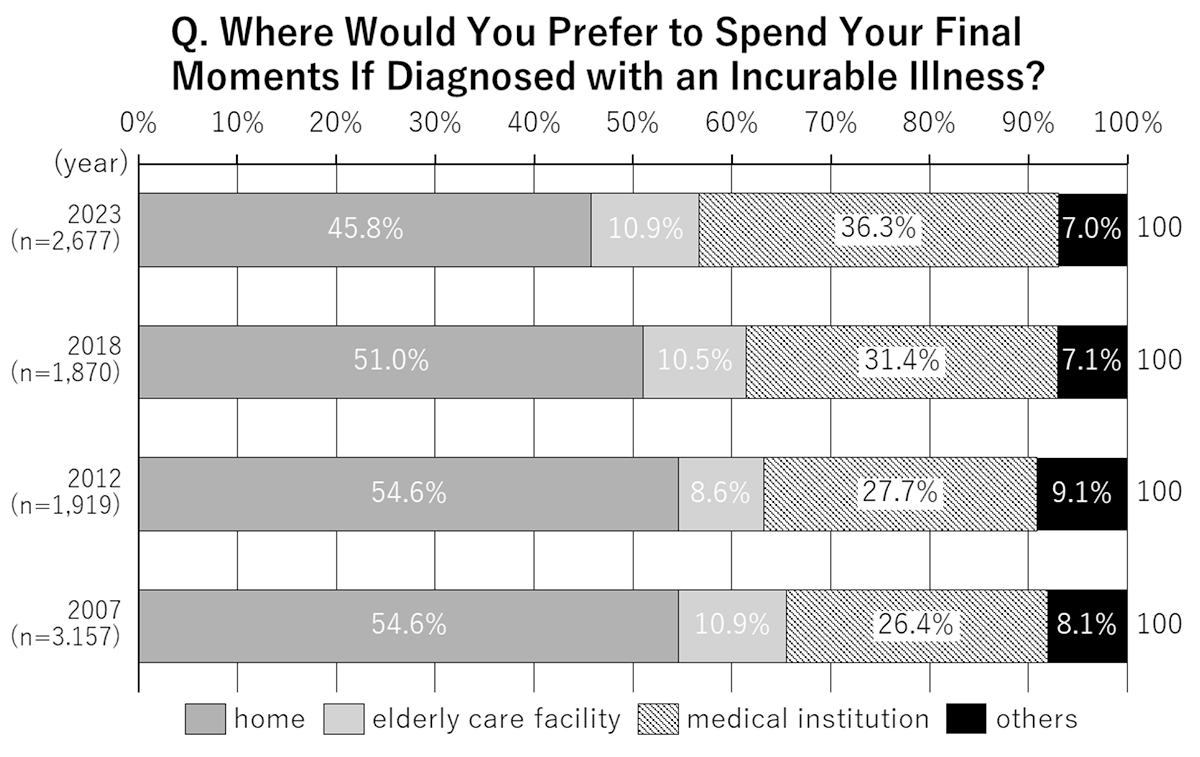
First, we refer to the results of surveys conducted by the Cabinet Office regarding Japanese citizens' preferences for their place to spend their final moments (Material 2). These surveys were conducted in 2007, 2012, 2018, and 2023.
Material 2: The Results of Surveys on the Preferred "Place to Spend One's Final Moments" (by the Cabinet Office)
Source: Compiled by Dai-ichi Life Research Institute based on materials published by the Cabinet Office.
Material 2: The Results of Surveys on the Preferred "Place to Spend One's Final Moments" (by the Cabinet Office)
Source: Compiled by Dai-ichi Life Research Institute based on materials published by the Cabinet Office.
Across all surveyed years, the highest proportion of respondents expressed a preference to spend their final moments at home. The proportions of people who preferred medical institutions or elderly care facilities were both lower than home.
When viewing trends over time, however, the proportion of people wishing to spend their final moments in a medical institution has increased year by year, while the proportion preferring to be at home has declined. The proportion who wish to spend their final moments in elderly care facilities has remained largely unchanged.
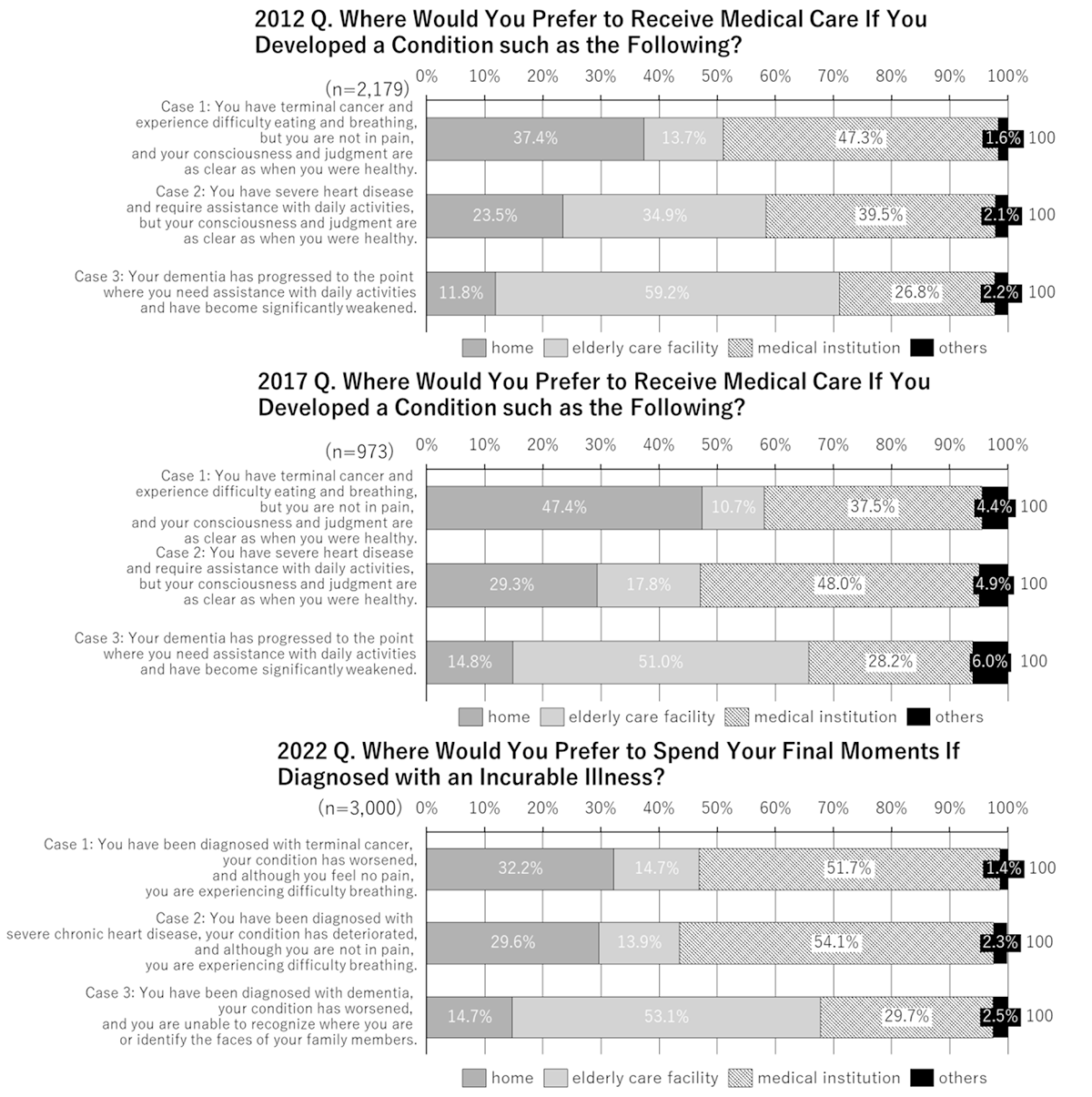
Next, we examine the results of surveys conducted by the MHLW regarding Japanese citizens' preferences for the "place to spend one's final moments" in specific scenarios (Material 3). These surveys were conducted in 2012, 2017, and 2022.
Material 3: The Results of Surveys on the Preferred "Place to Spend One's Final Moments" (by the MHLW)
Source: Compiled by Dai-ichi Life Research Institute based on materials published by the MHLW.
Material 3: The Results of Surveys on the Preferred "Place to Spend One's Final Moments" (by the MHLW)
Source: Compiled by Dai-ichi Life Research Institute based on materials published by the MHLW.
The survey results show that, unlike the Cabinet Office survey results, home was not consistently the highest preference for the "place to spend one's final moments" across all scenarios. In some scenarios, the proportions of people who preferred medical institutions or elderly care facilities as their "final place of residence" were higher than those who preferred home.
Comparing the Cabinet Office and the MHLW surveys shows that differences in how questions are posed lead to a range of different results. Based on these survey results, Japanese public attitudes regarding their preferred place to spend their final moments have not been fixed since around 2010. Preferences can shift depending on conditions and specific situations, indicating that people's choices regarding their place to spend their final moments are subject to change.
3. Japanese Public Expectations Towards the "Place to Spend One's Final Moments"
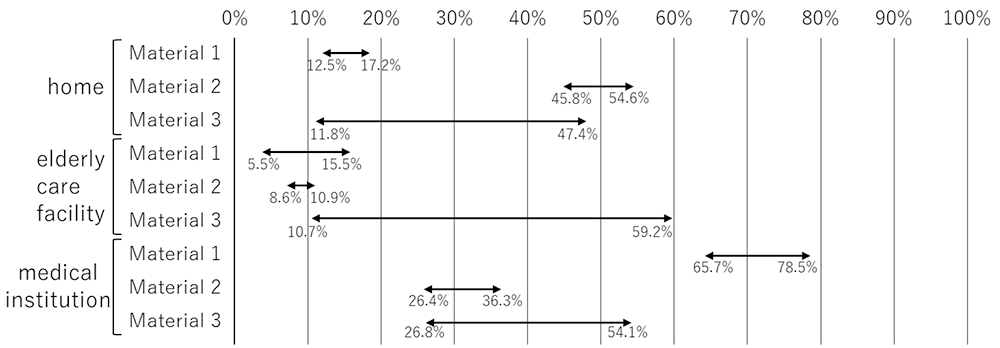
As discussed above, Japanese public attitudes regarding where to spend their final moments are diverse and fluctuate. Material 4 shows the results of summarizing the ranges of variations in the proportions explained in Materials 1, 2 and 3.
Material 4: Range of Variations in the Proportion of Actual Places of Death and the Preferred "Place to Spend One's Final Moments" explained in Material 1, 2 and 3
Source: Compiled by Dai-ichi Life Research Institute.
Material 4: Range of Variations in the Proportion of Actual Places of Death and the Preferred "Place to Spend One's Final Moments" explained in Material 1, 2 and 3
Source: Compiled by Dai-ichi Life Research Institute.
From this, it is apparent that, since around 2010, there has been a gap between the actual places of death and people's preferences for where they wish to spend their final moments.
For example, between 2011 and 2023, the proportion of deaths occurring at home was about 12–17%, but the proportion of respondents expressing a preference to spend their final moments at home was 45–54% in the Cabinet Office survey and 11–47% in the MHLW survey.
Additionally, while the proportion of deaths in elderly care facilities from 2011 to 2023 fluctuated between 5% and 15%, the proportion of respondents who indicated elderly care facilities as their desired lace to spend their final moments ranged from 8% to 10% in the Cabinet Office survey and from 10% to 59% in the MHLW survey.
By contrast, the proportion of deaths in medical institutions was 65–78%, while the proportion indicating a preference for medical institutions as their place to spend their final moments was 26–36% (the Cabinet Office) and 26–54% (the MHLW).
Taking these fluctuations into account, it is suggested that, in some cases, the expectation to spend final moments at home or in elderly care facilities has been higher than the actual proportion of people dying at those locations since around 2010.
Furthermore, regardless of specific context, the expectation to spend final moments in a medical institution has consistently remained lower than the actual proportion of deaths occurring in medical institutions.
As noted previously, in Japan since around 2010, the proportion of deaths occurring in elderly care facilities and at home has gradually increased, while deaths in medical institutions have decreased.
In summary, when considering how public attitudes in Japan may influence changes in the distribution of the "place to spend one's final moments", it can be pointed out that expectations regarding the "place to spend one's final moments" may be acting as a force for changes in the relative proportions of deaths occurring in elderly care facilities, at home, and in medical institutions.
Original in Japanese:
https://www.dlri.co.jp/report/ld/485524.html
Disclaimer:
This report has been prepared for general information purposes only and is not intended to solicit investment. It is based on information that, at the time of preparation, was deemed credible by Daiichi Life Research Institute, but it accepts no responsibility for its accuracy or completeness.