



- Report Index
- A Re-examination of "Japanese Traditional Companies"(JTC)
- DLRI Report
-
2025.07
A Re-examination of "Japanese Traditional Companies"(JTC)
Saki Takamiya
What is JTC?
"JTC" is an acronym for "Japanese Traditional Company" and refers to a company with traditional Japanese characteristics. It is an internet slang term that emerged on the internet and social media, and it lacks a clear, formal definition. In 1958, James C. Abegglen identified "lifetime employment," "seniority-based system," and "company-based unions" as the three pillars of the so-called Japanese employment system. However, the term JTC is not strictly confined to this definition and is used in a broader sense. Generally, it is used to ridicule or self-deprecate the negative customs and organizational cultures unique to long-established Japanese companies. While the media tends to focus on large corporations, any company that fosters such a culture is called a JTC, regardless of its size. According to a survey by Nikkei Inc. on X (formerly Twitter), there were more than 240,000 posts using the term in the period from January to mid-December 2023. Specific examples from these posts include: "Younger employees are expected to organize company athletic meets and trips," "An excessive amount of internal coordination is required," "Employees acquire internal coordination skills but not skills that are useful externally," "In our top-down culture, email recipients must be listed in order of seniority," and "There are too many formal procedures, leading to a lack of speed."
In this article, we will examine how these "negative customs and organizational cultures unique to Japanese companies" affect employees and the companies themselves.
Can organizational climate be measured?
Organizational climate encompasses a wide range of elements, from tangible aspects like evaluation systems to intangible ones like workplace atmosphere and motivation. Is it possible to measure such a climate? As an example, the Cabinet Office conducted the "Survey of Corporate Attitudes toward a Diversifying Workforce" in February 2019. This survey analyzes Japan's traditional organizational climate through the lens of "Japanese employment practices." The degree of these practices is analyzed using three variables: "average length of service," "turnover rate," and "the degree to which seniority is considered in wages." This approach measures organizational climate by focusing primarily on "hard" aspects such as personnel systems.
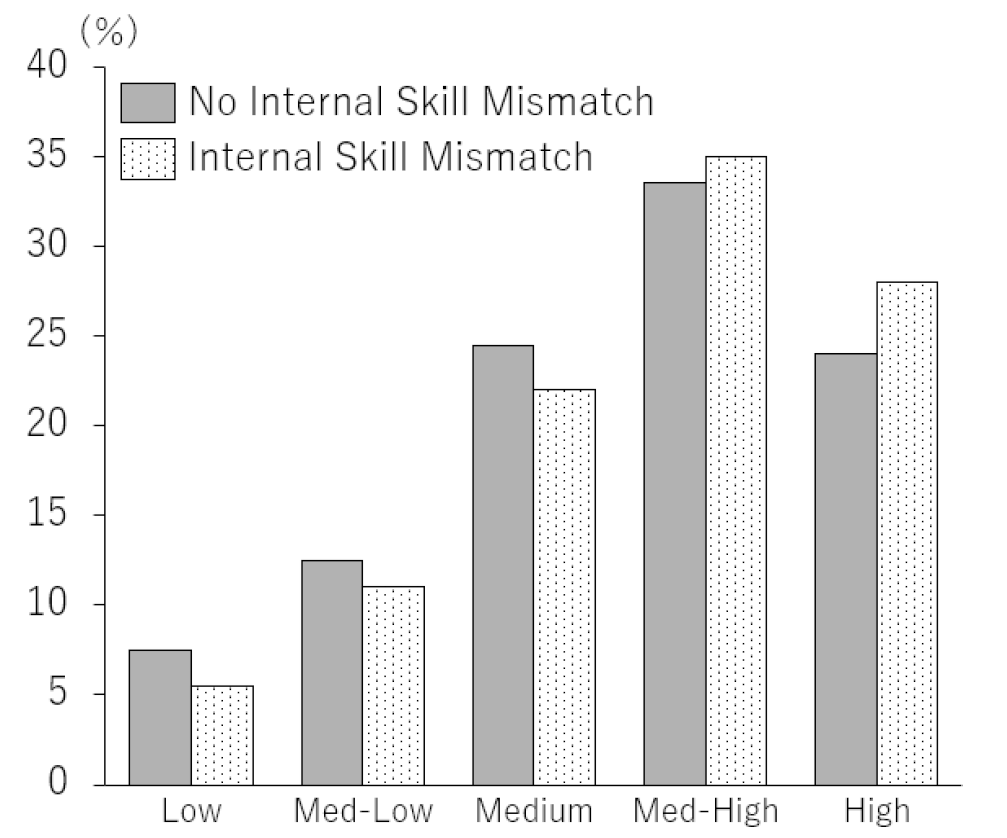
The analysis confirms that companies with strong Japanese employment practices, characterized by long-term employment and seniority-based wages, are more likely to experience internal skill mismatches (Note 1) (Figure 1). In such companies, human resource management tends to be based on seniority, which can lead to these mismatches and pose challenges to the active participation of a diverse workforce.
Figure 1: Japan Employment Practices and Internal Skill Mismatch
Source: Cabinet Office (2019) "Fiscal Year 2019 Annual Economic and Fiscal Report"
Figure 1: Japan Employment Practices and Internal Skill Mismatch
Source: Cabinet Office (2019) "Fiscal Year 2019 Annual Economic and Fiscal Report"
How does a traditional organizational climate affect employees?
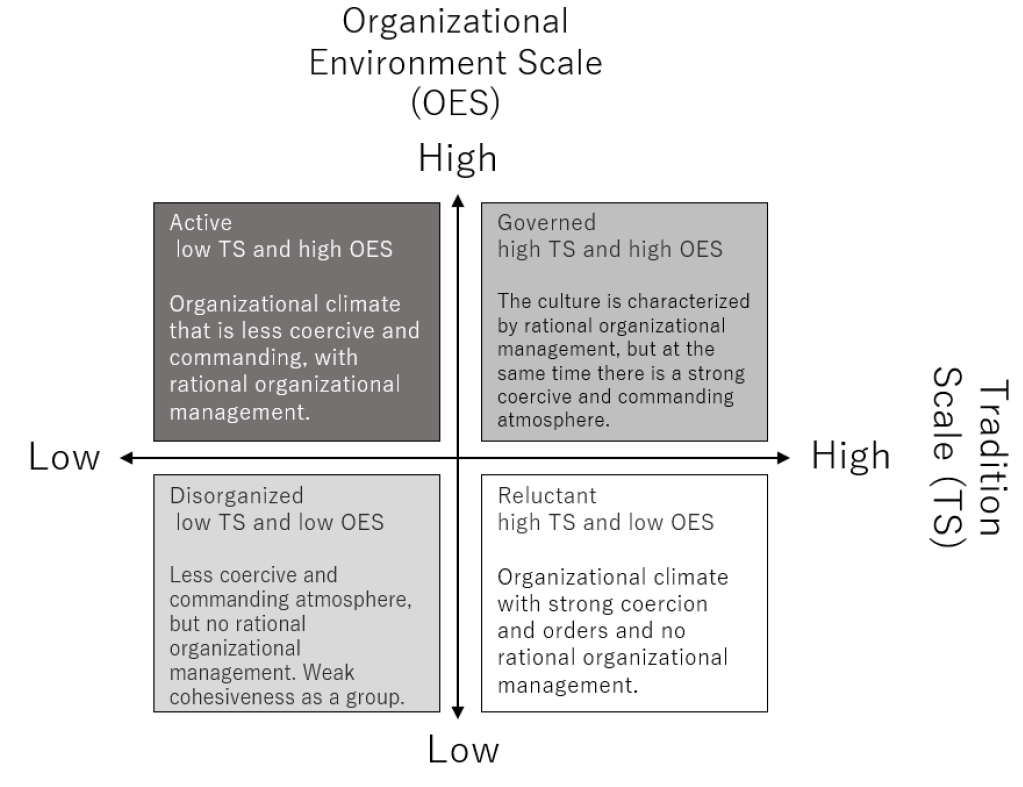
A significant body of academic research exists on the measurement of organizational climate. While various scales exist, here we introduce the 12-item Organizational Climate Scale (OCS-12) (Fukui, 2004), which has been validated for full-time employees at private companies in Japan. This scale has two subscales: the "Tradition Scale (TS)," which measures a coercive, imperative, and feudal climate, and the "Organizational Environment Scale (OES)," which measures a climate of high employee participation and rational organizational management.
Specific questions on the Tradition Scale include, "There is a tendency for the company to neglect the existence of the individual," and "Most employees regard the traditions and customs of their company as strictly enforced." The Organizational Environment Scale includes questions like, "The results of meetings are used effectively for subsequent tasks," and "Guidance from middle managers is detailed and meticulous."
Based on the scores of these two scales, organizational climate is classified into four types: Active, Governed, Disorganized, and Reluctant (Figure 2). Companies referred to as JTCs would fall into the Governed type (high TS, high OES) or the Reluctant type (high TS, low OES), both located on the right side of Figure 2.
Figure 2: Organizational Climate Scale: 4 Types
Source: Fukui, et al. (2004) " Measuring Workplace Climate: Reliability and Validity of the 12-item Organizational Climate Scale (OCS-12)
Figure 2: Organizational Climate Scale: 4 Types
Source: Fukui, et al. (2004) " Measuring Workplace Climate: Reliability and Validity of the 12-item Organizational Climate Scale (OCS-12)
A multiple comparison of these four types revealed that the mental health levels of employees ranked in the following order: Active (low TS, high OES), Disorganized (low TS, low OES), Governed (high TS, high OES), and Reluctant (high TS, low OES).
Notably, mental health is worse in the Governed type than in the Disorganized type, despite the former having a higher OES. This result indicates that even if rational organizational management is in place (high OES), employee mental health will suffer if the climate is highly traditional (high TS). This underscores the significant impact that a coercive, command-driven atmosphere, which enforces company traditions and customs, has on employees.
Furthermore, a higher TS has been confirmed to correlate with a higher quantitative workload, greater interpersonal conflict within groups, increased role conflict (Note 2), and lower job control.
It is clear that organizational climate is a critical factor affecting not only employee mental health but also workplace vitality and productivity. The first step in transforming the organizational climate is to accurately assess the current state of your organization.
Ultimately, "JTC" is a subjective evaluation of a company by its employees. For instance, an employee who feels a sense of satisfaction from meaningful dialogue with management about their role and career path is unlikely to label their company a "JTC." This can be true even if their work environment has traditions that an external observer might consider rigid. Reforming an organizational climate requires close communication between employees and management.
[Notes]
- An internal skill mismatch describes a situation where a shortage of personnel in one age group or job category coexists with a surplus in another. This imbalance occurs regardless of the company's overall staffing shortage.
- Role conflict arises when the expectations of one role conflict with the expectations of another. In the workplace, it often occurs in middle managers, who must balance the roles of both superior and subordinate. For example, middle managers may experience significant conflict when instructed by their superiors to "increase the utilization rate" while facing manpower shortages on-site.
[References]
- Fukui, et al. (2004) " Measuring Workplace Climate: Reliability and Validity of the 12-item Organizational Climate Scale (OCS-12)
Original in Japanese:
https://www.dlri.co.jp/report/dlri/485494.html
Disclaimer:
This report has been prepared for general information purposes only and is not intended to solicit investment. It is based on information that, at the time of preparation, was deemed credible by Daiichi Life Research Institute, but it accepts no responsibility for its accuracy or completeness.