




- Report Index
- Japan's Economic Policy 2025: Analyzing the Honebuto Framework
- Economic Trends
-
2025.6
Japan's Economic Policy 2025: Analyzing the Honebuto Framework
Takuya Hoshino
- Executive Summary
-
- The Cabinet approved Basic Policy 2025 on June 13, marking the first such policy framework under the Ishiba administration. While fundamentally continuing the previous administration's "New Form of Capitalism" with its emphasis on wage increases and industrial policy, the new framework demonstrates a stronger regional focus, reflecting Prime Minister Ishiba's commitment to "local revitalization."
- Regarding fiscal policy, notable changes include increased flexibility in the primary balance (PB) target—with achievement timing shifted from FY2025 to a range of FY2025-2026—and consideration of inflation adjustments across various public systems. This could have far-reaching implications for social security systems and other policy areas. For local revitalization, the standout initiative is the "Furusato Resident Registration System," which envisions allowing dual-area residents to maintain sub-resident registration. While the detailed framework remains to be determined, its effectiveness as an economic revitalization tool will become clearer through the design process.
We will accept press inquiries and interviews. Please contact us hoshino@dlri.co.jp.
Basic Policy 2025: Maintaining Overall Framework from Kishida Administration
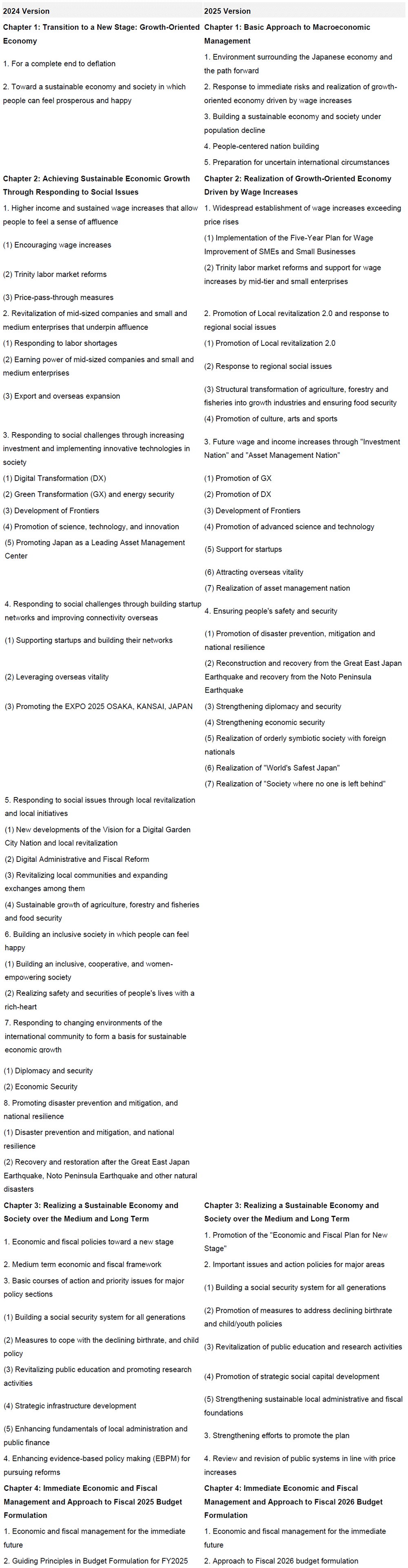
At the Economic and Fiscal Advisory Council meeting on June 6th, the draft Basic Policy 2025 was presented, which was subsequently approved by the Cabinet on June 13. This marks the first Basic Policy formulation under the Ishiba administration, which took office in October of last year. Table 1 compares the structure (table of contents) with last year's version. It maintains the same four-chapter structure as last year, with the basic framework remaining unchanged. Chapter 1 addresses the current macroeconomic environment and economic management approach, Chapter 2 covers specific economic policies such as wage increases and industrial policy, Chapter 3 focuses on fiscal consolidation plans and social security reforms, and Chapter 4 outlines the approach for next year's budget formulation. The content itself also inherits the "New Form of Capitalism" approach from the Kishida administration.
Table 1. Structure of Basic Policy 2025
Table 1. Structure of Basic Policy 2025
Source: Cabinet Office, Dai-ichi Life Research Institute.
Source: Cabinet Office, Dai-ichi Life Research Institute.
Word Cloud Analysis of Basic Policy: "Local" Shows Significant Increase
Creating a word cloud from the Basic Policy 2025 reveals the "Ishiba color." Reflecting Prime Minister Ishiba's policy focus on local revitalization, the frequency of "Local" has increased significantly (2024: 70 times → 2025: 128 times), becoming one of the most frequently appearing words in the document. Other frequently appearing words include traditional ones such as "investment" (75 times → 58 times), "technology" (87 times → 88 times), and "research" (78 times → 70 times). The appearance frequency of "investment" and "research" has somewhat decreased, suggesting that industrial policy has been de-emphasized in favor of regional initiatives Additionally, while not appearing in the word cloud, the word "tariffs" (0 times → 7 times) has emerged with President Trump's inauguration.
Table 2. Word Cloud of Basic Policy
Table 2. Word Cloud of Basic Policy
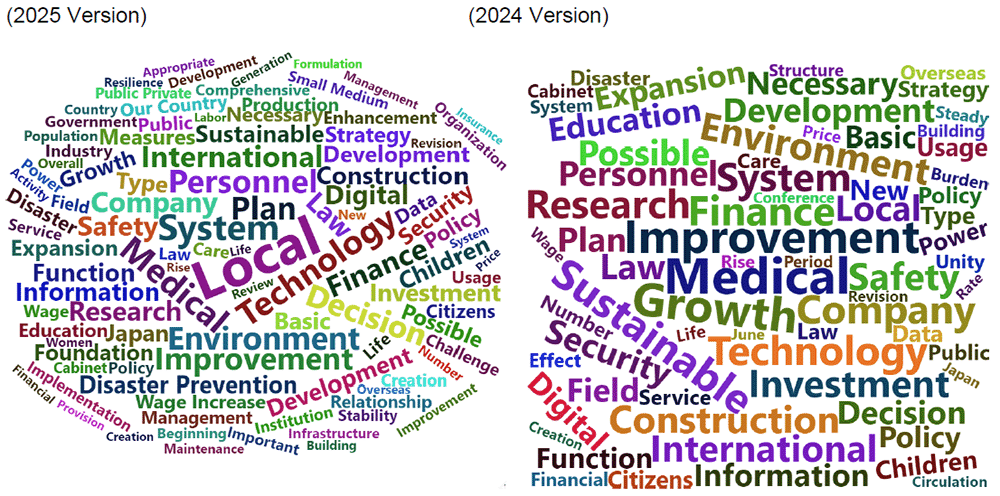
Note: Words that are frequently used but not directly related to policy content have been excluded by the author's judgment. Japanese terms in the word clouds have been translated into English for international readers.
Note: Words that are frequently used but not directly related to policy content have been excluded by the author's judgment. Japanese terms in the word clouds have been translated into English for international readers.
Source: Cabinet Office, Dai-ichi Life Research Institute.
Source: Cabinet Office, Dai-ichi Life Research Institute.
Key Points by Major Areas
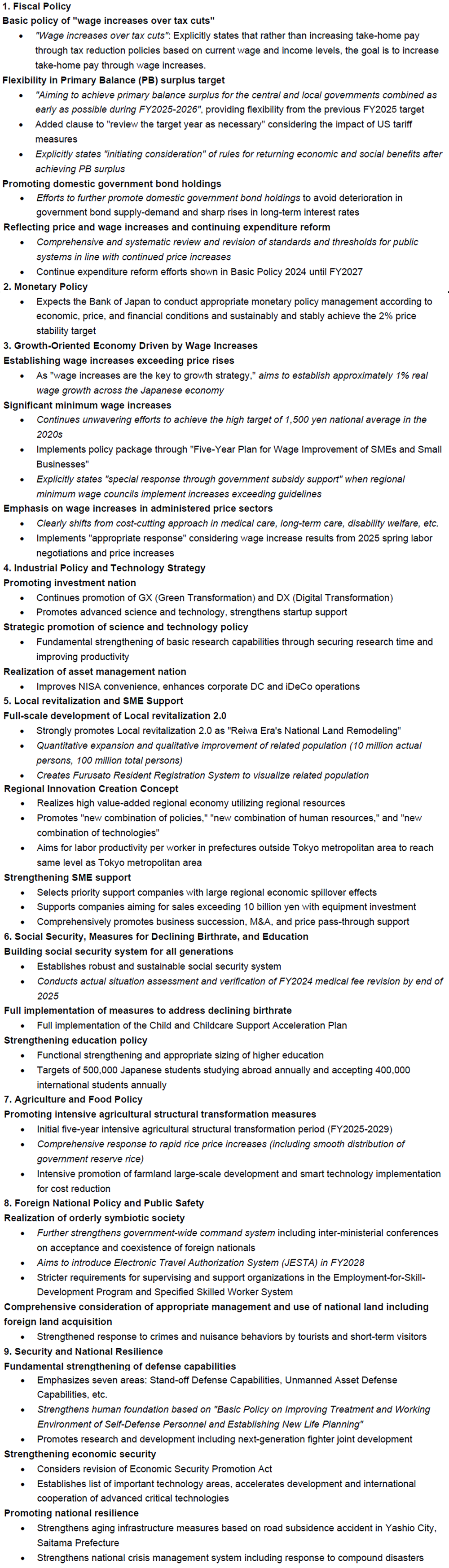
Table 3 provides a more detailed and comprehensive summary. Highlighting some key points focusing on changes from last year:
Regarding fiscal policy, the direction of "wage increases over tax cuts" has been explicitly stated. This serves as a substantial check against opposition parties advocating for consumption tax and other tax cuts. Also, in response to current concerns about long-term interest rate increases, efforts to further promote domestic government bond holdings have been indicated. The original primary balance target of achieving surplus in FY2025 has been revised to "achieving primary balance surplus for the central and local governments combined as early as possible during FY2025-2026." This appears to provide flexibility in the target timing considering concerns about global economic deterioration due to Trump tariffs (a factor for tax revenue decline) and autumn supplementary budget formulation. Additionally, as a minor but important point, the review and revision of standards and thresholds for public systems in line with price increases has been explicitly stated. This follows the "income barriers" issue that caused heated debate between ruling and opposition parties toward the end of last year and is currently being discussed in the Tax Commission. A mechanism for inflation adjustment of public systems in general is being considered. This appears to be intended to increase the linkage of medical and long-term care public prices to inflation, potentially having wide-ranging impacts centered on social security. Future developments in this discussion will be closely watched.
Regarding wage increases, numerical targets for "real wages" that were not previously included have been specified, aiming for approximately 1% increase. Also, "minimum wage of 1,500 yen in the 2020s" has been explicitly stated. To achieve this, government subsidy support has been indicated for cases where increases exceed the guideline. Last year, Tokushima Prefecture implemented a significant 84 yen increase, far exceeding the national guideline. Currently, the government assesses that general negative effects of minimum wage increases (employment reduction) have not been observed, and there is an intention to expand such efforts to other regions.
Regarding local revitalization, the Furusato Resident Registration System for visualizing "related population" (people who are connected to specific regions without residing there, distinguished from exchange population who visit temporarily such as tourists), and targets of 10 million actual persons and 100 million total persons for related population have been set. This system is envisioned to allow people engaged in "dual-area residence" to register as sub-residents in municipalities they are connected to, in addition to their main residential registration. Details such as who would be eligible, how voting rights would be handled, etc., will be determined through future deliberation. The effectiveness as a regional economic revitalization measure will gradually be determined through this process.
Table 3. Key Points of Basic Policy 2025
Table 3. Key Points of Basic Policy 2025
Source: Cabinet Office, Dai-ichi Life Research Institute.
Source: Cabinet Office, Dai-ichi Life Research Institute.
Original in Japanese:
https://www.dlri.co.jp/report/macro/465674.html
Disclaimer:
This report has been prepared for general information purposes only and is not intended to solicit investment. It is based on information that, at the time of preparation, was deemed credible by Daiichi Life Research Institute, but it accepts no responsibility for its accuracy or completeness. Forecasts are subject to change without notice. In addition, the information provided may not always be consistent with the investment policies, etc. of Daiichi Life or its affiliates.