




- Report Index
- Ishiba's Economic Agenda: A Departure from Kishida's "Growth First" Approach?
- Economic Trends
-
2024.9
Ishiba's Economic Agenda: A Departure from Kishida's "Growth First" Approach?
Takuya Hoshino
- Executive Summary
-
- With Shigeru Ishiba's victory in the LDP presidential election, the focus is on his stance on economic and fiscal policy. While Ishiba has historically prioritized fiscal consolidation over economic growth, his campaign rhetoric suggests an initial alignment with the "economic growth > fiscal discipline" approach of the outgoing Kishida administration.
- The forthcoming stimulus package is expected to focus on inflation control, regional revitalization through local allocation tax subsidies, a "three-pillar set" of labor market reform, addressing income inequality, and promoting corporate investment. The framework largely mirrors that of previous economic measures under the Kishida administration, with a possible emphasis on regional development.
- The size of the economic package is expected to be about the same as last year. Although Ishiba's personal stance and the "normalization of the fiscal expenditure structure" outlined in the June Basic Policy point to a smaller supplementary budget, significant cuts are unlikely in the run-up to the general election.
- The possibility of a corporate tax hike is increasing. While the groundwork was laid under the Kishida administration with the previous tax reform outline, Ishiba's endorsement of a possible increase during the LDP leadership race adds weight. As Ishiba has repeatedly stated his intention to "entrust tax reform to the party's tax panel", a more pronounced fiscal consolidation stance may emerge during discussions on the tax reform outline towards the end of the year.
We will accept press inquiries and interviews. Please contact hoshino@dlri.co.jp.
Ishiba to Become Next Prime Minister: What's Next for Economic and Fiscal Policies?
Shigeru Ishiba secured victory in the Liberal Democratic Party (LDP) presidential election on September 27, paving the way for his appointment as Japan's next prime minister. Let's examine the potential implications for Japan's economic and fiscal policies. Table 1 summarizes the policies of current Prime Minister Kishida, Ishiba, and the two leading candidates in the LDP presidential election, Takaichi and Koizumi.
Table1. Policies of Prime Minister Kishida and Top Candidates
in the LDP Presidential Election
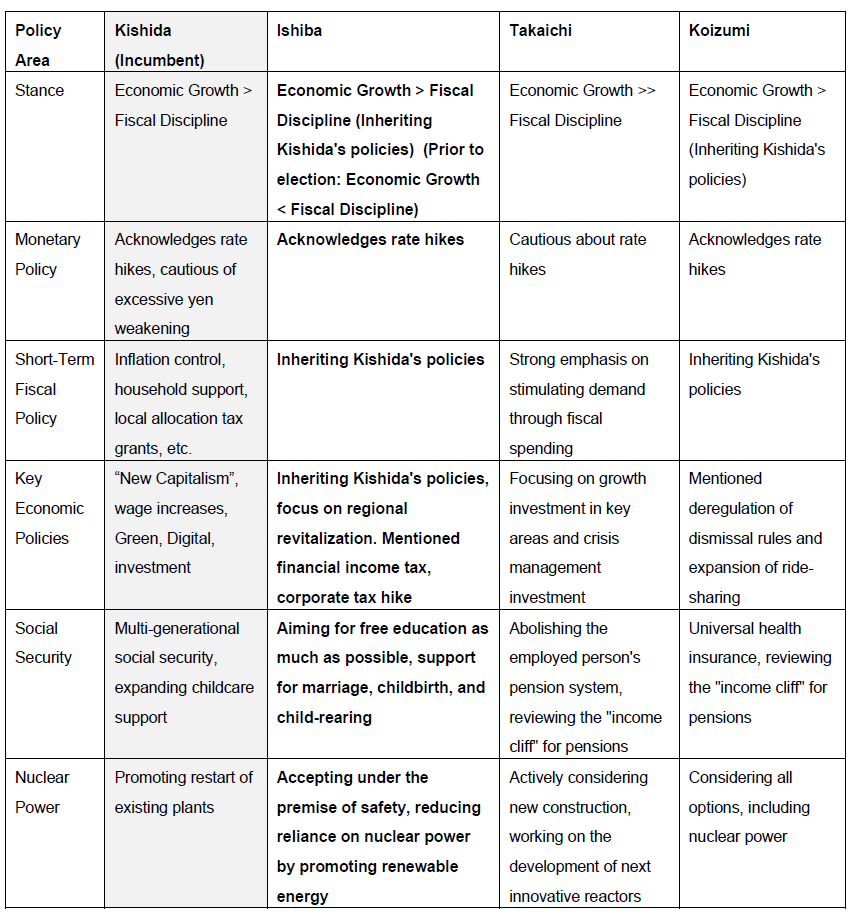
Source: Created by Dai-Ichi Life Research Institute based on various news reports, etc.
Ishiba has long advocated fiscal consolidation and tighter monetary control, opposing the "Abenomics" framework. However, his campaign for the LDP leadership marked a departure from his traditional stance. With statements such as "fiscal policy should support economic growth" and "economic and fiscal management should prioritize escaping deflation," he signaled a shift toward prioritizing economic growth over immediate fiscal tightening. After the election, he emphasized his intention to "inherit the economic policies of the Kishida administration. On monetary policy, he has stated in interviews that he "will not change the accommodative monetary policy stance," respecting a continuation of the Bank of Japan's current approach. The likelihood of significant upward pressure on interest rates under an Ishiba administration seems minimal.
In essence, Ishiba is aligning himself with the economic policy direction of the outgoing prime minister. Given the popularity of pro-stimulus policies among voters, as evidenced by the support for a rival candidate Takaichi, a sharp shift toward fiscal tightening seems unlikely. This is consistent with the trajectory of the Kishida administration, which initially sought to turn away from Abenomics and emphasized fiscal consolidation and income redistribution through measures such as the financial income tax. However, it gradually shifted to a growth-oriented policy centered on public-private partnership investment.
Fiscal policy focus: Priority on escaping deflation
About fiscal policy, the immediate focus is on the upcoming fiscal stimulus package and the supplementary budget to support it. Reports indicate that Ishiba has already ordered the drafting of both.
Table 2 shows Ishiba's intended short-term economic measures. The stimulus fiscal package is expected to revolve around five pillars: (1) fighting inflation, (2) regional revitalization, (3) the "three-pillar set" of labor market reform, (4) income redistribution and strengthening of social safety nets, and (5) promoting Japan as an "investment powerhouse. Policies targeting inflation, regional development, labor market reform, and investment in areas such as DX and GX (Digital and Green Investment) are consistent with the direction set by the Kishida administration. However, the emphasis on "income redistribution and strengthening social safety nets" marks a departure, reflecting Ishiba's focus on regional considerations and strengthening social safety nets. The prioritization of regional revitalization, which ranks second in his agenda, over public-private investment, which ranks last, may signal Ishiba's policy priorities. His rival, Ms. Takaichi, had made public-private investment a top priority.
Our current forecast for the fiscal stimulus package size is "comparable in size to last year," when a package of about 17 trillion yen was implemented, supported by a supplementary budget of 13.1 trillion yen (the difference was largely due to temporary tax cuts implemented in the FY2024 budget). Ishiba's personal stance leans toward fiscal consolidation, and the Basic Policy drafted under Prime Minister Kishida also calls for "normalization of the fiscal expenditure structure," indicating a preference for reducing the supplementary budget. However, an overt withdrawal of stimulus measures ahead of a general election seems unlikely. Local allocation tax subsidies, a key component of recent stimulus packages, may be strengthened under Ishiba's emphasis on regional revitalization.
Table2. Framework of Economic Measures Proposed by Ishiba
during LDP Presidential Election
- Inflation Control Measures
Protecting corporate economic activities and people's livelihoods from price increases until wage growth accompanies price rises (realizing a virtuous cycle of wages and prices). - Regional Revitalization 2.0
Halting the outflow of population from rural areas and correcting the adverse consequences of excessive concentration in Tokyo by creating regions that are attractive to young people, especially women. Utilizing ICT and other technologies to maximize the potential of local areas and revitalize their economies. - Labor Market Reform
Breaking away from outdated systems and practices to create workplaces where individuals can freely choose their work style without facing disadvantages. Promoting the "three-pillar set" labor market reform to facilitate labor mobility to growth sectors and realizing sustainable and structural wage increases by raising labor share. As part of the growth strategy, working towards raising the minimum wage to an average of 1,500 yen nationwide by the 2030s, considering the actual conditions of regional economies. - Addressing Income Disparities and Establishing a Stable Social Safety Net
Conducting a thorough review of the social security system based on objective data to rebuild a transparent and sustainable system. Utilizing My Number and other tools to establish a "push-type" social safety net system. - Promoting Investment
Examining measures such as strengthening corporate governance reforms and reviewing the corporate tax system to create a more strategic approach, to promote all investments, including Digital and Green, with a particular focus on human capital investment and impact investing.
Source: Created by Dai-Ichi Life Research Institute based on various materials..
Will regional revitalization focus on "regional growth" or "regional distribution"?
A key point of interest in Ishiba's economic strategy is the content of his emphasis on regional revitalization. In a recent interview (Jiji Press, Sep 20), he emphasized the activation of regional economies through the revitalization of agriculture, forestry, fisheries, and service industries, with the aim of creating regions that attract young women and counteract population migration. While he envisions encouraging unmarried women to move to regional areas to address the declining birth rate, specific policies remain unclear.
In another interview, he mentioned encouraging Japanese companies to return home. Currently, amid efforts to diversify the supply chain and the weaker yen, regions such as Kyushu and Tohoku are witnessing a surge in domestic and foreign investment in semiconductor-related facilities. Focusing on strengthening this trend would be a clear and feasible regional growth strategy. It is noteworthy,
however, that the previous interview emphasized "agriculture, forestry, fishing, and services," leaving out manufacturing and construction. This suggests a possible concern that relying solely on industries with a high proportion of male workers, such as manufacturing and construction, would not effectively address the exodus of women from regional areas.
As Ishiba's economic policies take shape, a key point to watch is whether his regional revitalization plan will emphasize "allocation" to regional areas (especially to the elderly) or "growth" within these regions. The forthcoming economic package is expected to provide early insights, which the market will be watching closely.
The possibility of a corporate tax hike is increasing
There are three main reasons why we believe that a corporate tax hike is becoming more of a reality under the Ishiba administration.
First, the groundwork for a corporate tax hike was already laid under the Kishida administration. The 2024 Tax Reform Outline formulated last year clearly states that "the possibility of raising the corporate tax rate in the future needs to be considered," suggesting a possible increase in the medium to long term. It also takes a critical view of past corporate tax cuts, stating that "it cannot be denied that recent corporate tax reforms have not necessarily achieved the expected results". Arguments for raising corporate taxes include (1) the lack of incentives for firms, which are reluctant to invest or raise wages despite various preferential tax regimes, and (2) the fact that many countries are choosing to raise corporate taxes as a source of revenue for public and private investment, in line with the global trend of shifting from corporate tax cuts to tax increases. Given the direction of the Kishida administration, it is only natural that Mr. Ishiba, who "inherits" the Kishida administration, would follow suit with the corporate tax increase.
Second, during the LDP presidential election, Mr. Ishiba has consistently stated that he will "entrust the party's Tax System Research Committee with the discussion of tax issues. This means that he will accept the leadership of the party's tax panel, which drafted last year's tax reform blueprint. Since the committee is dominated by fiscal hawks, it is highly likely that it will lean toward tax increases.
Third, in Mr. Ishiba's economic policy outline, there is an explicit reference to a "strategic corporate tax system," which is consistent with the points mentioned above (as you see table2). There is a possibility that Mr. Ishiba will not explicitly propose a corporate tax increase in his initial economic policy, as this may contradict his own argument that economic growth should take precedence over fiscal consolidation. However, there is a possibility that this direction will be strengthened in the tax reform outline at the end of the year.
Ishiba has also hinted at the possibility of raising other taxes. However, his initial proposal to raise the financial income tax has lost support due to public opposition. Judging by the market's reaction after his election victory, it is highly likely that this proposal will not move forward.
Ishiba said that he is "not considering" raising the consumption tax at this time but added that "it is possible to discuss it in the party's tax panel," leaving open the possibility of its implementation in the future. However, as the other candidates have also expressed a cautious stance, it will be difficult to reach an agreement on this issue, and it is unlikely to be implemented soon.
However, the expansion of free education expressed by Ishiba is noteworthy. The current free early childhood education and free higher education are funded from the rise of the consumption tax rate from 8% to 10% in October 2019. If Ishiba prioritizes the expansion of free education, the consumption tax may once again become a focus in terms of securing financial resources.
Ultimately, the outline of the tax reform at the end of the year, which Mr. Ishiba has said he will leave to the party's Tax System Research Committee, will be the clearest indication of his stance on fiscal soundness. We need to pay close attention to the contents of this outline.
Original in Japanese:
https://www.dlri.co.jp/report/macro/378069.html
Disclaimer:
This report has been prepared for general information purposes only and is not intended to solicit investment. It is based on information that, at the time of preparation, was deemed credible by Daiichi Life Research Institute, but it accepts no responsibility for its accuracy or completeness. Forecasts are subject to change without notice. In addition, the information provided may not always be consistent with the investment policies, etc. of Daiichi Life or its affiliates.